

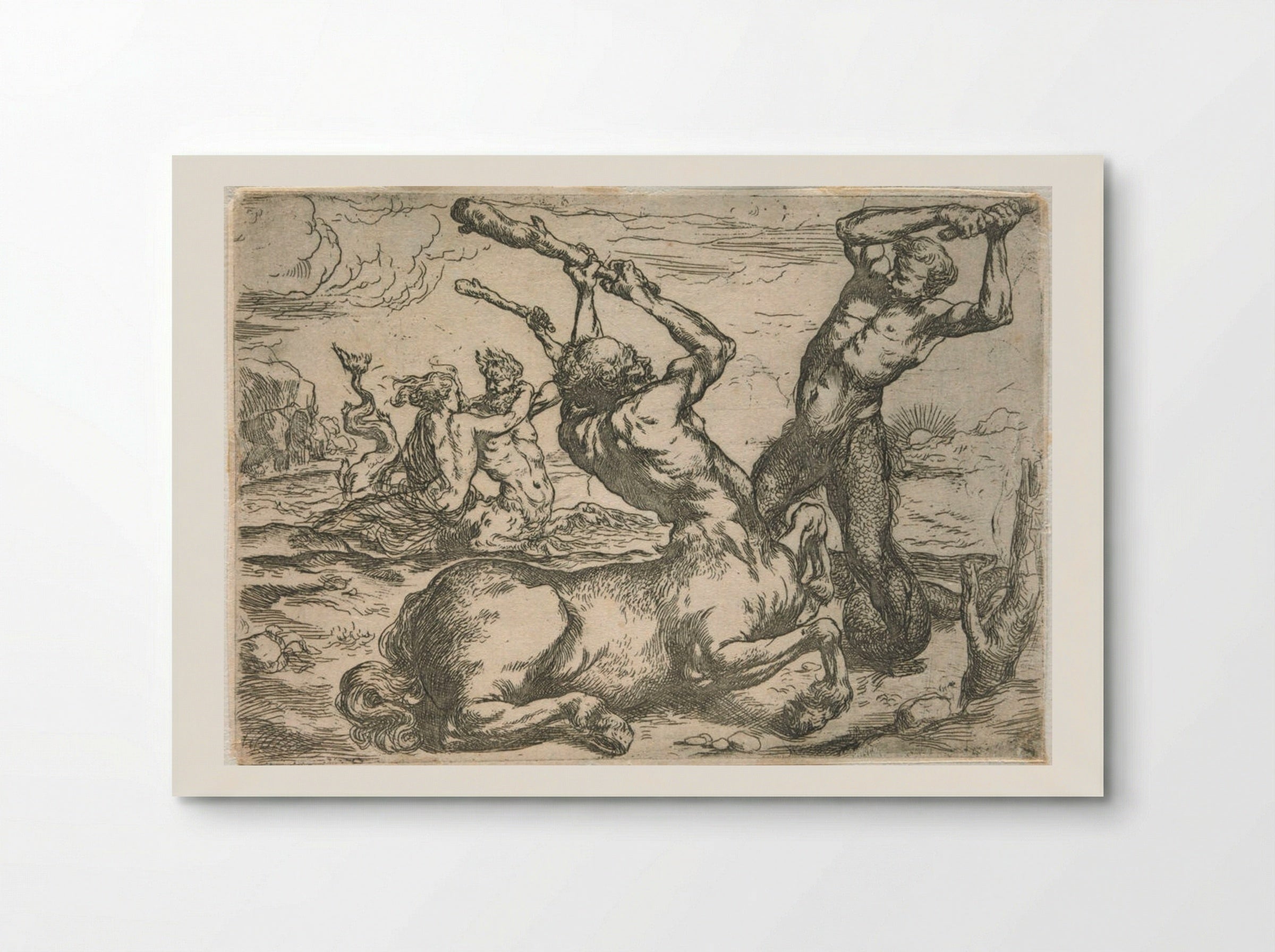
Centaur and Triton Fighting - Jusepe de Ribera
Archival giclée
Frames arrive ready to hang
Secure checkout
Made to order
Description
A dynamic etching by Jusepe de Ribera depicts a fierce battle between a centaur and a triton, showcasing the artist's mastery of anatomy and dramatic composition.
This etching by Jusepe de Ribera (1591-1652), a Spanish artist active in Italy, depicts a dramatic struggle between mythological creatures. Ribera, also known as José de Ribera and as Jusepe Ribera in Spanish contexts, was a leading painter and printmaker of the Baroque period. He is known for his tenebrist style, influenced by Caravaggio, and his interest in depicting human anatomy and dramatic scenes. The print shows a centaur and a triton locked in combat, both wielding clubs. The centaur, with the upper body of a man and the lower body of a horse, is shown rearing back, while the triton, a sea creature with the upper body of a man and the tail of a fish, lunges forward. In the background, another pair of figures, possibly representing a nymph and another triton, are embracing. The scene is set against a sparse background with a suggestion of water and sky. Ribera's skill as a draughtsman is evident in the detailed rendering of the figures' musculature and the dynamic composition of the scene. The etching technique allows for fine lines and tonal variations, adding to the drama and intensity of the image.
Return policy
Because every print is made to order, we don't offer change-of-mind returns, refunds or exchanges. If your order arrives faulty, damaged or incorrect, we'll replace it free of charge — just contact us within 48 hours of delivery. See our refunds page for full details.
Shipping
We ship worldwide, printing at the production hub nearest to your delivery address. Delivery times and costs vary by destination — you'll see the options available to you at checkout.
Manufacturing
Each print is produced to order using 12-colour giclée printing on FSC-certified archival paper. Designed in Britain and printed at your nearest production hub to reduce waste and speed up delivery.
Centaur and Triton Fighting - Jusepe de Ribera

Artist Biography
Jusepe De Ribera
Ribera's paintings are characterised by their raw, almost brutal, depiction of human suffering and religious ecstasy. He frequently portrayed saints and philosophers as weathered, world-worn figures, imbuing them with a palpable sense of humanity. Key works such as 'The Martyrdom of Saint Bartholomew' and 'The Clubfoot' showcase his mastery of light and shadow, and his willingness to confront difficult subjects with unflinching honesty. This unflinching approach earned him both admirers and detractors, but it also solidified his reputation as one of the most important and influential artists of his time.
Despite his Spanish roots, Ribera spent the majority of his career in Italy, becoming known as 'Lo Spagnoletto' (the Little Spaniard). He left behind a legacy of powerful and moving artworks that continue to resonate with viewers today. His influence can be seen in the works of later masters such as Goya and Rembrandt, who admired his ability to capture the human condition with such visceral intensity. Owning a Ribera print is to own a piece of art history, a testament to the enduring power of Baroque art.
Our Features
Designed for Lasting Impact
Specific Features
Every Solis piece is made to order with archival, gallery-quality materials built to last.
- Museum-grade giclée printing for rich, fade-resistant colour
- Archival matte fine-art paper, FSC-certified
- Multiple sizes and framing options available
- Frames in black, natural wood, dark wood or white
- Framed prints arrive ready to hang
Care & Cleaning
To keep your artwork looking its best:
- Dust gently with a soft, dry cloth
- Avoid prolonged direct sunlight
- Never use liquid cleaners on the print or canvas surface
- Keep in a dry, room-temperature space
- Handle prints with clean, dry hands
Materials & Sizing
Museum-grade giclée on FSC-certified archival matte paper, with framed and canvas options.
- Paper sizes: A4, A3, A2, A1, A0 and B2 (50×70 cm)
- Canvas: XS (20×30 cm) to Large (60×90 cm)
- Frames: black, natural wood, dark wood or white
Why Choose Us ?
Damage-free delivery guarantee
Fast Shipping
Museum-Quality Materials
Artist Biography
Jusepe de Ribera
Ribera's paintings are characterised by their raw, almost brutal, depiction of human suffering and religious ecstasy. He frequently portrayed saints and philosophers as weathered, world-worn figures, imbuing them with a palpable sense of humanity. Key works such as 'The Martyrdom of Saint Bartholomew' and 'The Clubfoot' showcase his mastery of light and shadow, and his willingness to confront difficult subjects with unflinching honesty. This unflinching approach earned him both admirers and detractors, but it also solidified his reputation as one of the most important and influential artists of his time.
Despite his Spanish roots, Ribera spent the majority of his career in Italy, becoming known as 'Lo Spagnoletto' (the Little Spaniard). He left behind a legacy of powerful and moving artworks that continue to resonate with viewers today. His influence can be seen in the works of later masters such as Goya and Rembrandt, who admired his ability to capture the human condition with such visceral intensity. Owning a Ribera print is to own a piece of art history, a testament to the enduring power of Baroque art.
You May Also Like