

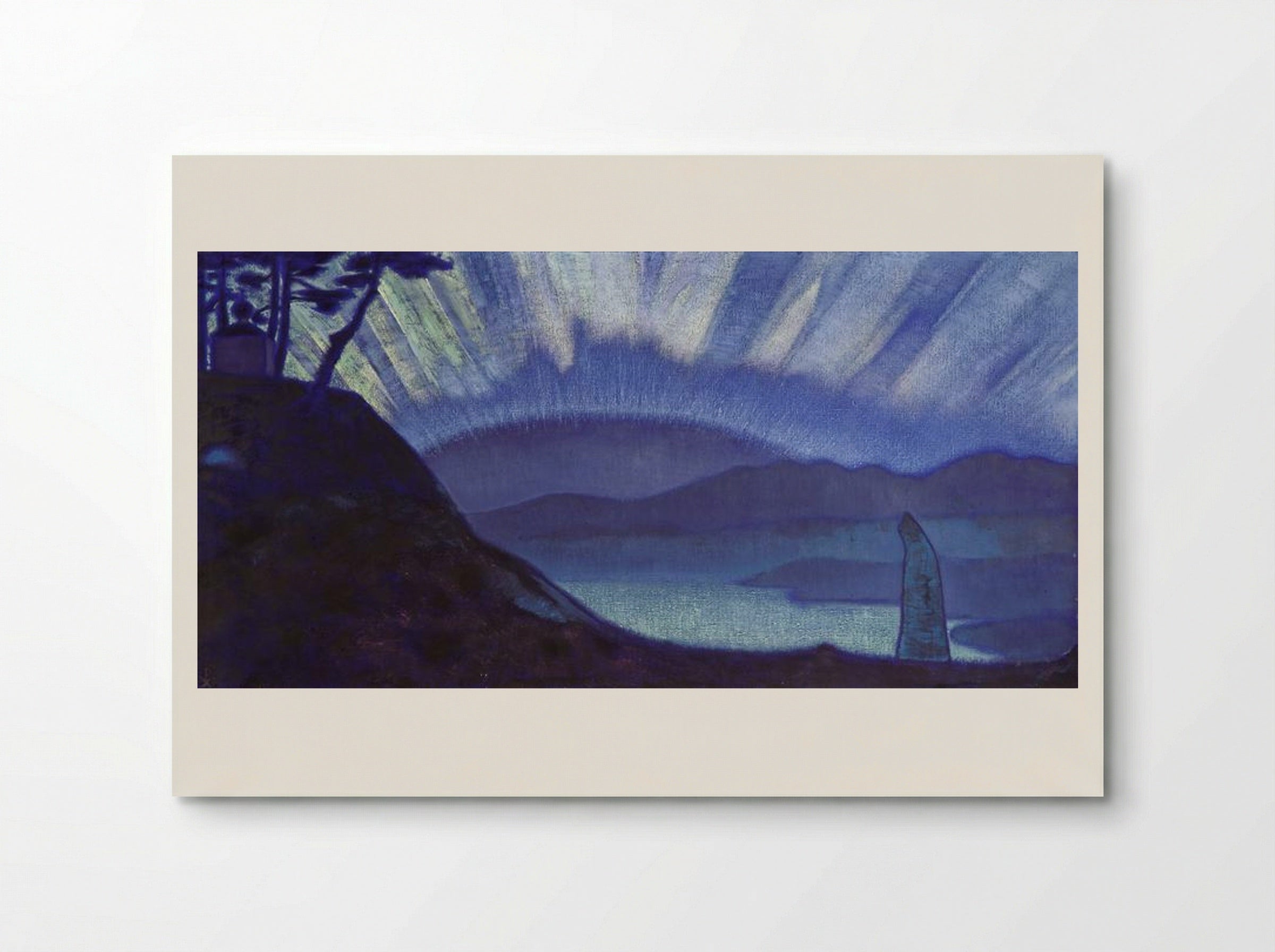
Bridge of Glory - Nicholas Roerich
Archival giclée
Frames arrive ready to hang
Secure checkout
Made to order
Description
A meditative Symbolist work by Nicholas Roerich, featuring a solitary figure overlooking a vast, blue-toned mountain landscape illuminated by celestial light.
Bridge of Glory is a characteristic work by Nicholas Roerich, painted during his extensive travels through the Himalayas. The composition features a stark, monochromatic blue palette that defines the atmospheric quality of the scene. A solitary, upright form stands in the foreground, overlooking a vast expanse of water and distant mountain ranges. Above, the sky is filled with radiating beams of light, suggesting a celestial or spiritual phenomenon that Roerich often explored in his later career. Roerich utilised tempera to achieve the matte, luminous finish seen here. The technique allows for layered applications of colour, creating a sense of depth without relying on traditional perspective. The silhouette on the left, perched upon a dark cliff, provides a sense of scale against the immense natural surroundings. This work reflects the artist's interest in theosophy and the intersection of human presence with the sublime forces of nature. The lack of specific detail in the terrain encourages a meditative response, focusing the viewer on the interplay between the dark earth and the ethereal light emanating from the horizon. Throughout his life, Roerich produced thousands of paintings that documented his fascination with Eastern philosophy and the rugged beauty of high-altitude environments. Bridge of Glory captures this synthesis of observation and imagination. The simplified forms and the focus on colour harmony are hallmarks of his mature style, which moved away from the historical subjects of his early Russian period toward a more universal, spiritual iconography. The painting remains a clear example of his ability to evoke a sense of quietude and mystery through minimal visual elements.
Return policy
Because every print is made to order, we don't offer change-of-mind returns, refunds or exchanges. If your order arrives faulty, damaged or incorrect, we'll replace it free of charge — just contact us within 48 hours of delivery. See our refunds page for full details.
Shipping
We ship worldwide, printing at the production hub nearest to your delivery address. Delivery times and costs vary by destination — you'll see the options available to you at checkout.
Manufacturing
Each print is produced to order using 12-colour giclée printing on FSC-certified archival paper. Designed in Britain and printed at your nearest production hub to reduce waste and speed up delivery.
Bridge of Glory - Nicholas Roerich

Artist Biography
Nicholas Roerich
He was born in St Petersburg in 1874 and studied law and art simultaneously before choosing art. After the Revolution, he left Russia and eventually settled in the Kullu Valley of India, where he established a research institute. His paintings of Central Asian mountains, produced in enormous quantities, glow with a flat, saturated colour that reflects his interest in theosophy and Eastern spiritual traditions.
The Roerich Pact, his treaty for protecting cultural sites during wartime, was the precursor to the 1954 Hague Convention. He died in Naggar, Himachal Pradesh, in 1947, at seventy-three.
Our Features
Designed for Lasting Impact
Specific Features
Every Solis piece is made to order with archival, gallery-quality materials built to last.
- Museum-grade giclée printing for rich, fade-resistant colour
- Archival matte fine-art paper, FSC-certified
- Multiple sizes and framing options available
- Frames in black, natural wood, dark wood or white
- Framed prints arrive ready to hang
Care & Cleaning
To keep your artwork looking its best:
- Dust gently with a soft, dry cloth
- Avoid prolonged direct sunlight
- Never use liquid cleaners on the print or canvas surface
- Keep in a dry, room-temperature space
- Handle prints with clean, dry hands
Materials & Sizing
Museum-grade giclée on FSC-certified archival matte paper, with framed and canvas options.
- Paper sizes: A4, A3, A2, A1, A0 and B2 (50×70 cm)
- Canvas: XS (20×30 cm) to Large (60×90 cm)
- Frames: black, natural wood, dark wood or white
Why Choose Us ?
Damage-free delivery guarantee
Fast Shipping
Museum-Quality Materials
Artist Biography
Nicholas Roerich
He was born in St Petersburg in 1874 and studied law and art simultaneously before choosing art. After the Revolution, he left Russia and eventually settled in the Kullu Valley of India, where he established a research institute. His paintings of Central Asian mountains, produced in enormous quantities, glow with a flat, saturated colour that reflects his interest in theosophy and Eastern spiritual traditions.
The Roerich Pact, his treaty for protecting cultural sites during wartime, was the precursor to the 1954 Hague Convention. He died in Naggar, Himachal Pradesh, in 1947, at seventy-three.
You May Also Like