



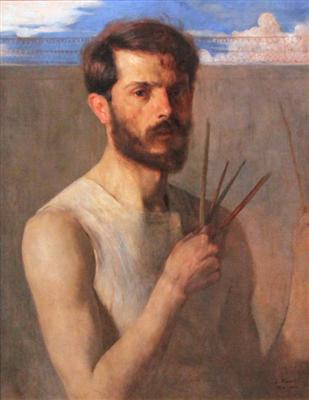
About Eliseu Visconti
Museums1
Countries1
Most worksSão Paulo Museum of Art, São Paulo · 5 works
Loading map…
Where to see Eliseu Visconti
Ranked by works you can see in person.
-
5 works
São Paulo Museum of Art
São Paulo, Brazil

Frequently Asked Questions
Where can I see Eliseu Visconti's work?
While it is difficult to pinpoint all locations of Eliseu Visconti's works, some museums with Art Deco collections may hold pieces by him. These include the Museo Art Nouveau y Art Deco (Salamanca, Spain), Museu Calouste Gulbenkian (Lisbon, Portugal) and Museu d’Art Modern (Barcelona, Spain). Others are the Charles Hosmer Morse Museum of American Art (Winter Park, FL), Los Angeles County Museum of Art, the Metropolitan Museum of Art (New York), the Minneapolis Institute of Arts, the Museum of Modern Art (New York), the Royal Ontario Museum (Toronto), the Virginia Museum of Fine Arts (Richmond, VA), and the Wolfsonian at Florida International University (Miami Beach, FL). In the UK, you could try the Brighton Museum & Art Gallery, Manchester Art Gallery, National Museums of Scotland (Edinburgh), and the Victoria & Albert Museum (London).What should I know about Eliseu Visconti's prints?
Eliseu Visconti (1866[1]-1944[1]) was a Brazilian[1] painter, designer and teacher. Although best known for his paintings, he also produced prints, mainly colour lithographs. Visconti studied at the Academia Imperial de Belas Artes in Rio de Janeiro, later travelling to Paris. There, he attended the École Nationale Supérieure des Beaux-Arts. He was influenced by Art Nouveau and Impressionism[1]. Visconti's prints often served as illustrations for books and periodicals. He designed posters and advertising material, adapting his artistic style to commercial purposes. He embraced the technical aspects of printmaking, exploring colour and texture. His prints share stylistic similarities with his paintings, featuring flowing lines, decorative elements, and a concern with light and atmosphere. Later in his career, Visconti returned to Brazil. He continued to produce paintings and prints, and taught at the Escola Nacional de Belas Artes. His prints offer a more accessible entry point to his artistic vision, compared to his large-scale paintings and decorative projects. They demonstrate his skill as a draughtsman and colourist, and his ability to synthesise different artistic influences.Why are Eliseu Visconti's works important today?
Eliseu Visconti (1866[1]-1944[1]) was a Brazilian[1] painter, designer, and teacher. He is considered one of the most important figures in the introduction of Impressionism[1] to Brazil. Visconti's significance stems from his role in modernising Brazilian art. After studying at the Academia Imperial de Belas Artes in Rio de Janeiro, he travelled to Paris. There, he absorbed the influences of Impressionism and Art Nouveau. He then adapted these European styles to Brazilian subjects and aesthetics. Visconti's work spans a range of genres, including portraits, genre scenes, and decorative projects. He is particularly known for his large-scale decorative paintings in public buildings, such as the Teatro Municipal in Rio de Janeiro. These works demonstrate his ability to synthesise international artistic trends with Brazilian themes. His exploration of light and colour, combined with his decorative sensibility, made him a central figure in the development of Brazilian modernism. He left a considerable body of work that continues to be appreciated for its artistic quality and historical importance.What techniques or materials did Eliseu Visconti use?
Eliseu Visconti experimented with diverse materials and methods. He was interested in innovations like painting on glass. One method involved laying a mezzotint print onto glass using an adhesive. After the paper was rubbed off, the inked outlines were coloured with oil varnish or watercolours. The result was then framed to resemble an oil painting. Another, less common, approach was 'eludoric' painting, which was favoured in the eighteenth century. This involved placing a support of fine cloth primed with poppy oil under a thin film of water. All painting was then done in oil under water. The transparency of the water allowed the painter to judge the quality of the brushstrokes and see the dark colours without needing to oil out. Excess oil floated off in the water, leaving only the amount necessary to adhere the pigment to the support. Visconti's work also reflected academic techniques, such as sketching outlines and blocking in colours with large bristle brushes, then applying subsequent layers of paint with softer brushes. He would then add detailed work with fine, soft brushes, and use oil glazes to modify the colours.Who did Eliseu Visconti influence?
Frans Floris's workshop produced many pupils who carried his influence into a new era. Joris van der Straeten and his nephew Cornelis III are documented at Fontainebleau. Another pupil, Georges Boba (also called Georges le Vénitien), worked for Charles de Lorraine, made drawings of Roman ruins, and produced several etchings. Hieronymus Francken's altarpiece of the Adoration of the Shepherds in Notre-Dame, Paris, dated 1585, is similar to one of Floris's last paintings. Francken's paintings continued to reflect Floris's influence, testimony to the durability of Floris's late, painterly style in France. Lucas d’Heere produced paintings in Floris’s idiom that also recall Lambert Lombard. These include Solomon and the Queen of Sheba, which closely resembles Floris's work, and The Awakening of the Arts, which derives from Floris’s treatment of the same subject.Who influenced Eliseu Visconti?
Eliseu Visconti, a Brazilian[1] artist of Italian origin, absorbed a range of influences during his career. Initial instruction at the Academia Imperial de Belas Artes in Rio de Janeiro provided a foundation in academic painting. Later, Visconti's time in Paris exposed him to contemporary European movements. He enrolled at the École Nationale Supérieure des Beaux-Arts, studying under professors such as Jean-Léon Gérôme (a painter in the academic style) and Pierre Puvis de Chavannes (an artist known for his murals). These teachers offered contrasting approaches to art making. Artistic circles in Paris introduced Visconti to Impressionism[1] and Art Nouveau. He encountered the work of artists like Claude Monet and Pierre-Auguste Renoir, whose handling of light and colour affected his style. The decorative aesthetic of Art Nouveau, with its emphasis on flowing lines and natural forms, also became apparent in Visconti's paintings and designs. These combined influences shaped his distinctive artistic vision, blending academic training with modern European trends.What is Eliseu Visconti's most famous work?
Eliseu Visconti, a Brazilian[1] artist of Italian origin, is best known for his contributions to the introduction of Art Nouveau to Brazil. Although he produced a varied body of work, including paintings, drawings, and decorative schemes, identifying a single "most famous work" is difficult. However, several pieces are particularly significant within his oeuvre. *Gioventú* (Youth), painted in 1898[1], is an early example of his Symbolist style. It earned him a gold medal at the Escola Nacional de Belas Artes (National School of Fine Arts) in Rio de Janeiro. Later, Visconti received the commission to decorate the Municipal Theatre of Rio de Janeiro. His work there, executed between 1904 and 1906, is a major example of Art Nouveau in Brazil. He also produced the ceiling panel for the foyer of the Biblioteca Nacional (National Library), another important commission. These large-scale decorative projects cemented his reputation. Therefore, while *Gioventú* marked an early success, his decorative work in Rio de Janeiro likely reached a wider audience and had a greater impact on Brazilian art.What style or movement did Eliseu Visconti belong to?
Eliseu Visconti's artistic affiliations connect to Impressionism[1], a movement that marked a shift in European painting. Impressionism moved away from the neo-classical traditions that had dominated art since the Renaissance. Impressionist artists, while trained in traditional techniques, changed their approach to painting. They challenged the established focus on historical, religious, and literary subjects. Instead, they turned to nature, particularly the genre of the landscape. The Impressionists valued direct observation over imagination. They believed it was more important to paint what one saw, rather than adhering to academic rules. This led them to paint outdoors, observing nature directly. They rejected traditional composition, perspective, and technique when these conflicted with their observations. This approach resulted in paintings that often resembled rapid oil sketches, prioritising the immediate impression over a polished finish.
Sources
Where to See guide aggregates verified holdings of Eliseu Visconti's works across the following collections.
- [1] wikipedia Wikipedia: Eliseu Visconti Used for: biography.
- [2] book guggenheim-guhe00solo Used for: biography.
- [3] book guggenheim-handboo00pegg Used for: biography.
- [4] book Masterpieces of western art : a history of art in 900 individual studies from the Gothic to the present day Used for: biography.
- [5] book 1892-1968, Panofsky, Erwin,, Tomb sculpture: four lectures on its changing aspects from ancient Egypt to Bernini Used for: stylistic analysis.
Editorial overseen by Solis Prints. Sources verified 2026-09-24. Click a source for details, or hover over [N] in the page above to preview.
Editorial standardsMethodologyCorrectionsAI disclosureAbout the editorial team