



About Carsten Nicolai
German · 1965–present
- electronica
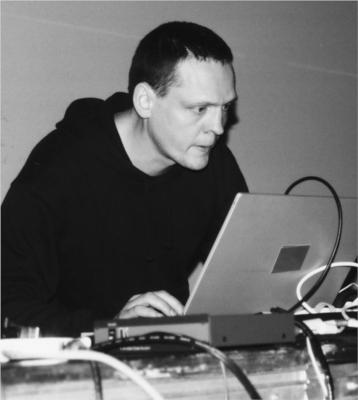
German[3] artist and electronic musician who works across visual installation and sound to make scientific phenomena perceptible to multiple senses.
Museums5
Countries4
Most worksVictoria and Albert Museum, London · 7 works
Loading map…
Where to see Carsten Nicolai
Ranked by works you can see in person.
-
 7 works
Victoria and Albert Museum
London, United Kingdom
-
1 works
Städel Museum
Frankfurt, Germany

-
 1 works
Art Institute of Chicago
Chicago, United States
-
1 works
Kunstmuseum Stuttgart
Stuttgart, Germany
Also here (3)
-
1 works
Stedelijk Museum voor Actuele Kunst
Ghent, Belgium


Frequently Asked Questions
Where can I see Carsten Nicolai's work?
Carsten Nicolai's artwork can be viewed in many museums and galleries. In Germany, these include the Brucke Museum, Nationalgalerie, Kunsthalle, and Sammlung Bottcherstrasse, all in Berlin. Other German[3] locations are the Ludwig Museum and Wallraf-Richartz Museum in Cologne; the Folkwang Museum in Essen; the Kunsthalle in Hamburg; the Landesmuseum in Hanover; the Stadtische Kunsthalle in Mannheim; the Bayerische Staatsgemaldesammlungen in Munich; the Stiftung Ada und Emil Nolde in Seebtill; and the Von der Heydt Museum in Wuppertal. Additional museums that hold similar artworks include the Bauhaus Archive-Museum für Gestaltung, the Bröhan-Museum, and the Kunstgewerbe Museum of Decorative Arts, all located in Berlin. Outside of Germany, one may visit the MAK Austrian Museum of Applied Art/Contemporary Art in Vienna. In the United States, museums include the Charles Hosmer Morse Museum of American Art in Winter Park, Florida; the Los Angeles County Museum of Art; the Metropolitan Museum of Art and the Museum of Modern Art in New York; the Minneapolis Institute of Arts; the Virginia Museum of Fine Arts in Richmond; and the Wolfsonian in Miami Beach.What should I know about Carsten Nicolai's prints?
Carsten Nicolai, who also works under the pseudonym Alva Noto, is a German[3] artist known for his work in electronic music and visual arts. Born in 1965[3] in Karl-Marx-Stadt (now Chemnitz), he studied architecture and design before turning to art. Nicolai's prints often explore the intersection of sound and image. He visualises sound frequencies and mathematical patterns, creating works that are both aesthetically pleasing and intellectually stimulating. His artistic practice includes installations, performances, and publications, all connected by an interest in systems, codes, and errors. Many of Nicolai's prints are created using digital tools and techniques. These methods allow him to manipulate and transform data into visual forms. The results are often minimalist and abstract, with a focus on line, shape, and pattern. His work invites viewers to consider the relationship between what they see and what they hear; he encourages a synaesthetic experience. Nicolai's art is held in collections internationally, marking him as a significant figure in contemporary art and experimental music.Why are Carsten Nicolai's works important today?
Carsten Nicolai, who also works under the name Alva Noto, explores the intersection of art and science. His work often translates scientific data into sensory experiences. Nicolai's practice encompasses visual art, music, and large-scale installations. Born in Chemnitz, Germany, in 1965[3], Nicolai's early work engaged with the minimalist aesthetic. He is interested in systems, codes, and mathematical principles. These interests inform his audio-visual projects. Nicolai gained recognition in the 1990s with his modular synthesiser projects. His work often explores the threshold between what is audible and inaudible, or visible and invisible. He uses precise, minimalist patterns to create complex sensory experiences. His installations often incorporate light, sound, and space, creating immersive environments for viewers. Nicolai's interdisciplinary approach is relevant in contemporary art. He bridges the gap between artistic expression and scientific inquiry. His work appeals to audiences interested in both the aesthetic and intellectual dimensions of art. Nicolai continues to exhibit and perform internationally.What techniques or materials did Carsten Nicolai use?
Carsten Nicolai's practice involves a wide array of materials and techniques, often exploring the intersection of art, science, and technology. His work frequently incorporates sound, light, and digital media to create immersive installations and performances. Nicolai is known for his use of mathematical patterns and scientific phenomena as aesthetic principles. He often employs precise, minimalist forms and explores the visual representation of data and algorithms. His interest in systems, codes, and errors is evident in projects that translate abstract information into sensory experiences. Examples of Nicolai's materials include lasers, electronic equipment, and custom-built software. He manipulates these elements to generate visual and auditory patterns, often blurring the boundaries between the physical and virtual realms. His work can involve the creation of specific environments that engage the viewer's perception and challenge traditional notions of art.Who did Carsten Nicolai influence?
It is difficult to identify specific individuals who were directly influenced by Carsten Nicolai (born 1965[3]), but his work has contributed to trends within contemporary art and music. Nicolai's practice combines visual and sonic elements, often using scientific data as a source. His work fits into a larger history of artists exploring the intersection of art and science. This includes earlier figures, such as the composer Iannis Xenakis, who used mathematical models in his compositions, and visual artists associated with the Op Art movement, who investigated perception and optical illusions. Nicolai's interest in data visualisation and generative art also connects him to more recent trends in digital art. Many contemporary artists now use algorithms and computer code to create dynamic and interactive installations. His performances and installations, which often involve large-scale projections and electronic sound, have an affinity with media art. His work, along with that of others in this field, has expanded the possibilities for sensory experience in art.Who influenced Carsten Nicolai?
It is difficult to summarise the influences on Carsten Nicolai. Minimalism is one clear area of influence. Minimalist composers such as Philip Glass, Steve Reich, and La Monte Young appear in research on the subject. Glass composed *Einstein on the Beach*; Reich, *Different Trains*; Young, *Dream Houses*. Visual artists associated with minimalism, such as Bruce Nauman, Barnett Newman, Ad Reinhardt, and Frank Stella, are also named. Nauman created *Clown Torture*, Newman, *Cathedra*, and Reinhardt, *Number 107*. Stella painted *Delaware Crossing*. The Dada art movement, and Marcel Duchamp, are also sometimes cited as influences. Duchamp is known for *Fountain*. Other possible influences include concrete poetry, figures from the Cubist movement, and the composer Arvo Pärt.What is Carsten Nicolai's most famous work?
It is difficult to name Carsten Nicolai's single "most famous work" because his practice encompasses diverse media and collaborative projects. He is known for installations, sound art, and visual experiments that explore the intersection of art, science, and technology. Nicolai's work often involves manipulating and visualising sound waves, creating immersive environments that challenge perception. He frequently uses mathematical patterns and scientific phenomena as a basis for his art, translating complex data into sensory experiences. While no individual piece may be universally recognised as his "most famous," his large-scale installations and audiovisual performances have received considerable attention. These works often feature precisely synchronised light and sound, generating hypnotic and disorienting effects. He also works under the name Alva Noto, often in collaboration with other artists, such as Ryuichi Sakamoto.What style or movement did Carsten Nicolai belong to?
Carsten Nicolai's practice resists easy categorisation. His work engages with aspects of minimalism, particularly in its focus on seriality, repetition, and the exploration of fundamental acoustic and visual elements. Minimalism, as an aesthetic tendency, appears across many artistic fields, from electronica[3] to jazz. Nicolai's sound-based work shares traits with the minimalist music of Steve Reich and Philip Glass, both of whom explored repetition and gradual change in their compositions. Nicolai's visual installations often feature simple geometric forms and patterns, aligning with the minimalist art of figures like Dan Flavin, who used serial arrangements of industrial light fittings. While connections to minimalism exist, Nicolai also moves beyond it. His interest in scientific visualisation, data mapping, and complex systems introduces a conceptual dimension not always present in earlier minimalist work. Nicolai's practice is best understood as situated at the intersection of art, science, and technology, drawing on diverse sources to create immersive, sensory experiences.
Sources
Where to See guide aggregates verified holdings of Carsten Nicolai's works across the following collections.
- [1] museum Art Institute of Chicago Used for: museum holdings.
- [2] museum Victoria and Albert Museum Used for: museum holdings.
- [3] wikipedia Wikipedia: Carsten Nicolai Used for: biography.
- [4] book Art Das Kunstmagazin Mai No 05 2019 Used for: biography.
- [5] book Dorling Kindersley, Artists: Inspiring Stories of the World's Most Creative Minds Used for: biography.
- [6] book Marc Botha;, A Theory of Minimalism Used for: stylistic analysis.
- [7] book guggenheim-mediascape00klot Used for: biography, stylistic analysis.
- [8] book guggenheim-refigur00kren Used for: biography.
- [9] book Charlene Spretnak (auth.), The Spiritual Dynamic in Modern Art _ Art History Reconsidered, 1800 to the Present Used for: stylistic analysis.
Editorial overseen by Solis Prints. Sources verified 2026-09-24. Click a source for details, or hover over [N] in the page above to preview.
Editorial standardsMethodologyCorrectionsAI disclosureAbout the editorial team