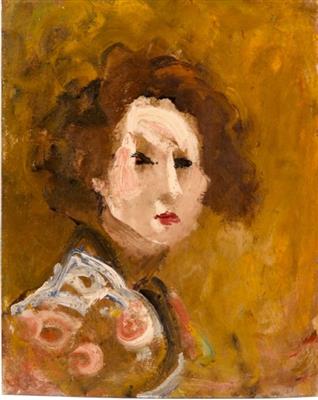
Portrait of Madame Guillaume with pamela by André Derain
Trees in L'Estaque by Raoul Dufy
Carrières-sur-Seine by André Derain
View of a Port by Raoul Dufy
Girl Embroidering, Seated in a Garden by Albert Marquet
The Village of Vosges by Albert Marquet

Fauvism

11 artists · 1904–1910

Fauvism[4] burned through the Paris art world between 1904 and 1910 with an intensity that matched its colours. The movement began when Henri Matisse[13] and André Derain spent the summer of 1905 painting together in Collioure, a fishing village on the French Mediterranean coast. They returned to Paris with canvases that used colour freed from any obligation to describe the visible world. At the Salon d'Automne that October, the critic Louis Vauxcelles compared their paintings to wild beasts, and the name stuck. Raoul Dufy joined the group after seeing Matisse's work at the Salon, abandoning Impressionism overnight. Samuel Peploe, working in France around the same period, absorbed Fauvist colour into a distinctive Scottish palette. Fauvism was never a formal movement with a manifesto or programme. It was a shared conviction, lasting only a few years, that colour could carry the full weight of pictorial expression. By 1908, most of the principal figures had moved on: Matisse toward greater decorative control, Derain toward a more structured classicism. The brevity of Fauvism measures its radicalism. It changed what colour could do in Western painting, and the change proved permanent.

Key Ideas

  • Portrait of Madame Guillaume with pamela — Fauvism

    Colour Unbound

    The Fauvists' central breakthrough was the liberation of colour from descriptive duty. A tree trunk could be painted red, a face green, a sky orange, if the emotional logic of the painting demanded it. This was not arbitrary. Matisse and Derain were responding to the colour theories of Eugène Chevreul, the example of Gauguin and Van Gogh, and the pointillist experiments of Signac. But they pushed further than any predecessor, using colour as an autonomous force equal to drawing and composition. The result was painting that operated on the nervous system before the intellect could intervene.

  • Trees in L'Estaque — Fauvism

    The Summer at Collioure

    The paintings Matisse and Derain produced at Collioure in the summer of 1905 constitute the movement's founding moment. Working side by side, they pushed each other toward ever bolder chromatic experiments. Derain wrote to Maurice de Vlaminck that colour was becoming 'sticks of dynamite'. Matisse's Open Window, Collioure and Derain's Boats at Collioure show two temperaments responding to the same Mediterranean light with different but equally radical results. The competitive intensity of that summer produced a body of work that neither artist could have made alone.

  • Carrières-sur-Seine — Fauvism

    A Movement Without a Programme

    Unlike Cubism or Surrealism, Fauvism had no manifesto, no theorist, and no leader dictating terms. It was a loose convergence of painters who shared a moment of chromatic ambition. Matisse was the most intellectually rigorous, but he never claimed leadership. Derain, Vlaminck, Dufy, and others pursued parallel experiments without coordinating strategy. This absence of doctrine gave Fauvism its freedom, and its brevity. When the initial energy dissipated, there was no programme to sustain the group.

Origins

From Neo-Impressionism to Collioure

Matisse's path to Fauvism ran through several earlier experiments. In 1899, he studied with Paul Signac, learning the Neo-Impressionist technique of applying pure colour in small, separated touches. His Luxe, Calme et Volupté (1904) used this method but pushed the colours beyond naturalistic description. By the following summer, when he and Derain settled in Collioure, Matisse was ready to abandon the systematic dot and use colour freely, in broad, spontaneous strokes. Derain brought a different energy: more physical, less theoretical, and willing to take chromatic risks that even Matisse might have hesitated over. Their partnership accelerated both artists' development.

The Salon d'Automne of 1905

The third annual Salon d'Automne opened in Paris in October 1905. Room VII contained paintings by Matisse, Derain, Vlaminck, Manguin, Marquet, and others. A small bronze sculpture by Albert Marque, modelled in a conventional academic style, stood in the centre of the room. The critic Louis Vauxcelles noted the contrast and wrote in Gil Blas: 'Donatello among the wild beasts.' The label was intended as an insult, but the artists adopted it with relish. The exhibition made Fauvism public and scandalous. It also attracted the attention of collectors. Leo and Gertrude Stein bought Matisse's Woman with a Hat from the show, beginning a patronage that would sustain Matisse through the following decade.

Dispersal and Legacy

By 1908, Fauvism had effectively dissolved. Derain turned toward Cézanne's structured compositions. Vlaminck darkened his palette. Dufy moved into decorative design. Matisse continued to explore colour but within increasingly controlled compositions. The movement's legacy was not a style to be perpetuated but a permission to be exercised. Every subsequent painter who used non-naturalistic colour, from the German Expressionists to the Abstract Expressionists, drew on the freedom the Fauves had won in a single Parisian autumn.

In Their Words

“My choice of colours does not rest on any scientific theory. It is based on observation, on feeling, on the very nature of each experience.”
Henri Matisse, Notes of a Painter, La Grande Revue, 1908
“Colours became sticks of dynamite. They were supposed to discharge light.”
André Derain, Letter to Maurice de Vlaminck, summer 1905
“Donatello among the wild beasts.”
Louis Vauxcelles, Gil Blas, 17 October 1905

All Fauvism Artists

8 artists.

Recommended Reading

  • The Unknown Matisse: A Life of Henri Matisse, Volume 1

    The Unknown Matisse: A Life of Henri Matisse, Volume 1

    Hilary Spurling · 1998

    Detailed biography covering Matisse's early career through the Fauvist period, based on extensive archival research.

  • Fauvism: Origins and Development

    Fauvism: Origins and Development

    John Elderfield · 1976

    The standard art-historical study of the movement, analysing each artist's contribution and the group's collective impact.

  • Matisse and Derain: Collioure 1905

    Rémi Labrusse and Jacqueline Munck · 2005

    Focused study of the summer that launched Fauvism, with side-by-side comparisons of both artists' Collioure paintings.

Frequently Asked Questions

  • What is Fauvism?
    Fauvism[4] was a short-lived French movement that ran from about 1904 to 1908, defined by wild, non-naturalistic colour applied in flat patches without traditional modelling. The name came from the critic Louis Vauxcelles, who described a gallery of Matisse, Derain and Vlaminck canvases at the 1905 Salon d'Automne as paintings by 'fauves', or wild beasts, surrounding a Renaissance-style sculpture.
  • When did Fauvism start?
    The movement took shape between 1904 and 1905 through the collaboration of Henri Matisse[13] with André Derain, following Matisse's summer in Saint-Tropez with Paul Signac in 1904. The public moment was the 1905 Salon d'Automne in Paris, where Vauxcelles coined the name 'fauves' after walking into Room VII. By 1908 most of the original group had moved on, and Matisse alone continued the experiment.
  • Who are the most famous Fauvist artists?
    Henri Matisse[13] led the movement, with André Derain and Maurice de Vlaminck as his closest collaborators. Raoul Dufy, Georges Braque (before his Cubist turn), Albert Marquet[10], Othon Friesz, Henri Manguin and Kees van Dongen made up the broader group. Georges Rouault, though often grouped with the Fauves by proximity, worked in a darker religious idiom that set him apart.
  • What defines the Fauvist style?
    Fauvist paintings use saturated unmixed colour straight from the tube, non-descriptive hues (green skies, red trees, blue faces), flat simplified shapes with minimal modelling, and bold outlines borrowed from Gauguin's late Tahitian work. The subject matter is typically landscape, harbour views, bathers and portraits. Matisse's Woman with a Hat (1905) and Derain's Charing Cross Bridge (1906) show the style at its clearest.
  • What is the difference between Fauvism and Expressionism?
    Both movements abandoned naturalistic colour in the mid-1900s, but for different reasons. Fauvism[4] (French, 1904 to 1908) used extreme colour for pictorial and decorative effect, building on Gauguin and Van Gogh. German Expressionism (particularly Die Brücke, founded 1905) used extreme colour for emotional and psychological intensity, often in paintings of urban alienation and erotic encounter. The French movement was the calmer of the two.
  • Why was Fauvism important?
    Fauvism[4] marked the point at which colour was definitively released from the obligation to describe the visible world, opening the path to full abstraction. The 1905 Salon d'Automne was a public breach with nineteenth-century assumptions. Matisse's post-Fauvist work through the 1910s and 1920s carried the colour logic into the twentieth century's most sustained exploration of decorative painting.
  • Where can I see the best Fauvist paintings?
    The Musée d'Orsay and the Centre Pompidou in Paris hold the densest Matisse and Derain Fauvist collections. The San Francisco Museum of Modern Art owns Matisse's Woman with a Hat. The Hermitage in Saint Petersburg and the Pushkin Museum in Moscow together hold the Shchukin and Morozov collections, which include major Matisse canvases. The Musée Matisse in Nice preserves the artist's late holdings.

Sources

Fauvism editorial draws on the following published scholarship.

  1. [1] book Hilary Spurling, The Unknown Matisse: A Life of Henri Matisse, Volume 1, 1998 Used for: biography, stylistic analysis.
  2. [2] book John Elderfield, Fauvism: Origins and Development, 1976 Used for: biography, exhibition history, stylistic analysis.
  3. [3] book Rémi Labrusse and Jacqueline Munck, Matisse and Derain: Collioure 1905, 2005 Used for: biography, stylistic analysis.
  4. [4] wikipedia Wikipedia: Fauvism Used for: biography.
  5. [5] book Carol Strickland and John Boswell, The Annotated Mona Lisa _ba crash course in art history from prehistoric to post-modern _cCarol Strickland and John Boswell Used for: biography.
  6. [6] book Carol Strickland and John Boswell, The Annotated Mona Lisa _ba crash course in art history from prehistoric to post-modern _cCarol Strickland and John Boswell_1 Used for: biography.
  7. [7] book Carol Strickland and John Boswell, The Annotated Mona Lisa _ba crash course in art history from prehistoric to post-modern _cCarol Strickland and John Boswell_2 Used for: biography.
  8. [8] book Nathalia Brodskaya, The Fauves Used for: biography.
  9. [9] wikipedia Wikipedia: Alexandru Ciucurencu Used for: biography.
  10. [10] wikipedia Wikipedia: Albert Marquet Used for: biography.
  11. [11] wikipedia Wikipedia: Berény Róbert Used for: biography.
  12. [12] wikipedia Wikipedia: Émilie Charmy Used for: biography.
  13. [13] wikipedia Wikipedia: Henri Matisse Used for: biography.

Editorial overseen by Solis Prints. Sources verified 2026-06-23. Click a source for details, or hover over [N] in the page above to preview.

Take Fauvism home.

See all Fauvism prints →
Back to Discover