

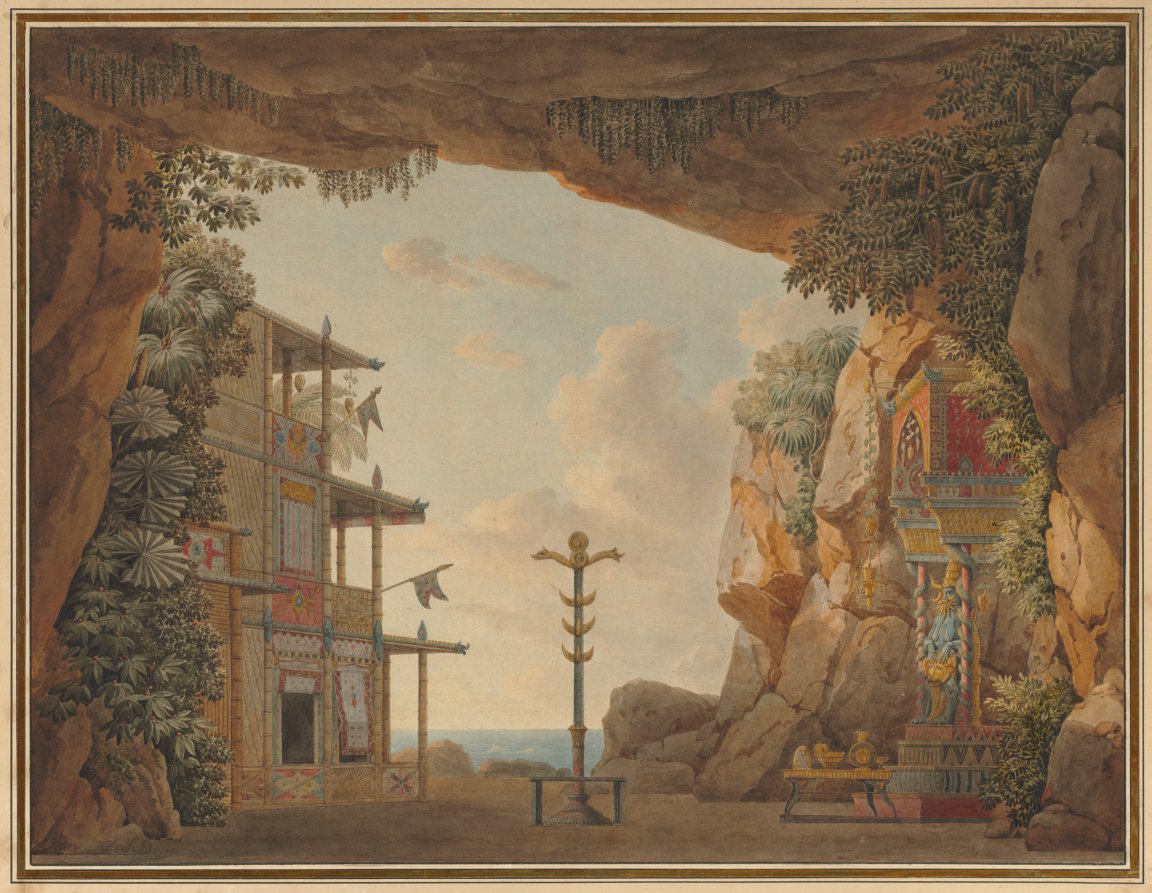
Jean-Thomas Thibault
Jean-Thomas Thibault began his career as a student of architecture under Marie-Joseph Peyre before winning the Prix de Rome in 1786. Unlike many of his contemporaries who focused on the romanticism of ruins, Thibault approached his Italian subjects with the technical eye of a structural designer. His time in Rome allowed him to study the proportions of classical buildings first-hand. He later became a professor at the Ecole des Beaux-Arts, where he taught perspective to a new generation of French artists.

Biography
The Neoclassical style of Thibault is defined by a strict adherence to spatial logic and clear geometry. In works like The Ponte di Augusto at Narni and Villa Pamphili, he uses a subdued colour palette to define form. He avoids the cluttered compositions common in late eighteenth-century painting. Instead, he focuses on the relationship between man-made structures and the natural environment. His watercolours and drawings of the Borghese Gardens and Subiaco use light to clarify the physical details of the architecture.
Collectors today value Thibault for the sense of order and calm his work provides. His views of Palazzo Chigi Ariccia and Monte Cavo offer a window into the Grand Tour era without the over-dramatisation found in Romantic art. These prints suit modern interiors because of their clean lines and architectural precision. The work provides a historical perspective that remains visually balanced and easy to integrate into a gallery wall or a minimalist room.
Notable Works
Tap to view larger.
Next stop
Neoclassicism →
Explore the artists and ideas of Neoclassicism.
Frequently Asked Questions
When was Jean-Thomas Thibault born?
Jean-Thomas Thibault was born in 1757 and died in 1826.What art movement was Jean-Thomas Thibault part of?
Jean-Thomas Thibault was associated with Neoclassicism.What is Jean-Thomas Thibault known for?
Jean-Thomas Thibault is known for jean-Thomas Thibault was a French Neoclassical architect and painter known for his precise architectural views of Italy and his mastery of linear perspective.


