

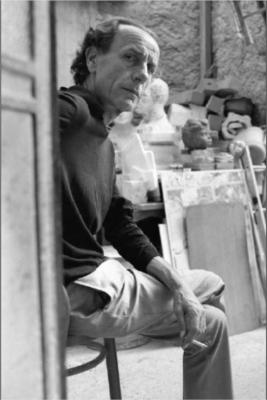
Enzo Cucchi
Enzo Cucchi emerged from the Marche region of central Italy to become one of the defining figures of Transavanguardia, the Neo-Expressionist movement that swept Italian[1] painting in the late 1970s and early 1980s. Born in Morro d'Alba in 1949[1], he was grouped by critic Achille Bonito Oliva alongside Sandro Chia and Francesco Clemente as the movement's central trio: a generation of Italian painters who wanted to return imagery, myth, and emotional weight to a canvas exhausted by Minimalism and Conceptualism.
Biography
His paintings draw on Italian[1] folk tradition, archaic symbolism, and Mediterranean iconography: saints, heroes, horses, dark landscapes, and figures caught at the threshold between life and death. The imagery has a visceral, hallucinatory quality, as though excavated from collective memory rather than composed. A French critic described his subjects as 'heroes and saints painted to console frightened little men,' which Cucchi probably took as a compliment.
The 1984 series 'Vitebsk/Harar' is among his most intellectually charged works. The title pairs two places of artistic exile: Vitebsk, the Soviet city where Malevich spent his most politically constrained years, and Harar, the Ethiopian trading post where Rimbaud abandoned poetry for commerce. The juxtaposition frames Cucchi's practice within a lineage of radical self-reinvention under pressure.
Major exhibitions in the early 1980s at the Stedelijk Museum, Museum Folkwang, and ICA Boston established his international presence. In 1986 the Solomon R. Guggenheim Museum mounted a solo show with a catalogue essay by Diane Waldman. He continues to work between Ancona and Rome.
Timeline
- 1949Born in Morro d'Alba, in the Marche region of central Italy.
- 1970Became one of the defining figures of Transavanguardia, a Neo-Expressionist movement.
- 1980Achille Bonito Oliva grouped him with Sandro Chia and Francesco Clemente as the central trio of the movement.
- 1980Major exhibitions took place at the Stedelijk Museum, Museum Folkwang, and ICA Boston.
- 1984Created the series "Vitebsk/Harar", pairing Vitebsk and Harar as places of artistic exile.
- 1986The Solomon R. Guggenheim Museum mounted a solo show of his work, with a catalogue essay by Diane Waldman.
- 2024Continues to work between Ancona and Rome.
Notable Works
Tap to view larger.
Next stop
Browse the movements →
Every movement in the collection, from the Renaissance to Pop art.
Related Artists


Frequently Asked Questions
What is Enzo Cucchi known for?
Enzo Cucchi is known for his dynamic and monumental canvases. His work is characterised by an instinctive, painterly directness, and the forcefulness of expression depends upon the visionary poetics of his narratives of confrontation and survival.What is Enzo Cucchi's most famous work?
It is difficult to name one single "most famous" work by Enzo Cucchi, as his notability arises from a body of work produced since the late 1970s. Cucchi was born in Morro d'Alba in 1949[1]; he lives and works in Ancona and Rome. His paintings often relate to Ancona, a port city on the Adriatic Sea with Greek and Roman monuments. His art combines tradition and personal history. Cucchi's paintings feature primordial figures and deal with man's destiny and survival in a violent world. His surfaces use primary and secondary colours in their purest form. One example of his style is *Headless Hero* (1981-82), which shows a blood-red head between the legs of a figure with raised hands. The painting uses colour expressively and symbolically, with rough forms and charged simplicity. Other works include *Saint's Foot* (1981), a large-scale painting of white drawing on black. Cucchi had one-person exhibitions from 1977 onwards in Milan, Rome, Bologna, and Cologne. A retrospective exhibition of his work was held at the Solomon R. Guggenheim Museum, New York, in 1986.What should I know about Enzo Cucchi's prints?
Enzo Cucchi, an Italian[1] artist born in 1949[1], is associated with the Transavantgarde movement. This artistic tendency, identified by Achille Bonito Oliva, moved away from conceptual art and embraced a return to painting and more traditional methods. Cucchi's prints often feature mythological or symbolic imagery. He frequently combines different printmaking techniques, such as etching, aquatint, and woodcut, to create varied textures and effects. His style is characterised by bold lines and a dreamlike quality. Cucchi has worked with various publishers and print workshops. These collaborations have resulted in a diverse body of graphic work. Examples include his lithographs created with Stamperia Romero in Rome. His prints are held in numerous public collections, including the Museum of Modern Art in New York. Collectors are drawn to his distinctive imagery and technical skill in printmaking.What style or movement did Enzo Cucchi belong to?
Enzo Cucchi, born in 1950, is associated with the Italian[1] Transavantgarde movement. This artistic tendency, active mainly during the 1980s, moved away from conceptual art and embraced a return to figurative painting. Cucchi's style is characterised by dynamic compositions and painterly directness. His canvases often feature primordial figures and are connected to his surroundings in the Marches region of Italy. He has lived and worked in Ancona, a port city on the Adriatic Sea, for many years. The sea and the variations in terrain of this area appear in his work. His paintings often explore themes of man's destiny and survival in a violent world. Cucchi concentrates on primary and secondary colours, using them in their purest forms. He renders figures simply, with bold contour lines. His work suppresses detail in favour of elemental phenomena. He admires Masaccio, Caravaggio and El Greco as artists of truth and simplicity.What techniques or materials did Enzo Cucchi use?
Enzo Cucchi employed a range of materials and techniques in his art. He is known for his use of oil paint, often combined with other media to create textured surfaces and expressive forms. Cucchi's approach involved a combination of traditional painting methods and more experimental techniques. He frequently worked on canvas, preparing the surface with gesso to create a smooth base for his compositions. His application of paint could vary from thin washes to thick impasto, building up layers of colour and texture. In addition to oil paint, Cucchi incorporated materials such as charcoal, pastel, and mixed media into his works. These additions enhanced the tactile quality of his art. He also explored printmaking techniques, including woodcut, etching, and lithography, to produce graphic works that complement his paintings. His methods allowed for a diverse range of visual effects, from delicate lines to bold, expressive marks.What was Enzo Cucchi known for?
Enzo Cucchi, born in Morro d'Alba, Italy, in 1949[1], is known for art that combines instinctive, painterly directness with visionary poetics. His dynamic canvases often reference themes of confrontation and survival. His works incorporate a visceral quality achieved through vigorous handling of paint, colour, and drawing. Cucchi lived and worked for seven years in the port city of Ancona, on the Adriatic Sea. The sea figures strongly in his pieces. The variations in terrain of the Marches, the shoreline, steep ravines, and dramatic rock formations find counterparts in the undulating hills and sharp perspectival changes in Cucchi's paintings. He exploits scale, colour, and paint surface to heighten the urgency and impact of expression in his canvases. He often concentrates on primary and secondary colours, using them in their purest, most highly saturated form.When did Enzo Cucchi live and work?
Enzo Cucchi was born on 14 November 1949[1], in Morro d'Alba, Italy. He is an Italian[1] artist associated with the Transavantgarde movement. Cucchi's artistic career began in the 1970s, with early exhibitions at Galleria Luigi De Ambrogi, Milan, in 1977 and Incontri Internazionali d'Arte, Rome, also in 1977. Throughout the 1980s, his work was exhibited internationally, including shows at Galerie Paul Maenz, Cologne; Sperone Westwater Fischer, New York; and Galerie Bruno Bischofberger, Zurich. His work was the subject of a solo exhibition at the Solomon R. Guggenheim Museum, New York, in 1986. He also had an exhibition at the Musée National d'Art Moderne, Centre Georges Pompidou, Paris, in the same year. Cucchi lives and works in Ancona and Rome. Ancona, a port city on the Adriatic Sea, has been a significant influence on his art, with its marine environment and industrial connections shaping his imagery. His art explores themes of man's destiny and survival, often depicting figures and environments as intertwined.Where can I see Enzo Cucchi's work?
Enzo Cucchi (born 1949[1]) has been the subject of many solo exhibitions since 1977. His work has appeared in galleries and museums across Europe and North America. Early solo shows include the Galleria Luigi De Ambrogi, Milan (1977); Incontri Internazionali d'Arte, Palazzo Taverna, Rome (1977); and Galleria Giuliana De Crescenzo, Rome (1978). In the 1980s, Cucchi had solo exhibitions at Galerie Paul Maenz, Cologne; Sperone Westwater Fischer, New York; and Galerie Bruno Bischofberger, Zurich. Museum shows include the Museum Folkwang, Essen; Stedelijk Museum, Amsterdam; and Kunsthalle Basel. A major exhibition, Enzo Cucchi, was held at the Solomon R. Guggenheim Museum, New York, in 1986. Also in 1986, the Musée National d'Art Moderne, Centre Georges Pompidou, Paris, mounted Enzo Cucchi: Voyages.Where was Enzo Cucchi from?
Enzo Cucchi was born in Morro d'Alba, Italy, on 14 November 1949[1]. He resided in Ancona and Rome. Ancona, a port city on the Adriatic Sea, figures prominently in his work. The city has Greek origins, dating to the fourth century BC. It was later under Roman colonisation. Ancona is the principal town in the Marches, built like a Greek amphitheatre on a rocky promontory. The dramatic shoreline, steep ravines, undulating hills, and busy harbour are all reflected in Cucchi's paintings. His art expresses a specific identification with place and a view of history as a living entity. Cucchi sees himself as part of his surroundings and depicts man and his environment as intertwined. His narrative style addresses man's destiny and the difficulty of survival in a violent world.Who did Enzo Cucchi influence?
It is difficult to name specific artists directly influenced by Enzo Cucchi. The art world has become pluralistic, making it nearly impossible for one artist to dominate a group. However, it is possible to examine artists who worked in similar styles or were part of related movements. Cucchi was a member of the Italian[1] Transavantgarde movement, which emerged in the late 1970s. This movement rejected the conceptual and minimalist art that had become dominant, returning to figurative painting and expressionism. Other artists associated with the Transavantgarde include Sandro Chia, Francesco Clemente, and Mimmo Paladino. These artists shared a similar aesthetic, characterised by bold colours, mythological imagery, and a rejection of modernist ideals. While it is difficult to trace direct influence, Cucchi's work, along with that of the other Transavantgarde artists, contributed to a broader revival of painting and a renewed interest in subjective expression in the late 20th century.Who influenced Enzo Cucchi?
Enzo Cucchi's artistic approach involves suppressing detail to favour elemental aspects of nature and life. When asked about painters he admired, Cucchi named Masaccio, Caravaggio and El Greco, regarding them as artists of truth and simplicity. He stated that Masaccio, in particular, gave him a feeling of relief; he appreciated Masaccio's simple ideas that were closely linked to the universe. He sees himself as part of his surroundings, so he depicts man and his environment as intertwined. Cucchi's paintings evoke a sense of the primitive. The artist has said that the only paintings he saw as a child were of saints in churches. These saints were Cucchi's earliest heroes, and his continuing fascination with them is revealed in references to martyrdom and frequent use of crosses and halos. In both its reference to primordial nature and the physicality of its surfaces, Cucchi's painting is reminiscent of the work of Clyfford Still.Who was Enzo Cucchi?
Enzo Cucchi (born 1949[1]) is an Italian[1] artist associated with the Transavantgarde movement. He was born in Morro d'Alba, Italy, and currently lives in Ancona and Rome. Cucchi's canvases often feature a painterly directness, with narratives of confrontation and survival. His art connects intimately to his surroundings, particularly the port city of Ancona on the Adriatic Sea, where he lived and worked for seven years. The sea and industry around the harbour figure strongly in his work. He also draws inspiration from the variations in terrain of the Marches region, with its shoreline, ravines, and rock formations. These find counterparts in the undulating hills and sharp changes of perspective in his paintings. Cucchi sees man and his environment as intertwined, depicting themes of destiny and survival in a violent world. His figures are primordial, often nude, and rendered schematically. Cucchi has had many solo exhibitions, including shows at the Galleria Luigi De Ambrogi, Milan (1977); the Solomon R. Guggenheim Museum, New York (1986); and the Stedelijk Museum, Amsterdam (1983).
Sources
Editorial draws on the following primary and tertiary references for Enzo Cucchi.
- [1] wikipedia Wikipedia: Enzo Cucchi Used for: biography, birth dates, death dates, identifiers, movement attribution, nationality.
- [2] book guggenheim-emergingartists100wald Used for: biography.
- [3] book guggenheim-italianartnowame00wald Used for: biography, stylistic analysis.
- [4] book Masterpieces of western art : a history of art in 900 individual studies from the Gothic to the present day Used for: biography.
Editorial overseen by Solis Prints. Sources verified 2026-08-24. Click a source for details, or hover over [N] in the page above to preview.
Editorial standardsMethodologyCorrectionsAI disclosureAbout the editorial team