



Emma Amos
- Feminist Art
- Postmodernism
The only woman in Spiral. That fact shadows Emma Amos's career from the start. Founded in 1963[1] by African American[1] artists responding to the civil rights movement, Spiral counted Romare Bearden, Norman Lewis, and Hale Woodruff among its members. Woodruff introduced Amos at 23, making her the group's first and only female member. Her contribution to their 1965 Christopher Street exhibition was an etching called Without a Feather Boa, a title whose wry precision is characteristic of everything she made.
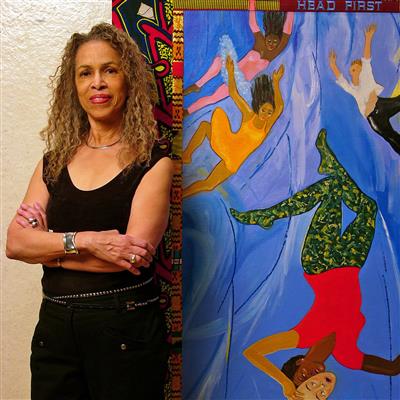
Biography
Born in Atlanta in March 1937[1], Amos studied at Antioch College in Ohio before travelling to London in 1959[1] to take an etching certificate at the Central School of Art and Design. It was there, under Anthony Harrison, that she first worked seriously with oils: a counterintuitive origin story for an artist so firmly associated with the New York scene. She completed an MA at NYU in 1966 and taught for many years at the Mason Gross School of the Arts at Rutgers University.
Her mature work combined printmaking, painting, and textile. She worked on large-scale linen pieces bordered with Kente cloth and batik fabrics, making the frame itself a cultural argument: West African textile traditions installed at the edges of Western easel painting. She painted clothed figures rather than nudes, arguing that clothing reveals more about culture than bare skin, and that nudity in painting is inherently sexist. When she incorporated imagery of the Ku Klux Klan, it was a direct challenge to assumptions about which subjects African American[1] artists should address.
Initially sceptical of white-dominated feminist movements, she later joined the Heresies Collective and participated in the Guerrilla Girls under the pseudonym Zora Neale Hurston, aligning her feminism with Black literary and cultural tradition. Her 1995[1] painting Measuring Measuring appeared on the cover of Lisa Farrington's foundational text Creating Their Own Image: The History of African American[1] Women Artists. Amos died in May 2020[1]. A travelling retrospective, Emma Amos: Color Odyssey, launched in 2021.
Timeline
- 1937Born in Atlanta, Georgia, in March.
- 1959Travelled to London at 22 to study at the Central School of Art and Design, earning an etching certificate.
- 1963Introduced to the Spiral group by Hale Woodruff at 26, becoming its first and only female member.
- 1965Contributed the etching "Without a Feather Boa" to the Spiral group's Christopher Street exhibition.
- 1966Completed an MA at NYU.
- 1995Her painting "Measuring Measuring" appeared on the cover of Lisa Farrington's book Creating Their Own Image: The History of African American Women Artists.
- 2020Died in May, aged 83.
Notable Works
Tap to view larger.
Next stop
Browse the movements →
Every movement in the collection, from the Renaissance to Pop art.
Related Artists

Frequently Asked Questions
What is Emma Amos known for?
Emma Amos is known for combining printmaking, painting, and textile techniques in her art. She created large-scale linen pieces bordered with Kente cloth and batik fabrics, integrating West African textile traditions with Western easel painting.What is Emma Amos's most famous work?
It is difficult to name one single work as Emma Amos's most famous. Her body of work engages with themes of race, gender, and class, often incorporating personal narratives and challenging conventional artistic boundaries. Amos was associated with the Spiral Group in the 1960s, a collective of Black artists who discussed the role of Black artists in the Civil Rights movement. Later, she became a member of the feminist collective Heresies. Her art often combines painting, printmaking, and textiles, creating layered and textured surfaces. While no single piece may eclipse her other works, recurring motifs and themes appear throughout her career. These include explorations of the female body, representations of African textiles, and a critical examination of Western art history. Her distinctive approach and engagement with social issues have secured her a place in contemporary art discourse.What should I know about Emma Amos's prints?
Emma Amos created original prints, often sold in limited editions. These are distinct from reproductions because the artist creates the artwork directly on a plate, woodblock, stone, or screen. Original prints can be woodcuts, engravings, linocuts, mezzotints, etchings, lithographs or serigraphs. Each print in a limited edition is considered an original because the artist produces it by hand. The number of prints is limited either by the medium or by the artist's decision. Printmakers mark up each print with the edition number, the print's title, and their signature, usually in pencil on the bottom margin. The edition is written as a pair of numbers; for example, 35/100, where 100 is the total number of prints, and 35 is the sequential number of that particular print. Some artists also create artist's proofs, marked AP. Prices for prints depend on the quantity available, the artist’s reputation, the image's popularity, and the quality of materials.What style or movement did Emma Amos belong to?
Emma Amos's career coincided with the rise of both feminist art and postmodernism. These movements, emerging in the late 1960s, questioned traditional artistic norms and power structures. Feminist art specifically addresses inequalities faced by women, aiming to instigate change. It lacks a singular style, encompassing various media and approaches. Some scholars link feminist art with conceptual art, where the idea behind a work takes precedence over its physical form. Conceptual art can manifest as performance, happenings, or even written statements. Postmodernism[1], gaining traction in the 1970s, views contemporary society as fragmented, lacking a central, coherent structure. Postmodern artists often borrow from the past, blending styles to mirror this fragmented reality. The relationship between feminism and postmodernism is complex; some feminist scholars have critiqued postmodern theories for potentially hindering political action and marginalising certain voices. Despite these criticisms, feminist art history has also adopted postmodern tools of analysis.What techniques or materials did Emma Amos use?
Emma Amos employed varied materials and methods in her artistic practice. Historically, painters have used media such as fresco, egg tempera, and watercolour, progressing to oil paint. Contemporary materials include acrylics, household emulsions, and mixed media, which combines different materials in a single work. Knowledge of how materials such as oil paint can be applied thickly (impasto) or thinly (glazes) informs understanding of the artwork. Brushwork varies from fine and disguised to thickly applied with a palette knife, or stencilled. Technique is more than a method; it is how manual and mechanical operations act upon raw material to shape it according to artistic intentions. Some artists begin with craft, then move to ideas; others start with ideas and then address the practicalities of craft to express them. Artists are not always confined by their chosen medium. Choices exist outside the constraints of materials and techniques.What was Emma Amos known for?
Emma Amos (born 1937[1]; died 2020[1]) was an American[1] artist known for work that engaged with feminist and postmodernist ideas. Her career developed during a period when feminist art historians analysed how culture and visual representation maintained the secondary status of women. Amos's work can be situated within a broader art world that, from the late 1960s, saw artists explore conceptual and performance art. Feminist art, linked with conceptual art, focused on inequalities faced by women and aimed to provoke change. This movement had no set style; it could include painting or performance. Postmodernism[1], dating from 1970[1] onwards, viewed society as fragmented, lacking a coherent centre. Artists sometimes borrowed from the past, mixing old styles to reflect contemporary society. Some feminist artists explored how women were presented in the media.When did Emma Amos live and work?
Emma Amos was born in 1937[1] and died in 2020[1]. Amos explored themes of race, gender, and class in her artwork. She was associated with the Spiral Group, a collective of Black artists formed in 1963[1]. The group included Romare Bearden, Charles Alston, and Hale Woodruff; they sought to examine the relationship between art and the Civil Rights movement. Her work often incorporated elements of figuration and pattern. She challenged conventional representations of women, particularly Black women. Amos frequently used bright colours and bold compositions. Her art included painting, printmaking, and textile construction. She had a long career as an artist and educator. Amos taught at Rutgers University from 1980 until 2008. Her work has been exhibited in museums and galleries across the United States.Where can I see Emma Amos's work?
Museums regularly adjust their schedules and COVID-19 rules. Some museums are temporarily closed, while others are open but require timed-entry tickets to limit visitor numbers. Almost all require face coverings. Many have also increased their online presence through social media or virtual exhibitions. It is best to check museum websites for the latest information. As of 2021, several museums were planning solo exhibitions of women artists. The Baltimore Museum of Art planned to exhibit Joan Mitchell's work from March 21 through July 18, in an exhibition co-organised with the San Francisco Museum of Modern Art. The Westmoreland Museum of American[1] Art in Greensburg, Pennsylvania, planned to present Simple Pleasures: The Art of Doris Lee from September 26 through January 9, 2022.Where was Emma Amos from?
Information about Emma Amos's origins is not present in the reference passages. However, the passages do offer details about other artists: Edmonia Lewis, of Native American[1] and African American heritage, was an American sculptor. In 1865, she moved to Rome to develop her skills, remaining abroad for her career. Alma Thomas was an American artist who, in 1924, became the first graduate of Howard University’s new art department. She later gained an MA from Columbia University. She lived, taught, and painted in Washington DC from 1921 and became associated with Colour Field painters. In 1972[1], she became the first African-American woman with a solo show at the Whitney Museum in New York. Elizabeth Catlett was born in Washington DC. She became an art teacher and was taught by Lois Mailou Jones and Grant Wood. She studied sculpture at the University of Iowa and was a guest artist at the Taller de Grafica Popular in Mexico. She became a Mexican citizen in 1962.Who did Emma Amos influence?
Emma Amos's direct artistic influence is difficult to measure, but some general trends can be identified. Elizabeth Catlett, for example, acted as a role model for younger African-American[1] women artists. Catlett championed modern art, black aesthetic traditions, and black liberation ideology. Younger artists had opportunities to meet her through the National Conference of Artists, an organisation of professional black artists, critics, and art historians founded in 1959[1]. Faith Ringgold co-founded a black women’s art group in 1971 with Dinga McCannon and Kay Brown, called Where We At: Black Women Artists. Ringgold focused more on her black female sensibility, leaving avenues open for networking with other artists and groups. Within two years, she had ‘begun to speak almost exclusively for women, Black women,’ who in turn began to speak to the world through her art.Who was Emma Amos?
Information about Emma Amos is limited in the provided texts. However, the passages do discuss several other black women artists of the 20th century. Betye Saar, born in 1927, created boxed assemblages of found objects and sculpted bodies that reference her African, Native American[1], and Irish heritage. Early works addressed stereotypes, such as *The Liberation of Aunt Jemima* (1972[1]). Later, she created room-size installations with symbolic references to multiple religions. Faith Ringgold is noted for her quilts. After her mother's death in 1981, Ringgold created *Who’s Afraid of Aunt Jemima?* (1983), a quilt composed of dyed, painted, and pieced fabric. The quilt combines personal and political elements, telling the story of Aunt Jemima as a successful African American businesswoman. Ringgold also produced *The Screaming Woman* (1981), a soft sculpture addressing the murders of black children in Atlanta.Why are Emma Amos's works important today?
Emma Amos (1937[1]-2020[1]) was a painter, printmaker, and weaver who explored themes of race, gender, and identity in her art. Amos was associated with the Spiral Group, a collective of Black artists formed in 1963[1] to discuss the role of Black artists in the Civil Rights movement. She was also a member of the Heresies Collective, a feminist art collective founded in 1976. Amos's work often incorporates images of herself and her family, as well as references to popular culture and art history. She challenged conventional representations of Black women in art, presenting them as complex, multifaceted individuals. Her Afrofemcentrist perspective gave primacy to Black-female consciousness. Amos's innovative approach to figuration and her willingness to address difficult social issues make her work relevant today.
Sources
Editorial draws on the following primary and tertiary references for Emma Amos.
- [1] wikipedia Wikipedia: Emma Amos Used for: biography, birth dates, death dates, identifiers, movement attribution, nationality.
- [2] book guggenheim-museum00solo Used for: biography.
- [3] book Shirley Samuels;, Race and Vision in the Nineteenth-Century United States Used for: stylistic analysis.
- [4] book Norma Broude, The Expanding Discourse Used for: biography, stylistic analysis.
- [5] book Hodge, Susie, 1960- author, The short story of women artists : a pocket guide to movements, works, breakthroughs, & themes Used for: biography.
- [6] book Charlene Spretnak (auth.), The Spiritual Dynamic in Modern Art _ Art History Reconsidered, 1800 to the Present Used for: stylistic analysis.
Editorial overseen by Solis Prints. Sources verified 2026-09-22. Click a source for details, or hover over [N] in the page above to preview.
Editorial standardsMethodologyCorrectionsAI disclosureAbout the editorial team