Dada Artists
Dada emerged in Zurich in 1916 as a revolt against the catastrophe of the First World War and the rational, nationalistic culture that had produced it. The movement adopted nonsense, chance, and provocation as creative principles. Hugo Ball and Emmy Hennings founded the Cabaret Voltaire as a performance venue where poetry, music, and costume combined in deliberate absurdity. Marcel Duchamp, working independently in New York, challenged the concept of art itself by presenting mass-produced objects as sculpture. Max Ernst developed collage techniques in Cologne that reassembled commercial imagery into disturbing new narratives. Man Ray brought photography into the Dada orbit, inventing techniques that turned the camera into a tool for the irrational. Jean Arp used chance operations to create reliefs and collages that bypassed conscious design. Kurt Schwitters, based in Hannover, built an entire aesthetic from discarded tram tickets, newspaper fragments, and urban debris. Dada spread across cities and continents, adapting to local conditions in Berlin, Paris, and New York while maintaining its core hostility to bourgeois art, logic, and propriety. By the mid-1920s its energies had flowed into Surrealism, but its strategies of appropriation, disruption, and institutional critique remain active in contemporary art.
Key Ideas
Anti-Art as Art
Dada's founding gesture was refusal. If Western civilisation had produced a war that killed millions, then the cultural values that civilisation prized, beauty, skill, permanence, were complicit. Dada artists rejected all of them. Duchamp's readymades (a urinal, a bottle rack, a snow shovel) argued that the artist's choice, not manual skill, constituted the creative act. Ball's sound poems abandoned meaning altogether. Schwitters built art from rubbish. These were not pranks. They were systematic dismantlings of the assumptions that had governed art for centuries.
Chance and the Unconscious
Jean Arp dropped torn pieces of paper onto a surface and glued them where they fell. Tristan Tzara composed poems by pulling words from a hat. These chance operations were intended to bypass rational control, the same rationality that Dadaists held responsible for the war. The embrace of accident anticipated the Surrealist interest in automatic writing and the Abstract Expressionist reliance on spontaneous gesture. Dada established randomness as a legitimate creative method, and that permission echoes through every subsequent avant-garde that has privileged process over intention.
Performance and Provocation
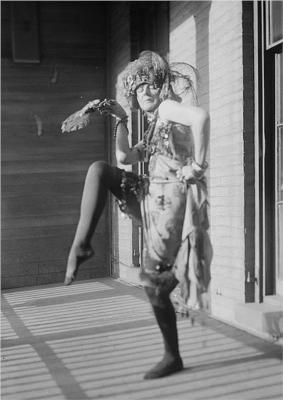
Dada was a performing art before it was a visual one. The Cabaret Voltaire hosted nightly events combining simultaneous poetry, masked dance, noise music, and confrontational addresses to the audience. Berlin Dada staged exhibitions designed to offend: the 1920 International Dada Fair hung a stuffed German officer's uniform from the ceiling. These events treated the audience as material, provoking reactions that became part of the work. Performance art, happenings, and institutional critique all trace their lineage to Dada's insistence that art could be an event rather than an object.
Key Artists


Progression of Art
Fountain

Duchamp purchased a standard Bedfordshire-type urinal from the J. L. Mott Iron Works in New York, signed it 'R. Mutt 1917', rotated it ninety degrees, and submitted it to the Society of Independent Artists' exhibition. The board, which had promised to accept all submissions with the entrance fee paid, voted to reject it. The original was lost; Duchamp authorised replicas in 1964. Fountain did not ask whether a urinal was beautiful. It asked who has the authority to declare something art, and on what grounds. The gesture stripped away craft, beauty, and personal expression, the qualities that had defined art for centuries, leaving only the act of selection. Every conceptual artist since has worked in the space that Fountain opened.
The Hat Makes the Man

Ernst assembled illustrations from hat catalogues and industrial supply advertisements into a vertical composition of stacked cylindrical forms that resemble human figures. Pencil lines connect the hat forms, adding organic curves that make the commercial images look biological and slightly threatening. The title implies that identity is a product, something assembled from off-the-shelf components. Ernst's Cologne collages took the Cubist technique of pasting paper fragments and turned it toward psychological unease. The materials are banal; the effect is unsettling. This tension between the mundane source and the strange result became Ernst's signature method and anticipated the Surrealist collage novels he produced later in the decade.
Cadeau (Gift)

Man Ray glued a row of fourteen brass tacks along the sole of a household iron, transforming a domestic tool into an object that would destroy anything it touched. The original was made during an exhibition opening and stolen that same day; Ray remade it in various editions. Cadeau operates through contradiction: it looks like a useful object and functions as a destructive one. The wit is immediate but the implications extend further. Domestic life, labour, and the gendered associations of the iron are all destabilised by the addition of the tacks. Man Ray brought a sculptor's instinct for material contrast to Dada's conceptual strategies, producing objects that are simultaneously funny, elegant, and menacing.
Untitled (Collage with Squares Arranged According to the Laws of Chance)

Arp tore sheets of coloured paper into rough squares and dropped them onto a larger sheet, gluing them approximately where they landed. The resulting composition has an organic irregularity that no deliberate arrangement could produce. Arp's use of chance was philosophical: he sought to remove the ego from the creative process and align art with natural forces rather than human will. The torn edges and imprecise placement distinguish these works from the geometric precision of Constructivism. Arp's chance collages influenced mid-century composers like John Cage and Fluxus artists who pursued similar strategies of relinquishing authorial control.
Rayograph (abstract composition)

Man Ray placed objects directly on photographic paper in his darkroom and exposed them to light, producing shadow images without a camera. He called the results Rayographs. Everyday items, a comb, a coil of wire, a strip of film, become ghostly, weightless silhouettes floating against a black or grey ground. The technique bypasses the camera's claim to objectivity and turns photography into a medium for abstraction and chance. Tristan Tzara saw the first Rayographs and immediately recognised their Dada credentials, writing the preface for their first published collection. The photogram method was simultaneously and independently developed by László Moholy-Nagy in Berlin, suggesting that the idea was in the cultural air.
Merzbild 25A (The Star Picture)
Schwitters built his Merz pictures from tram tickets, newspaper scraps, wire mesh, fabric, wood, and other urban debris, glued and nailed onto board. Merzbild 25A features a five-pointed star shape at its centre, surrounded by layered fragments of printed text and coloured paper. The composition is balanced and formally considered despite the randomness of its materials. Schwitters called his one-man art movement 'Merz' (clipped from 'Kommerz', the German word for commerce) and insisted it was distinct from Dada, though the strategies overlap heavily. His Merz pictures argue that any material can become art through arrangement and attention. The Hannover Merzbau, his room-filling sculptural environment built from similar debris between 1923 and 1937, extended this principle to architectural scale before it was destroyed in an Allied bombing raid.
Origins
Cabaret Voltaire: Zurich 1916
On 5 February 1916, Hugo Ball and Emmy Hennings opened the Cabaret Voltaire at Spiegelgasse 1 in Zurich's old town. Switzerland was neutral, and the city had filled with refugees, exiles, and draft evaders from across Europe. Ball invited artists and writers to contribute to nightly performances combining poetry, music, dance, and visual art. Tristan Tzara, Jean Arp, Marcel Janco, Richard Huelsenbeck, and Sophie Taeuber-Arp became regular participants. Ball performed his sound poems in a cardboard costume shaped like a bishop's mitre and geometric tubes. The Cabaret ran until the summer of 1916. From that small room, Dada spread outward.
New York: Duchamp, Ray, and Arensberg
Marcel Duchamp arrived in New York in 1915, already notorious for his Nude Descending a Staircase, which had scandalised the 1913 Armory Show. He and Man Ray became the centre of an anti-art circle that gathered at the apartment of the collectors Walter and Louise Arensberg. New York Dada was cooler and more cerebral than its Zurich counterpart. Duchamp's readymades and optical experiments replaced performance with conceptual puzzles. Man Ray's objects and photographs brought American pragmatism to European absurdism. The Arensberg salon provided a social infrastructure, but New York Dada remained a small, elite affair compared to the mass provocations of Berlin.
Berlin, Cologne, Hannover: Political Edge
When Richard Huelsenbeck carried Dada to Berlin in 1917, the movement acquired a political sharpness absent in Zurich and New York. Germany was losing the war, the economy was collapsing, and revolution was imminent. Berlin Dadaists, including George Grosz, John Heartfield, and Hannah Hoch, used photomontage to attack militarism, capitalism, and the Weimar Republic. In Cologne, Max Ernst and Johannes Baargeld staged deliberately provocative exhibitions. In Hannover, Kurt Schwitters pursued a gentler, more aesthetically driven variant he called Merz, collaging urban detritus into compositions of surprising beauty. Each city adapted Dada to its local conditions, proving the movement's flexibility.
In Their Words
“Dada was an extreme protest against the physical side of painting. It was a metaphysical attitude.”
“What we call Dada is a piece of tomfoolery from the void, in which all the lofty questions have become involved.”
“Every page should explode, either because of its staggering absurdity, the enthusiasm of its principles, or its typography.”
Related Movements
Recommended Reading
First-hand account by a participant, covering Zurich, Berlin, Cologne, Hannover, New York, and Paris Dada with personal anecdotes and primary documents.
Essential collection of manifestos, memoirs, and critical texts by Dada artists, assembled by the Abstract Expressionist painter.
Extended conversations with Duchamp recorded in the 1960s, covering his Dada years, the readymades, and his withdrawal from art-making.
All Dada Artists


Explore Dada prints
Browse Dada Prints →