



El Anatsui
- Contemporary
- Sculpture
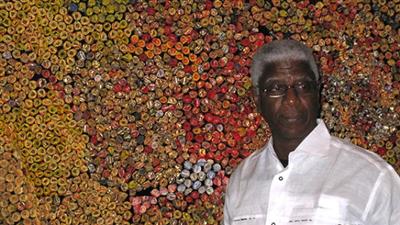
El Anatsui is celebrated for transforming discarded metal bottle caps and other waste materials into large, shimmering wall hangings. His artistic practice, which began to focus on these materials around 1998, challenges conventional ideas about sculpture and painting. He came across a bag of discarded bottle tops near his studio in Nsukka, Nigeria, which sparked his innovative approach.
Biography
Born in Anyako, Ghana, in 1944, Anatsui trained at the College of Art, University of Science and Technology in Kumasi. He later moved to Nigeria, teaching at the University of Nigeria, Nsukka, from 1975 until his retirement. His early work included wood sculptures and clay pieces, often drawing on Ghanaian adinkra symbols and Igbo uli designs. This period established his interest in local traditions and materials.
The bottle cap works involve an extensive, collaborative process. Anatsui employs a team of assistants who flatten, cut, and stitch thousands of aluminium caps together with copper wire. The resulting cloths are flexible, allowing for varied installations; they can hang freely, be folded, or draped to create different forms each time they are shown. This fluidity reflects both the nature of textiles and the changing stories of the materials themselves.
His art engages with themes of consumption, waste, and the histories embedded within found objects. The colours and patterns in his metallic cloths often echo traditional African textiles and ceremonial garments. Anatsui's work has been exhibited globally, including at the Venice Biennale and the British Museum, bringing his unique vision to a broad international audience.
Timeline
- 1944Born in Anyako, Ghana.
- 1975Began teaching at the University of Nigeria, Nsukka.
- 1998Began focusing on discarded metal bottle caps and other waste materials for his art, near his studio in Nsukka, Nigeria.
- 2007His work was included in the Venice Biennale for the first time.
- 2013His work was exhibited at the British Museum.
Notable Works
Tap to view larger.
Next stop
Contemporary →
Explore the artists and ideas of Contemporary.
Related Artists
_%E2%80%93_LOC.jpg)


Frequently Asked Questions
What is El Anatsui known for?
El Anatsui is known for his abstract artworks. He is also known for working with wood, brandmalereitechniken, and experimenting with terracotta fragments.What is El Anatsui's most famous work?
El Anatsui is best known for his large-scale 'metal cloths', a unique art form that blurs the lines between sculpture and textile design. These monumental, wall-based works are constructed from thousands of discarded aluminium bottle caps and other metal fragments, sourced from Nigeria, where Anatsui has spent much of his career. These pieces are pierced, flattened, and linked together using copper wire; the scale of these works often requires a team of assistants to assemble. Anatsui's interest in textiles is longstanding. Early in his career, he incorporated the iconography of adinkra cloth into his work. For a time, he used chainsaws to sculpt wood, echoing the narrow strips of cloth woven on West African looms. The metal cloths evoke associations with Ghanaian kente cloth, connecting his work to his cultural heritage. His use of everyday materials, things that have 'passed through many hands', reflects his interest in imbuing his art with the spirit of those who have used them.What should I know about El Anatsui's prints?
El Anatsui, born in Ghana in 1944, is best known for his large-scale "metal cloths". These hangings blur the lines between sculpture and textile art. He did not achieve international recognition until he was in his 60s, quite late in his career. Anatsui's wall-based sculptures are constructed from discarded bottle caps, aluminium cans, and other found metal objects. These materials are crushed, pierced, and then stitched together using copper wire. A large team of assistants in Nigeria helps him to prepare the materials. The finished works can be manipulated; they can be rolled, folded, and draped in different ways for each installation. The colours in his work often recall Asante kente cloth. Anatsui is interested in using objects that have been handled and used. He says he is drawn to bottle tops because people have drunk from the bottles and left "a charge on them". His choice of materials evokes narratives about local African cultures. Some see his work as connecting Africa, Europe, and the Americas through the history of trade.What style or movement did El Anatsui belong to?
It is difficult to assign El Anatsui to a single style or movement. His work resists easy categorisation, existing somewhere between sculpture and textile design. Some have described his output as Postminimal form or Pop recycling. Born in Ghana in 1944, Anatsui was educated in a Modernist tradition. He later moved to Nigeria. He initially worked with wood and clay, referencing Ghanaian and Nigerian themes. Anatsui is best known for large-scale assemblages of flattened metal caps from liquor bottles. These are connected with copper wire, creating works that resemble textiles. The materials reference trade between Africa, Europe, and America. His pieces evoke art historical analogies, while combining mass-produced media into forms that are both abstract and refer to African textiles. Some consider comparisons of Anatsui's work to Western art as "intellectual laziness". Anatsui's art combines contemporary, global, and African influences, which both require and transcend art historical classifications.What techniques or materials did El Anatsui use?
El Anatsui is known for large-scale sculptures created from discarded materials. He often employs bottle tops and aluminium cans, pierced and linked together with copper wire. These metal components are manipulated to create flexible, textile-like structures. Anatsui's studio in Nigeria employs around 30 assistants. They flatten and sort the metal pieces, punch holes, and connect them into larger sections. Anatsui then directs the assembly of these sections into shimmering, textured artworks. Before his large-scale metal works, Anatsui created sculptures from wooden plates used by merchants, and also from worn mortars. His early ceramic work incorporated shards, referencing broken pots reused as tools. He also experimented with terracotta fragments and used a chainsaw. Anatsui has stated that he is drawn to materials that have been handled by many people. He sees a connection between these objects and the history of trade between Africa, Europe, and the Americas, particularly the exchange of alcohol for goods and raw materials during the colonial era.What was El Anatsui known for?
El Anatsui, born in Ghana in 1944, is known for his large-scale sculptural works. These pieces often blur the lines between sculpture and textile design. He is particularly noted for creating wall-based sculptures from found materials, especially recycled aluminium bottle caps and metal packaging. These are crushed, pierced, and then linked together using copper wire. Anatsui's interest in reused materials stems from their connection to human interaction. He sees these objects as carrying a "charge" from the many hands that have touched them. His choice of materials also relates to African history, specifically the trade between Africa, Europe, and America during colonisation. He views the bottle caps as symbolic links between these continents, aiming to connect cultures through his art. Based in Nigeria for most of his career, Anatsui's studio employs a team of assistants who help prepare and assemble the materials. The finished works often evoke the colours and patterns of Asante kente cloth. They are flexible and can be installed in various ways, either on walls, suspended from ceilings, or draped over buildings.When did El Anatsui live and work?
El Anatsui was born in Anyako, Ghana, in 1944. He is still alive and working. Anatsui began his career as a sculptor and teacher. He taught at the University of Nigeria, Nsukka, from 1975. There, he joined a group of artists interested in exploring indigenous aesthetic traditions and philosophies. He experimented with wood carving, ceramics, and painting, often incorporating traditional Adinkra symbols of the Akan people and developing ways to fracture his media. Around 1998, Anatsui began creating his signature metal wall hangings. These large-scale works are constructed from discarded bottle caps, metal wrappers, and other found materials. He flattens, shapes, and stitches these elements together. The resulting flexible textile-like sculptures can be installed in various configurations, responding to the specific architecture of the exhibition space. Anatsui lives and works primarily in Nsukka, Nigeria. He has received international recognition for his innovative approach to sculpture. His work appears in major museum collections around the world.Where can I see El Anatsui's work?
El Anatsui's artwork has been exhibited globally in various museums and galleries. His pieces have appeared in both African art and contemporary art spaces. Retrospectives, such as *When I Last Wrote to You About Africa* and *A Fateful Journey*, opened in ethnography museums in Toronto and Osaka before touring to art and natural history museums. One can find his work in major institutions like the Metropolitan Museum of Art and the Los Angeles County Museum of Art. In 2019, his work was part of the Ghana Freedom pavilion at the Venice Biennale. A major retrospective, *Triumphant Scale*, was held at the Haus der Kunst in Munich in 2019, later travelling to the Mathaf: Arab Museum of Modern Art in Doha, the Kunstmuseum Bern, and the Guggenheim Museum Bilbao. Anatsui's pieces often blur the lines between sculpture and textile, utilising recycled materials to create large-scale, flexible works that can be displayed in diverse ways. These installations respond to their environments, making each viewing a unique experience.Where was El Anatsui from?
El Anatsui was born in Ghana in 1944. Although from Ghana, he has spent most of his professional life in Nigeria, moving between the two countries for various projects. He is one of a few studio artists from Africa with an international profile. Unusually, he did not achieve widespread recognition until he was in his 60s. Anatsui's early work included sculptures made from wooden plates used by traders and sculptures of mortars used to pound grain. In 1980, during a US-based artist residency, he discovered a fondness for working with chainsaws. Around 20 years ago, he found a bag full of discarded whisky, gin, and brandy bottle tops; this led to his use of metal in art. He employs a team of around 30 assistants at his studio in Nsukka, Nigeria.Who did El Anatsui influence?
El Anatsui's influence is visible in the work of numerous contemporary artists who work with unconventional materials and explore themes of globalisation, consumption, and transformation. His impact extends to artists interested in bridging the gap between sculpture, textiles, and installation art. While it is difficult to name every artist directly affected by Anatsui's practice, his methods have resonated with those who question traditional art-making processes. His use of discarded materials, such as bottle caps and aluminium printing plates, has encouraged other artists to reconsider waste as a medium for artistic expression. Anatsui's large-scale, flexible sculptures have also influenced artists working with installation art, prompting them to think about space, form, and the viewer's interaction with the artwork in new ways. The global reach of his exhibitions and the critical acclaim he has received have further amplified his impact, making him an important figure for artists interested in addressing social and environmental issues through their art. His work has become a point of reference for discussions about contemporary African art and its place in the international art world.Who influenced El Anatsui?
El Anatsui's influences are diverse, arising from his environment and artistic journey. His early sculptures incorporated wooden plates used by traders and worn mortars. He also experimented with terracotta fragments. A period in the United States led to his interest in chainsaws, which he saw as representing the impact of colonisation on African society. Anatsui's work uses everyday materials that have passed through many hands. He once said that an artist must work with what their surroundings provide. A bag of discarded whisky, gin, and brandy bottle tops became a key material. He saw these as connected to the trade between America, Europe, and Africa during the colonial era. His attraction to materials lies in their prior use, imbuing them with a human element. He aims to create connections between objects and cultures.Who was El Anatsui?
El Anatsui, born in Ghana in 1944, is a sculptor known for large-scale assemblages of found materials. He spent much of his career in Nigeria and achieved international recognition later in life, after the age of 60. Anatsui's work often incorporates everyday objects that have passed through many hands. Early sculptures used wooden plates from markets, worn mortars, and ceramic shards. More recent pieces utilise metal graters and condensed milk tin lids, especially bottle caps and aluminium cans, stitched together with copper wire. These materials evoke narratives of local African life and culture. His large-scale "metal cloths" resemble textiles. The colours in these works have parallels with Asante kente cloth. The sculptures can be rolled or folded and are installed in ways that allow them to move with the breeze. Anatsui employs a team of assistants at his studio in Nsukka, Nigeria, to prepare the materials. The bottle caps are sorted, flattened, pierced, and linked into larger sections before being assembled under Anatsui's direction.
Sources
Editorial draws on the following primary and tertiary references for El Anatsui.
- [1] book McLean, Ian; , Double Desire Used for: biography.
- [2] book Penelope J.E. Davies, Walter B. Denny, Frima Fox Hofrichter, Joseph Jacobs, Ann S. Roberts, David L. Simon, Janson's History of Art_ The Western Tradition (8th Edition) Used for: biography.
- [3] book Fred S. Kleiner, Helen Gardner, Kleiner & Mamiya, Gardner's Art through the Ages, Western Perspective, 16th edition, Vol. 2, Harcourt Brace Jovanovich, Used for: biography.
Editorial overseen by Solis Prints. Sources verified 2026-09-27. Click a source for details, or hover over [N] in the page above to preview.
Editorial standardsMethodologyCorrectionsAI disclosureAbout the editorial team