



Dorothy Tanner
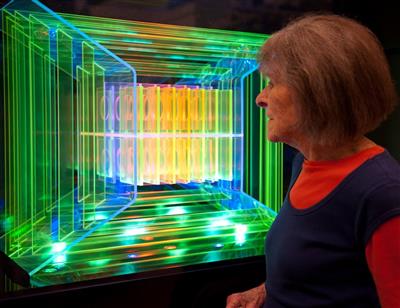
For over four decades, Dorothy Tanner and her husband Mel made art from light itself. Working from studios in Reston, Virginia and later Bradenton, Florida, the pair developed "Lumonics," a synthesis of internally-lit acrylic sculpture, colour organ programming, video projection, and original music. The installations were immersive before the term became a gallery commonplace: audiences entered darkened rooms surrounded by shifting colour and sound composed as a single coherent experience.
Biography
Born in the Bronx on 30 January 1923[1], Dorothy studied woodcarving with Chaim Gross, sculpture with Aaron Goodleman and Milton Hebald, and life drawing with Gabor Peterdi at the Brooklyn Museum Art School, where she met Mel Tanner in 1951[1]. The two married and began their joint practice, exhibiting at science museums, universities, and arts centres throughout the United States. Their work drew on lumia art principles: Thomas Wilfred's tradition of non-figurative light projection given new technical means by the couple's own engineering.
When Mel died in 1993[1], Dorothy continued. She collaborated with Marc Billard to build new Lumonics installations, relocated to Denver in 2009, and remained active into her nineties. In 2018 the city awarded her its Mayor's Award for Excellence in Arts and Culture Innovation, recognising both the longevity of her practice and the technical originality of the work. She died on 23 July 2020, aged 97.
The Lumonics archive documents over sixty years of installations. Dorothy Tanner's career is a reminder that the post-war art world included practitioners working well outside the gallery circuits that attracted most critical attention.
Timeline
- 1923Born in the Bronx on 30 January.
- 1951Met Mel Tanner at the Brooklyn Museum Art School.
- 1951Married Mel Tanner and began their joint art practice.
- 1993Her husband, Mel Tanner, died.
Notable Works
Tap to view larger.
Next stop
Browse the movements →
Every movement in the collection, from the Renaissance to Pop art.
Related Artists
_%E2%80%93_LOC.jpg)


Frequently Asked Questions
What is Dorothy Tanner known for?
Dorothy Tanner is known for "Lumonics", a synthesis of internally-lit acrylic sculpture, colour organ programming, video projection, and original music developed with her husband Mel. The installations were immersive, surrounding audiences with shifting colour and sound composed as a single coherent experience.What is Dorothy Tanner's most famous work?
It is difficult to name one single work as Dorothy Tanner's 'most famous'. Her artistic output includes a wide variety of light sculptures and environments, many of which were collaborative efforts with her husband, Mel Tanner. One notable example of her work is the series of 'Luminal Paintings'. These sculptures combine light, colour, and form to create immersive, meditative environments. These works often incorporate translucent and reflective materials that manipulate light in unique ways, producing a sense of depth and movement. Tanner's intention was to create spaces that encourage contemplation and spiritual connection. Her installations have been featured in public spaces, galleries, and private collections. Her work with light and space has made a contribution to the development of light art as an established art form.What should I know about Dorothy Tanner's prints?
When considering Dorothy Tanner's prints, bear in mind that 'original prints' are produced by hand, distinguishing them from reproductions. These include various techniques such as woodcuts, engravings, and lithographs. The artist creates the artwork directly on the plate, block, or screen. Each print is considered an original because of this direct creation. Original prints are often sold in fine art galleries. The number of prints is limited because plates wear out with use. Some publishers limit impressions to increase a print’s value; these limits may be set as high as 700 to 1,000 impressions, but some prints are limited to 250 to 500. Factors such as the artist’s reputation, the image's popularity, and the materials used affect prices. Since 1890, photographic halftone illustrations and commercial print technology have blurred the lines between an original print and a reproduction.What style or movement did Dorothy Tanner belong to?
Without more information, it is difficult to place Dorothy Tanner within a specific style or movement. Tanner (1923[1]-2020) is best known as a sculptor who worked with light and plastics. She and her husband, Mel Tanner, created sculptural works and installations, many of which were displayed in their studio and gallery in Denver, Colorado. They termed this space the Lumonics Light & Sound Gallery. Light art is a relatively recent area; it grew out of kinetic art trends in the 1960s. Light as a medium offers a dematerialised aesthetic. Artists working in this area often explore perceptual effects; they may also engage with technology and industrial materials. Some artists create light art installations within the natural world, while others, like the Tanners, create interior environments.When did Dorothy Tanner live and work?
Dorothy Tanner (1923[1]-2020) was an American[1] light sculptor. She was born in New York City. Tanner began her career as a painter. She later shifted her focus to three-dimensional art, especially light sculpture. In the 1960s, Tanner and her husband, Mel Tanner, relocated to Denver, Colorado. There, they established the "Lumonics" studio. This became the centre for their collaborative artistic explorations. Lumonics combined sculpture, light, and sound to create immersive art experiences. These installations aimed to alter viewers' perceptions. Tanner's work often incorporated abstract forms. These were made from translucent materials, such as acrylic. Coloured light was projected onto and through these forms. This created a sense of movement and ethereal beauty. Her pieces were exhibited in galleries and museums. They were also featured in public art installations. Tanner continued to produce art until her death in 2020, leaving behind a substantial body of work in the light art field.Where can I see Dorothy Tanner's work?
To view Dorothy Tanner's work, several museums and galleries exhibit art that may include her pieces. These institutions span various countries, offering opportunities to see a range of artistic styles and movements. In the United States, you might find her work at the Charles Hosmer Morse Museum of American[1] Art in Winter Park, Florida, or the Los Angeles County Museum of Art (LACMA) in Los Angeles. Other options include the Metropolitan Museum of Art and the Museum of Modern Art, both located in New York City, and the Minneapolis Institute of Arts in Minneapolis. The Virginia Museum of Fine Arts in Richmond and the Wolfsonian at Florida International University in Miami Beach are also possibilities. Outside the United States, consider the Royal Ontario Museum in Toronto, Canada. In the United Kingdom, you could check the Bakelite Museum, Brighton Museum & Art Gallery, Geffrye Museum, Manchester Art Gallery, National Museums of Scotland Royal Museum in Edinburgh, or the Victoria & Albert Museum in London. Other museums that sometimes exhibit similar works are the Musée du Louvre in Paris and the Kunsthistorisches Museum in Vienna.Who did Dorothy Tanner influence?
Dorothy Tanner's direct influence is difficult to catalogue, as her career centred on collaborative artistic creation and immersive installations. Her work with light and sculpture, however, impacted a number of younger artists who engaged with similar themes. Tanner's decades-long partnership with Mel Tanner produced environments that explored perception and altered states of consciousness. These environments, often exhibited at their studio in Denver, Colorado, became spaces for artistic exchange. Though not widely documented, it is likely these installations influenced local artists interested in light, space, and technology. Her work also intersected with the psychedelic art movement; this connection suggests influence on artists exploring similar themes of expanded consciousness. Later in life, Tanner taught workshops and mentored emerging artists. These educational activities provided a more direct avenue for her ideas to affect the next generation. Without extensive documentation, the full scope of her artistic impact remains somewhat unclear; however, her collaborative practice and teaching activities suggest a network of individuals who absorbed her artistic approaches.Who influenced Dorothy Tanner?
Annelise Fleischmann (who later changed her name to Anni Albers) influenced Dorothy Tanner. Albers was a textile artist, weaver, printmaker, and designer. She taught at the Bauhaus in Weimar and Dessau, and at Black Mountain College near Asheville, North Carolina. Albers began her art training at around age ten. She studied with a Miss Violet, creating naturalistic watercolours. At fourteen, she studied with Toni Mayer, drawing from nude models. Later, she studied with Postimpressionist Martin Brandenburg. Albers's work blended the personal with the impersonal, order with spontaneity, and incorporated playfulness and surprise. She combined machine production with creativity, seeing technical constraints as aids to inspiration. Albers's approach was original, based on her observations. Her teaching and writings guided many artists, and she collaborated with technicians to blend screenprint with photo-offset, etching, and lithography.Who was Dorothy Tanner?
Dorothy Tanner (1923[1]-2020) was an American[1] light sculptor. She is known for her work with acrylic glass. Her early career involved painting and sculpture, but she shifted her focus to light art in the 1960s. Tanner collaborated with her husband, Mel Tanner, to create immersive environments using light and colour. These environments, often called "Lumetric Sculptures", aimed to evoke emotional and spiritual experiences. Their work incorporated fluorescent and incandescent lights, as well as innovative uses of translucent materials. Living and working in Florida, Tanner's art was exhibited in museums and galleries, and she received several awards for her contributions to the field of light art. Her pieces often explored themes of perception and altered states of consciousness.Why are Dorothy Tanner's works important today?
Dorothy Tanner (1923[1]-2020) was an American[1] light sculptor. Working in a male-dominated field, she explored the interplay of light, colour, and form. Her work often incorporated innovative materials such as Plexiglas and neon, pushing the boundaries of sculpture. Tanner's artistic journey was intertwined with her personal life; she collaborated closely with her husband, Mel Tanner, creating immersive environments. Her art is significant because it challenges conventional notions of sculpture. Tanner's installations invite viewers to step into a realm where light becomes a tangible medium. She explored themes of spirituality, consciousness, and interconnectedness. Her pieces offer a contemplative experience, encouraging audiences to reflect on their relationship with the world. Tanner's experiments with light and space continue to inspire artists interested in immersive and experiential art.What was Dorothy Tanner's art style?
Dorothy Tanner's art drew on lumia art principles, which is Thomas Wilfred's tradition of non-figurative light projection. She and her husband used new technical means through their own engineering.When was Dorothy Tanner born?
Dorothy Tanner was born in 1923[1].
Sources
Editorial draws on the following primary and tertiary references for Dorothy Tanner.
- [1] wikipedia Wikipedia: Dorothy Tanner Used for: biography, birth dates, death dates, identifiers, movement attribution, nationality.
- [2] book Caws, Mary Ann; Wright, Sarah Bird, Bloomsbury and France _ art and friends Used for: stylistic analysis.
- [3] book Caws, Mary Ann; Wright, Sarah Bird, Bloomsbury and France _ art and friends Used for: stylistic analysis.
- [4] book guggenheim-twopri00weis Used for: biography.
- [5] book guggenheim-youngereuropeanp00swee Used for: biography.
- [6] book Masterpieces of western art : a history of art in 900 individual studies from the Gothic to the present day Used for: biography.
- [7] book Penelope Rosemont, Surrealist Women Used for: biography.
- [8] book Christopher Zara, Tortured Artists: From Picasso and Monroe to Warhol and Winehouse, the Twisted Secrets of the World's Most Creative Minds Used for: stylistic analysis.
Editorial overseen by Solis Prints. Sources verified 2026-10-16. Click a source for details, or hover over [N] in the page above to preview.
Editorial standardsMethodologyCorrectionsAI disclosureAbout the editorial team