



Dondi
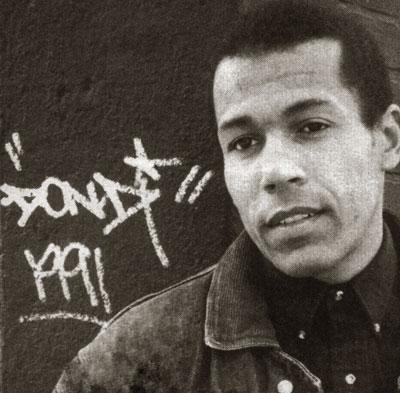
Between 1978[1] and 1980, a teenager from East New York painted "Children of the Grave" three times across entire New York City subway cars. Named after a Black Sabbath track, the three sequential pieces established Donald White, known as Dondi, as one of the defining figures of the city's graffiti movement. Nothing he did looked like anyone else's work.
Biography
Born in Brooklyn in 1961[1] to an African American[1] and Italian American family, Dondi began writing in 1977[1] with the crew TOP (The Odd Partners) before founding CIA (Crazy Inside Artists) the following year. Where many writers of the period pursued the maximum visual density of wildstyle lettering, Dondi moved toward clarity: readable letterforms with elaborate fills, intricate character work, and compositions that rewarded extended looking. The effect was less aggression, more architecture.
His reputation spread to Europe before American[1] galleries paid much attention. In the early 1980s he became the first graffiti artist to stage solo exhibitions in the Netherlands and Germany, and his work entered institutional collections on the continent while still largely excluded from New York's gallery system. The Fun Gallery on Manhattan's Lower East Side eventually brought him into the same orbit as Basquiat and Keith Haring.
Dondi died of AIDS in October 1998[1], aged thirty-seven. In 2018 his 1984[1] work "Solid Formation" sold at auction for $240,000, a figure that confirmed what decades of writers had already known. The techniques he developed in the late 1970s still circulate in contemporary graffiti as a set of standards nobody formally agreed upon but everyone follows.
Timeline
- 1961Born in Brooklyn to an African American and Italian American family.
- 1977Began writing graffiti with the crew TOP (The Odd Partners).
- 1978Founded the graffiti crew CIA (Crazy Inside Artists).
- 1978Painted "Children of the Grave" across New York City subway cars; he repeated this three times by 1980.
- 1980Established himself as a defining figure in New York City's graffiti movement, aged 19.
- 1980Moved toward clarity in his graffiti, using readable letterforms and elaborate character work.
- 1980His reputation spread to Europe before American galleries paid much attention.
- 1980Became the first graffiti artist to stage solo exhibitions in the Netherlands and Germany.
- 1984Created the work "Solid Formation".
- 1998Died of AIDS in October, aged 37.
Notable Works
Tap to view larger.
Next stop
Browse the movements →
Every movement in the collection, from the Renaissance to Pop art.
Related Artists
_%E2%80%93_LOC.jpg)


Frequently Asked Questions
What is Dondi known for?
Dondi is known for his graffiti art on New York City subway cars, particularly the sequential piece "Children of the Grave." He gained recognition for his unique style and was one of the first graffiti artists to have solo exhibitions in Europe.What is Dondi's most famous work?
Dondi White (1961[1]-1998[1]) was a graffiti artist from New York City. He is regarded as one of the leading figures in the development of graffiti as an art form during the late 1970s and early 1980s. Dondi's work is characterised by its dynamic compositions, bright colours, and incorporation of lettering and cartoon-like figures. He gained recognition for painting entire New York City subway cars. These were moving canvases seen by thousands of commuters daily. While Dondi created many notable pieces throughout his career, one of his most celebrated works is "Children of the Grave, Part 3" (1980[1]). Painted on a subway car, it features bold lettering, comic characters, and complex design elements. The title references a song by the heavy metal band Black Sabbath. "Children of the Grave, Part 3" is a striking example of Dondi's artistic skill and his ability to merge graffiti with popular culture. It has become an iconic image of the era.What should I know about Dondi's prints?
Dondi White (1961[1]-1998[1]) was a graffiti artist from New York City. Born Donald Joseph White, he became known for his elaborate, colourful graffiti pieces on subway trains and walls. Active primarily in the 1970s and 1980s, Dondi was a member of the graffiti crew, "The Odd Partners" (TOP). His work often incorporated lettering and character designs. He moved from simple tags to complex compositions, earning recognition within the graffiti subculture and, later, the mainstream art world. Prints of Dondi's work are often reproductions of his original graffiti pieces or drawings. These prints capture the energy and style of New York graffiti art from that period. Some prints are reproductions of photographs of his subway car paintings. Others are based on his drawings and paintings on canvas, which translate the aesthetics of street art into a more conventional art format. His art is associated with the wider hip-hop culture that emerged in New York during the same time.What style or movement did Dondi belong to?
Dondi White is associated with the graffiti art movement, which emerged in New York City during the 1970s. This period saw the rise of subway graffiti, with artists using spray paint to create elaborate designs and tags on trains and other public surfaces. While graffiti art is often seen as separate from the established art world, some graffiti artists, including Dondi, gained recognition for their work and transitioned into galleries and art spaces. Dondi's style is characterised by his use of bold lettering, dynamic compositions, and a distinctive colour palette. His pieces often incorporated elements of pop culture and social commentary, reflecting the urban environment in which he worked. It is worth noting that graffiti art has connections to other art movements, such as pop art and abstract expressionism, due to its emphasis on visual impact and its rejection of traditional artistic conventions. However, graffiti art remains a distinct form of artistic expression with its own history, techniques, and cultural significance.What techniques or materials did Dondi use?
Dondi White (1961[1]-1998[1]) was a graffiti artist who rose to prominence in New York City during the late 1970s and 1980s. He is best known for his elaborate, colourful, and stylised graffiti pieces on subway trains and, later, canvases. Dondi primarily employed spray paint as his medium. He developed a distinctive style characterised by dynamic lettering, often incorporating bubble letters, arrows, and other graphic elements. His mastery of the spray can allowed him to create clean lines and complex compositions. While Dondi's early work was primarily on trains and walls, he transitioned to creating art on canvas as his career progressed. These works allowed for greater control and detail. He sometimes used mixed media in his studio work, but spray paint remained central. Dondi's techniques influenced many other graffiti artists and helped to elevate graffiti from street vandalism to a recognised art form.What was Dondi known for?
The name "Dondi" appears in reference books about the Italian Renaissance, but the reference is to Giovanni Dondi, a Paduan astrologer. Albrecht Dürer, a German artist of the Renaissance, is known as a master of graphic arts and painting. His work is considered the quintessence of the spirit of German art. Dürer was a mediator between Italian and German art, and his graphic art influenced Italian painting of the 16th century. Dürer may have learned goldsmithing from his father before entering the workshop of Michael Wolgemut in 1486. Graphic works featured largely in his early period. The linear design of his fifteen woodcuts of the “Apocalypse” achieved a height of expression never reached before. This was followed by sets of woodcuts entitled “The Great Passion” (1498-1500[1]) and the “Life of Mary” (1501-1511). His “Feast of the Rosary”, which he painted for the German merchant group in Venice, is the first proof of his new conception. He produced his major works (“The Adoration of the Trinity”; “Four Apostles”), also painting many portraits, including “Hieronymus Holzschuher”.When did Dondi live and work?
James Lewis Dine (born 1935), who worked under the name Dondi, was born in Cincinnati, Ohio. His grandfather owned a hardware shop, and his father owned a smaller one across the river in Covington, Kentucky. Dine worked at both stores during his boyhood, an experience that later appeared in his art. In 1946, Dine took his first art class at the Cincinnati Art Museum. He studied watercolour painting at the studio of Vincent Taylor in Cincinnati in 1948. In 1951, Dine moved into his maternal grandparents' home. His grandfather taught him carpentry, mechanics, and sewing. He began making art in the basement of the house, painting over old canvases and on wooden paint stirrers. Dine saw reproductions of works by Georges Braque and Pablo Picasso that inspired his fascination with objects affixed to the canvas. Dine continues to pursue the idea of self-portraiture. Following a series of White Suit self-portraits, Dine began to evoke his own figure in his works through the motif of an uninhabited bathrobe.Where can I see Dondi's work?
Dondi's artwork can be viewed in several museums and institutions. In the United States, these include the J. Paul Getty Museum in Los Angeles; the Cooper-Hewitt, National Design Museum, Smithsonian Institution, in New York; and the Cleveland Museum of Art. Other locations include the Los Angeles County Museum of Art (LACMA); the Metropolitan Museum of Art in New York; the Minneapolis Institute of Arts; the Museum of Modern Art in New York; the Royal Ontario Museum in Toronto; the Virginia Museum of Fine Arts; and the Wolfsonian at Florida International University in Miami Beach. In the United Kingdom, his work can be seen at the Bakelite Museum; the Brighton Museum & Art Gallery; the Geffrye Museum in London; the Manchester Art Gallery; the National Museums of Scotland-Royal Museum in Edinburgh; and the Victoria & Albert Museum in London. In Italy, his art can be viewed at the Fondazione Regionale Cristoforo Colombo, the Museo del Bijou di Casalmaggiore, and the Museo Richard-Ginori della Manifattura di Doccia.Where was Dondi from?
Dondi White (1961[1]-1998[1]), a graffiti artist, was from New York City. Born Donald Joseph White, he grew up in the East New York section of Brooklyn. This area, during Dondi's youth, faced economic hardship. He began writing graffiti in the late 1970s. His early tags included "NACO" and "DONDI". He gained wider recognition in the early 1980s. Dondi's work appeared on subway trains. These moving artworks reached a large audience. He became known for his elaborate, colourful pieces. Dondi moved from subway graffiti to creating art on canvas. He participated in gallery shows, both in the United States and internationally. His art is associated with the graffiti art movement that emerged from New York City. This movement had a significant impact on the art world. Dondi's background in New York City's urban environment shaped his artistic style and subject matter.Who did Dondi influence?
It is difficult to identify specific individuals who were directly influenced by Dondi (Donald Joseph White). However, his work impacted the broader graffiti movement and street art. As a prominent figure in New York City's graffiti scene during the late 1970s and 1980s, Dondi gained recognition for his elaborate and stylised lettering, as well as his whole-car murals on subway trains. Dondi's artistic approach, which combined elements of pop art, cartooning, and surrealism, helped to elevate graffiti from simple tagging to a more complex and respected art form. His work, along with that of other graffiti artists such as Fab Five Freddy, Futura 2000, and Keith Haring, contributed to the wider acceptance of street art in the mainstream art world. These artists inspired many younger artists who saw the potential for graffiti and street art to be a means of creative expression and social commentary.Who was Dondi?
Dondi (1961[1]-1998[1]) was a graffiti artist who became known in New York City during the late 1970s and 1980s. Born Donald Joseph White, he is regarded as one of the leading figures in the development of graffiti as an art form. Dondi began painting subway trains in the mid-1970s, quickly gaining recognition for his elaborate and colourful pieces. His work often featured cartoon-like characters, lettering, and imagery drawn from popular culture. Unlike some graffiti artists who focused on tagging or simple throw-ups, Dondi's pieces were complex compositions that demonstrated a high level of technical skill and artistic vision. He was a member of the graffiti crew known as CIA (Crazy Inside Artists). In the early 1980s, Dondi's work transitioned from the streets to art galleries, as he participated in shows alongside other graffiti artists such as Jean-Michel Basquiat. Dondi died of AIDS in 1998[1], at the age of 37.Why are Dondi's works important today?
Dondi White (1961[1]-1998[1]) was an American[1] graffiti artist. He moved from the Bronx to Manhattan in the late 1970s. He is known for his elaborate, colourful graffiti pieces on New York City subway cars. Dondi's work is important for several reasons. He helped to elevate graffiti from a street-level activity to a recognised art form. His complex letterforms and character designs set a new standard for graffiti art. He moved beyond simple tags to create full-car murals. These murals often incorporated themes from popular culture and his personal experiences. Dondi gained recognition in the art world during the early 1980s. He had gallery shows in New York and Europe. His work appeared in documentaries, such as "Style Wars" (1983[1]). Dondi, along with other artists like Keith Haring and Jean-Michel Basquiat, helped bring graffiti into mainstream art circles. He demonstrated the artistic potential of graffiti. He inspired a generation of artists both within and outside the graffiti community. His innovations in style and technique continue to influence artists working today.
Sources
Editorial draws on the following primary and tertiary references for Dondi.
- [1] wikipedia Wikipedia: Dondi Used for: biography, birth dates, death dates, identifiers, movement attribution, nationality.
- [2] book Dorling Kindersley, Artists: Inspiring Stories of the World's Most Creative Minds Used for: stylistic analysis.
- [3] book Factory work : Warhol, Wyeth, Basquiat Used for: biography.
- [4] book guggenheim-berriarei00bilb Used for: biography.
- [5] book guggenheim-refigur00kren Used for: biography.
- [6] book guggenheim-twopri00weis Used for: biography.
- [7] book Masterpieces of western art : a history of art in 900 individual studies from the Gothic to the present day Used for: biography.
- [8] book The Editors of New York Magazine, The Encyclopedia of New York Used for: stylistic analysis.
Editorial overseen by Solis Prints. Sources verified 2026-10-16. Click a source for details, or hover over [N] in the page above to preview.
Editorial standardsMethodologyCorrectionsAI disclosureAbout the editorial team