



Donatello
- Early Renaissance
Three years in Rome at the start of the fifteenth century changed Donatello. He arrived with the architect Filippo Brunelleschi in roughly 1404, and the two spent their time measuring and sketching ancient ruins while local Romans reportedly mistook them for treasure hunters. What Donatello absorbed during that stay shaped the next sixty years of his career and, by extension, the entire arc of Western sculpture.
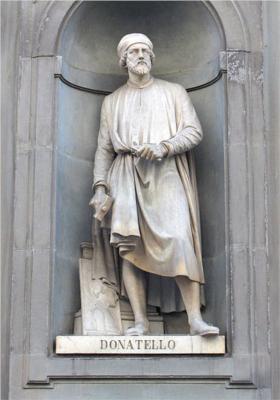
Biography
Born Donato di Niccolò di Betto Bardi in Florence around 1386[1], he trained first with a goldsmith before entering the workshop of Lorenzo Ghiberti, where he contributed to the celebrated bronze Baptistery doors. His early independent works showed classical knowledge applied with growing freedom: the marble Saint Mark (1411-13) and Saint George (c. 1415-17) at Orsanmichele demonstrated a command of contrapposto that no sculptor had achieved since antiquity.
The Bronze David, cast around 1434 to 1440, went further still. It was the first free-standing life-size nude sculpture since ancient Rome, displayed in the Medici courtyard as a symbol of Florentine civic pride. The Gattamelata in Padua (1447-53) was equally without precedent: the first monumental equestrian bronze since the ancient Marcus Aurelius, and a work Michelangelo studied carefully before designing his own never-executed equestrian commission.
Donatello also invented stiacciato, a technique of extremely shallow relief carving that creates the illusion of deep space through delicate tonal gradation. He worked in marble, bronze, wood, and polychrome terracotta across a career that lasted well into old age, dying in Florence in December 1466[1]. The Medici family, his primary patrons, paid for his burial in the church of San Lorenzo.
Timeline
- 1386Born Donato di Niccolò di Betto Bardi in Florence.
- 1404Travelled to Rome with Filippo Brunelleschi to study ancient ruins.
- 1411Completed the marble "Saint Mark" sculpture for Orsanmichele, Florence (completed in 1413).
- 1415Completed the marble "Saint George" sculpture for Orsanmichele, Florence (completed c. 1417).
- 1434Began work on the "Bronze David" (completed c. 1440).
- 1447Began work on the "Gattamelata" equestrian statue in Padua (completed in 1453).
- 1466Died in Florence in December. He was buried in the church of San Lorenzo, with the Medici family paying for the burial.
Notable Works
Tap to view larger.
Next stop
Browse the movements →
Every movement in the collection, from the Renaissance to Pop art.
Related Artists
.jpg!Portrait.jpg)


Frequently Asked Questions
What is Donatello known for?
Donatello is known for his skill in working with various materials, including marble, bronze, wood, terracotta, and stucco. He also developed his own style of basso relievo, or low relief, called schiacciato, which involved shallow carving to create dramatic images using light and shadow.What is Donatello's most famous work?
Donatello was a prolific artist who worked in marble, bronze, wood and terracotta. His sculpture *St George*, carved from marble around 1417 for the Guild of Armourers, is considered one of his finest early works. Originally, the sculpture was placed in an exterior niche of Or San Michele; it is now held in the Museo Nazionale (Bargello). The figure seems poised to step out of the niche. He appears able to move his limbs easily, even though he is dressed in armour. His stance suggests he is ready for combat. The controlled energy of his body is reflected in his eyes, which seem to scan the horizon. Donatello also completed the relief panel below the niche, which depicts St George slaying a dragon to free a princess. Here, Donatello devised a new kind of shallow relief (called *schiacciato*, meaning flattened out), creating an illusion of depth.What should I know about Donatello's prints?
Donatello was a sculptor of the early Renaissance in Florence. He is not generally known for making prints; his artistic output consisted primarily of sculpture in marble, bronze, and wood. His sculptures include the marble "St George", the wooden "Magdalen", and the marble "Zuccone". The "Zuccone" (pumpkin head) is a close portrait of a bald Florentine man. Donatello's bronze equestrian statue of Gattamelata stands in Padua. Prints, as opposed to reproductions of works in other media, are conceived by the artist as prints and created solely as prints. Each print in a numbered edition is an original, made from a plate, stone, screen, block or other matrix. The artist inks and pulls each print individually. The number of prints in the edition is decided by the artist. Each print has a specific number, such as 12/25 (print number 12 from an edition of 25). Early prints were not usually numbered or signed; in some cases the artist might have signed the plate or stone itself, with no pencilled signature on each print.What style or movement did Donatello belong to?
Donatello was a sculptor of the Early Renaissance[1] period. He was born Donato di Niccolò di Betto Bardi in Florence around 1386[1], and he died there in 1466[1]. Donatello is recognised as one of the most important Italian[1] artists of the 15th century. His innovations in sculpture mark a departure from the Gothic style, which had previously dominated European art. Donatello's work is characterised by a renewed interest in classical forms and ideals, a hallmark of the Renaissance. His sculptures often display a realism and emotional expressiveness that was rare at the time. He studied classical sculpture, and he developed new techniques, such as *schiacciato* (a shallow relief), to create a sense of depth and space. Donatello's use of perspective, anatomical accuracy, and dynamic compositions had a major impact on later artists. His work influenced painting and sculpture for generations.What techniques or materials did Donatello use?
Donatello was skilled in marble, bronze, wood, terracotta, and stucco. For bronze sculpture, Donatello would construct a figure or object from wax or clay to make a cast. The model was coated with plaster, and after the plaster dried, the sections were removed. The inner faces of the plaster were covered with a thick wax layer. These wax shells were removed from the plaster moulds and affixed to a core of clay by wires. The wax was coated with a mixture of ash and water and covered with more clay. He developed his own style of low relief, called schiacciato (flattened out). This technique involved shallow carving to create images that reflected light and shadow. An example of this technique is the predella from Donatello's St George (circa 1415, Florence, Bargello). The figures in the foreground are carved away from the block, while the background is sketched by exploiting the grainy texture of the marble through incisions. Donatello was interested in depicting emotions in his sculptures and reliefs.What was Donatello known for?
Donatello (Donato di Niccolò di Betto Bardi, circa 1386[1]-1466[1]) was a Florentine sculptor of the early Renaissance. He is known for his sculptures in marble, bronze, wood, and other materials. Donatello developed a style of shallow relief, called *rilievo schiacciato*, which allowed him to include atmospheric perspective in his work. His work drew inspiration from classical antiquity. He moved away from the prevailing Gothic style. His bronze *David* (circa 1440s) was one of the first unsupported bronze sculptures of the Renaissance, and the first known free-standing nude sculpture produced since antiquity. It depicts David with an enigmatic expression, after his victory over Goliath. The sculpture is thought to have been commissioned by the Medici family. It resided in the Palazzo Medici courtyard. Other important works include the marble *David* (1408-09), made early in his career; *Saint Mark* (1411-13) at Orsanmichele; *Gattamelata* (circa 1450), a bronze equestrian statue in Padua; and sculptures for the Basilica di Sant'Antonio in Padua.When did Donatello live and work?
Donatello (Donato di Niccolò di Betto Bardi) was born circa 1386[1] and died in 1466[1]. The Florentine sculptor is considered a leading figure of the Early Renaissance[1]. He moved away from accepted Gothic representations of the human form, establishing a new, humanistic style of sculpture. His early artistic training was with a goldsmith. He then worked briefly in the studio of Lorenzo Ghiberti, assisting with the creation of the bronze doors of Florence’s Baptistry. From 1404, he spent three years in Rome with the architect and sculptor Filippo Brunelleschi, studying ancient Roman artifacts. His innovations soon became known elsewhere in Italy, leading to commissions in other cities, such as Siena and Padua. His career was long and productive, making him the most influential sculptor of fifteenth-century Italy. His statue *David* (1408) was the first life-sized nude statue since classical times.Where can I see Donatello's work?
Donatello's sculptures can be viewed in several locations, primarily in Italy. Florence holds a significant concentration of his works. The Museo Nazionale del Bargello in Florence possesses Donatello's bronze David (circa 1440s), his marble David (1408-09), and his St. George (circa 1415-17). The Museo di San Marco, also in Florence, houses his relief, Virgin and Child (circa 1425-30), also known as the Madonna of the Stairs. The Basilica di Sant'Antonio in Padua features Donatello's bronze equestrian statue of Gattamelata (completed 1453), a notable example of early Renaissance equestrian sculpture. The Victoria and Albert Museum in London has Donatello's relief The Ascension with Christ Giving the Keys to St. Peter (circa 1428-30). Other works can be found in museums and churches in Siena, Venice, and Naples. These collections offer a comprehensive view of Donatello's development and his impact on Renaissance sculpture.Where was Donatello from?
Donatello, born Donato di Niccolò di Betto Bardi, was Florentine. Born circa 1386[1], he was the son of a wool comber. Donatello moved away from accepted Gothic representations of the human form, establishing a new, humanistic style of sculpture. He trained with a goldsmith, then worked in the studio of Lorenzo Ghiberti, assisting with the creation of the bronze doors of Florence’s Baptistry. From 1404, he spent three years in Rome with the architect and sculptor Filippo Brunelleschi, excavating and studying ancient Roman artifacts. Donatello combined classical lines with realism. He was inspired by the naturalism he saw in these great works of antiquity and by the humanist movement that had started in Florence. He began creating statues that appeared to have a life of their own and individual personalities; this was a radical departure from the decorative Gothic style that he had been trained in.Who did Donatello influence?
Donatello's influence on later sculptors is considerable. His focus on realism and the expression of human emotion directed his successors toward life as the source of artistic inspiration. Luca della Robbia was influenced by Donatello's realism, though della Robbia mixed it with his own style. Desiderio da Settignano, a pupil of Donatello, achieved a delicacy in his youthful figures that Donatello never reached. Antonio Pollaiuolo was a vigorous experimenter in movement. Andrea Verrocchio combined Donatello's vitality with Desiderio's delicacy. Later artists such as Antonio Rossellino amplified Donatello's forms. Pollaiuolo and Verrocchio both worked in bronze and excelled in expressing energy. Verrocchio's bronze statue of David depicts him as a wiry youth, more energetic than Donatello's David.Who influenced Donatello?
Donatello (1386[1]-1466[1]) was initially trained as a goldsmith, then worked briefly in the studio of Lorenzo Ghiberti, assisting with the creation of the bronze doors of Florence’s Baptistry. This would have given him a solid grounding in Florentine workshop practice. From 1404, Donatello spent three years in Rome with Filippo Brunelleschi, excavating and studying ancient Roman artifacts. Like Brunelleschi, Donatello developed an enthusiasm for classical remains. He acquired an acquaintance with the spirit of antiquity from ancient coins and cameos (ancient statues were still largely buried). He combined classical lines with realism. Donatello’s study of ancient Greek and Roman sculpture, and the humanist movement that had started in Florence, inspired him. He moved away from accepted Gothic representations of the human form. He began creating statues that appeared to have a life of their own and individual personalities; this was a departure from the decorative Gothic style in which he trained.Who was Donatello?
Donato di Niccolò di Betto Bardi, known as Donatello, was an Early Renaissance[1] artist. He is known for his sculpture, such as the Bronze David, which was the first free-standing life-size nude sculpture since ancient Rome.
Sources
Editorial draws on the following primary and tertiary references for Donatello.
- [1] wikipedia Wikipedia: Donatello Used for: biography, birth dates, death dates, identifiers, movement attribution, nationality.
- [2] book Susie Hodge, Art Used for: biography, stylistic analysis.
- [3] book Susie Hodge, Art: Everything You Need to Know About the Greatest Artists and Their Work Used for: biography, stylistic analysis.
- [4] book Ferdinand Schevill, Medieval and Renaissance Florence 2 Used for: biography.
Editorial overseen by Solis Prints. Sources verified 2026-09-13. Click a source for details, or hover over [N] in the page above to preview.
Editorial standardsMethodologyCorrectionsAI disclosureAbout the editorial team