



Dobri Dobrev
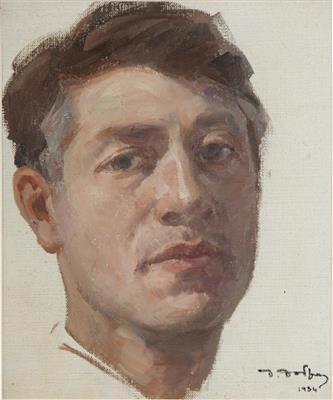
Dobri Dobrev left Sliven for Prague in the early 1920s and spent fifteen formative years in Czechoslovakia, graduating from the Academy of Fine Arts in 1925[1] under Professor Jakub Obrovský. The dual exposure never left his work: his Bulgarian[1] canvases of the 1930s treat Sliven markets and landscapes with an Impressionist looseness absorbed in central Europe, while a parallel Czech and Slovak cycle depicts miners, foundries, and mountain subjects drawn from his years abroad.
Biography
Born in Sliven on 21 December 1898[1], Dobrev returned permanently to Bulgaria in 1937[1] and settled in Sofia. Morning Song (1932) and Marketplace (1932), both in the Sliven Art Gallery, illustrate the lively realism of his interwar peak. He was regarded in his time as among Bulgaria's foremost portraitists, though landscape became increasingly prominent as his career progressed.
Between 1923[1] and 1971 Dobrev mounted around fifty solo exhibitions in Bulgaria and Czechoslovakia, a sustained exhibition record that kept him visible across both countries throughout the Socialist period. He died in Sofia on 1 March 1973[1].
Timeline
- 1898Born in Sliven on 21 December.
- 1920Moved from Sliven to Prague in the early 1920s.
- 1925Graduated from the Academy of Fine Arts in Prague under Professor Jakub Obrovský.
- 1932Painted "Morning Song".
- 1932Painted "Marketplace".
- 1937Returned permanently to Bulgaria and settled in Sofia.
- 1971Mounted around fifty solo exhibitions in Bulgaria and Czechoslovakia between 1923 and 1971.
- 1973Died in Sofia on 1 March.
Notable Works
Tap to view larger.
Next stop
Browse the movements →
Every movement in the collection, from the Renaissance to Pop art.
Related Artists
Frequently Asked Questions
What is Dobri Dobrev known for?
Dobri Dobrev was regarded as one of Bulgaria's foremost portraitists, though he also painted landscapes.What is Dobri Dobrev's most famous work?
Dobri Dobrev (1914[1]-2018[1]) was not a painter or printmaker. He was a Bulgarian[1] Orthodox Christian ascetic, known as the "Saint of Bailovo" or "Grandpa Dobri". He was noted for his lifelong dedication to charitable fundraising. Dobrev was born in the village of Bailovo, near Sofia. During the Second World War, he lost most of his hearing as the result of a bomb explosion near him. He began donating to churches and monasteries around 1990. He lived very modestly, subsisting on his state pension and additional alms that he begged for. Dobrev became particularly associated with the Alexander Nevsky Cathedral in Sofia. He collected money for its restoration for many years. He also donated to other religious institutions. These included the Eleshnitsa Monastery and the Gorno Botevo Monastery. His ascetic lifestyle and generosity gained him considerable public attention in Bulgaria. Dobrev's example of selfless giving made him a respected figure late in life. He died at the age of 103.What style or movement did Dobri Dobrev belong to?
It is difficult to assign Dobri Dobrev to a specific movement. The analysis of movement, as it relates to the human form, has connections to both material and spiritual life. Movement can be separated into the physical, such as locomotion and hygiene, and the psychological expression of feelings or emotions. Emotions cause involuntary movement of muscles in the human body. Body motion is often used to support words, or as a substitute for speech. This is the origin of mimicry, dance, and ballet. These forms of expression have become less popular as people seek to express more subtle workings of the human soul. A need for a new emotional language has emerged. The older forms of dance include circus routines of clowns, acrobats, and tight-rope walkers. People who tire of the psychological atmosphere of the theatre often escape to the circus for its simpler form of expression through movement. Even an ordinary acrobat goes through a sequence of motions, concluding with a graceful gesture of accomplishment that cannot be translated into words. There is no concrete emotion expressed in the acrobat's act; however, we can glimpse the deeper meaning of movement.Where can I see Dobri Dobrev's work?
I am unable to provide specific information on where to view works by Dobri Dobrev. However, I can offer a list of museums that feature similar art. In the United States, you might visit the Charles Hosmer Morse Museum of American Art (Winter Park, Florida), the Los Angeles County Museum of Art, the Metropolitan Museum of Art (New York), the Minneapolis Institute of Arts, the Museum of Modern Art (New York), the Virginia Museum of Fine Arts (Richmond), or the Wolfsonian at Florida International University (Miami Beach). In Canada, the Royal Ontario Museum (Toronto) may be of interest. In the United Kingdom, consider the Bakelite Museum (Williton), Brighton Museum & Art Gallery, the Geffrye Museum (London), Manchester Art Gallery, the National Museums of Scotland (Edinburgh), Leeds City Art Gallery, or the Victoria & Albert Museum (London). Other European museums with relevant collections include the Rijksmuseum Kréller-Miller (Otterlo, Netherlands), Museum Boymans-van Beuningen (Rotterdam), the Nasjonalgalleriet (Oslo), Museu Nacional de Arte Antiga (Lisbon), Muzeul de Arta (Craiova, Romania), the Tretyakov Gallery (Moscow), the Hermitage Museum (St Petersburg), Museo de Bellas Artes (Bilbao), Fundacién Coleccion Thyssen-Bornemisza (Madrid), Museo Nacional del Prado (Madrid), Offentliche Kunstsammlung Kunstmuseum Basel, Musée d’Art et d’Histoire (Geneva), Towneley Hall Art Gallery (Burnley), The Fitzwilliam Museum (Cambridge), the National Museum of Wales (Cardiff), the National Gallery of Scotland (Edinburgh), the Scottish National Gallery of Modern Art (Edinburgh), The Burrell Collection (Glasgow), and the Jersey Museum and Art Gallery (St Helier).Who did Dobri Dobrev influence?
Dobri Dobrev (1914[1]-2018[1]) was a Bulgarian[1] ascetic and church donor, known as "The Saint of Bailovo" during his later life. He is not generally considered to be an artist who worked in a visual medium. Therefore, he did not have artistic influence in the conventional sense. Dobrev's influence was primarily spiritual and social. He was known for his donations to the Bulgarian Orthodox Church and various charities, all collected through begging. His example of selfless giving and simple living affected many people who encountered him or learned about his actions through media coverage. While Dobrev did not directly inspire other artists to create works in a similar style, his persona and actions became a subject for artistic interpretation. He appeared in paintings, photographs, and documentaries, thus indirectly shaping the work of artists who chose to represent him or his ideals. His impact is more readily seen in ethical and philosophical discussions about altruism than in direct artistic movements.Who influenced Dobri Dobrev?
Information on Dobri Dobrev's artistic influences is scarce. He was born in 1914[1] in the village of Bailovo, Bulgaria, and became known for his religious-themed artwork. Without specific documented influences, we can only speculate based on the context of Bulgarian[1] art and religious painting during his lifetime. The style of Orthodox Christian iconography, with its stylised figures and symbolic colour palettes, likely played a role in shaping his artistic vision. Bulgarian folk art may have also been a factor. Further research into the artistic environment of Bulgaria in the 20th century could reveal more about the specific artists or movements that informed Dobrev's work. However, at present, his direct influences remain largely unknown.Who was Dobri Dobrev?
The reference texts provided do not contain any information about an artist named Dobri Dobrev. However, they do mention Mstislav Valerianovich Dobuzhinsky (1875-1957[1]), a Russian artist. Dobuzhinsky was born in Novgorod and studied in Saint Petersburg and Munich. He trained with Lev Dmitriyev-Kavkazsky, Anton Ažbe, Simon Hollósy, and Vladimir Mathé. Dobuzhinsky travelled extensively in Europe and Russia, sketching at the front during World War I. He joined the World of Art group in 1902[1] and taught at various art schools between 1906 and 1923. After 1917, he helped preserve Saint Petersburg's monuments. He contributed to journals such as *Strekoza*, *Shut*, *The World of Art*, and *Apollon*. Dobuzhinsky also designed for literary publications. His artwork focused on urban themes, including Saint Petersburg, Russian provincial towns, and European cities. He also created historical paintings and portraits and worked in decorative art.Why are Dobri Dobrev's works important today?
It is difficult to assess Dobri Dobrev's importance today because opinions on modern art vary widely. Some consider the value of modern art to be connected to social conflict or scandal, rather than artistic merit. These observers might argue that the attention given to modern art is disproportionate to its actual achievements, and that it relies more on extraneous factors than on traditional artistic skills. Others suggest modern art's importance lies in its revolutionary role, challenging conventional norms and paving the way for future artistic expression. They might argue that the controversies surrounding modern art are integral to its value, as they reflect a broader societal shift. Still others may see modern art as a reflection of contemporary society's complexities, marked by reflection, abstract thinking, and a blurring of lines between art history and artistic practice. Ultimately, the assessment of Dobrev's work depends on one's perspective on the role and value of modern art itself.How did Dobri Dobrev die?
Dobri Dobrev died in 1973[1] at the age of 75.
Sources
Editorial draws on the following primary and tertiary references for Dobri Dobrev.
- [1] wikipedia Wikipedia: Dobri Dobrev Used for: biography, birth dates, death dates, identifiers, movement attribution, nationality.
- [2] book guggenheim-artoftomorrowfif1939gugg Used for: biography.
- [3] book guggenheim-onehundredpainti00thom Used for: biography.
- [4] book Masterpieces of western art : a history of art in 900 individual studies from the Gothic to the present day Used for: biography.
Editorial overseen by Solis Prints. Sources verified 2026-10-15. Click a source for details, or hover over [N] in the page above to preview.
Editorial standardsMethodologyCorrectionsAI disclosureAbout the editorial team