



Dirk Bouts
- Early Netherlandish painting
Dirk Bouts is among the least documented major painters of the fifteenth century. Born Theodorik Romboutszoon, probably in Haarlem in the 1420s, he does not appear in the Louvain archives until 1457, and virtually nothing certain survives about the three decades before that. Art historians have long assumed he trained with or alongside Albert van Ouwater in Haarlem, and that through Petrus Christus he absorbed the lessons of Jan van Eyck and Rogier van der Weyden. His earliest attributed work, the Infancy Altarpiece in the Prado (c.1445), bears out both influences.
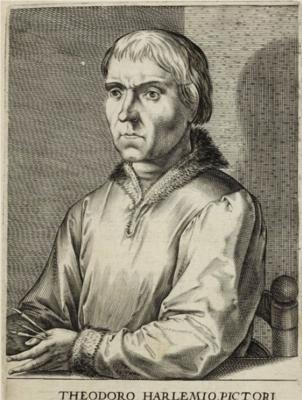
Biography
He settled in Louvain, where he married into a prosperous family (his wife Katharina van der Brugghen was known, with Flemish directness, as Metten Gelde, meaning "with the money") and established a large workshop. The city appointed him its official painter in 1468. In 1464, four members of the Brotherhood of the Holy Sacrament at Saint Peter's Church commissioned what became his major surviving work: the Last Supper Altarpiece, completed in 1468. The composition places the central scene inside a vast, mathematically receding hall, one of the most resolved spatial experiments in Netherlandish painting before the sixteenth century.
Bouts's particular contribution to the tradition is his treatment of landscape. Where contemporaries used natural backgrounds as symbolic or secondary elements, Bouts gave them an atmospheric weight that creates what German scholars call Stimmung: a mood of nature that precedes the action and outlasts it. This predilection for landscape as emotional register would pass to his two painter sons, Dieric the Younger and Aelbrecht.
He died in Louvain on 6 May 1475[1], having dictated his will the previous month.
Timeline
- 1415Born Theodorik Romboutszoon, probably in Haarlem.
- 1445Attributed with painting the "Infancy Altarpiece" in the Prado, bearing influences from Jan van Eyck and Rogier van der Weyden.
- 1457Appears in the Louvain archives.
- 1464Commissioned by the Brotherhood of the Holy Sacrament at Saint Peter's Church to create the Last Supper Altarpiece.
- 1468Appointed official painter of Louvain.
- 1468Completed the "Last Supper Altarpiece".
- 1475Died in Louvain on 6 May, after dictating his will the previous month.
Notable Works
Tap to view larger.
Next stop
Browse the movements →
Every movement in the collection, from the Renaissance to Pop art.
Related Artists
%20-%20Portrait%20of%20Quinten%20Massijs%20(I)%20%2C%201572%20(cropped).jpg)
.jpg)


Frequently Asked Questions
What is Dirk Bouts known for?
Dirk Bouts is particularly known for his treatment of natural backgrounds. Unlike contemporaries who used these as symbolic elements, he gave them an atmospheric weight, creating a mood that precedes and outlasts the action depicted.What is Dirk Bouts's most famous work?
Dirk Bouts, also called Dieric or Thierry Bouts, was a Dutch painter active in Leuven (Louvain). While his early life is not well documented, it is thought he was born in Haarlem in the 1420s. He became Leuven's city painter in 1468. Bouts is most famous for the *Last Supper Altarpiece*, located in St-Pierre, Leuven. Commissioned in 1464 by the Confraternity of the Holy Sacrament, its theme was dictated to Bouts by two theology professors from the University of Leuven. He completed it in 1467. The central panel depicts the Institution of the Eucharist, departing from previous representations that typically portrayed Jesus's prophecy of Judas's betrayal. The altarpiece also includes four wings with prefigurations of the theme: Abraham meeting Melchizedek, the sacrifice of the Paschal Lamb, the gathering of the manna, and Elijah and the angel.What should I know about Dirk Bouts's prints?
Dirk Bouts (c. 1415[1]-1475[1]) was an Early Netherlandish painter. While he was a painter, not a printmaker, his paintings were sometimes turned into prints by others. The painter and print publisher Pieter Bruegel the Elder (c. 1525-1569[1]) is a later example of an artist whose paintings became prints. Bruegel was from a later generation, but the circulation of his designs through prints is instructive. Bruegel’s paintings were converted into prints by engravers like Cornelis Cort, who worked for publisher Hieronymus Cock. Prints made after paintings allowed wider access to an artist’s compositions. The networks that developed around printmaking ensured that these images lived on and influenced future generations of artists.What style or movement did Dirk Bouts belong to?
Dirk Bouts is associated with the Early Netherlandish style, also known as the Northern Renaissance. He was active in the mid-15th century, a period when artists in the Netherlands and surrounding areas were developing new approaches to painting. Bouts's style is characterised by a concern for detail, especially in rendering plants, stones, and trees. His landscapes often feature a tilted plane and a progression of space, using winding roads and overlapping coulisses to lead the eye to the horizon. Figures are placed along diagonal axes, integrated into the setting. Bouts's art shows the influence of Rogier van der Weyden and Jan van Eyck, but he developed his own approach. He is known for his emotionless figures and his interest in perspective, possibly learned from Petrus Christus. Bouts was commissioned to paint civic projects for city halls, including group portraits of town officials. He was appointed city painter of Louvain in 1468.What techniques or materials did Dirk Bouts use?
Dirk Bouts primarily worked in the medium of panel painting. His "Entombment" (circa 1455-60) is an exceptional example of a painting on linen. Bouts's technique involved creating convincing spatial illusions and colour harmony. He employed a one-point perspective, possibly learned from Petrus Christus, where perspective lines converge. This can be seen in his "Last Supper Altarpiece" (1464-67). The high eye level in this work creates a feeling of unreality, contrasting with the clearly presented, richly coloured forms and even illumination. His colour palette is described as magnificent, with warm colours, such as reds and blues, in the foreground, and delicate tones of brown and green in the backgrounds. Bouts is also known for his landscapes, which feature crisply delineated flowers, plants, stones, and trees. He framed his views with rocks or trees, constructing the space along a tilted plane. He used winding roads and multiple coulisses to create a gradual recession of space.What was Dirk Bouts known for?
Dirk Bouts (active 1457-1475[1]) was a Dutch painter known for his contributions to early Netherlandish art. Though the details of his early life are sparse, it is thought he was born in Haarlem in the 1420s. He settled in Louvain, becoming the city's painter in 1468. Bouts's work shows the influence of Jan van Eyck and Rogier van der Weyden. His earliest known work is the *Infancy Altarpiece* (c. 1445). Bouts is further recognised for his spatial awareness and realistic forms. A professor at the University of Louvain, Johannus Molanus, hailed him as the 'famous inventor in depicting the countryside'. Bouts introduced a popular variation of Rogier's half-length Madonna, placing Mary and her Child in an interior with a window and a deep view. Bouts's *Last Supper Altarpiece* (1464-1467) is another noted work. He died in Louvain in 1475.When did Dirk Bouts live and work?
Dirk Bouts (also called Dieric or Thierry Bouts, actually Theodoric Romboutszoon) was probably born in Haarlem in the 1420s. Documents place him in Louvain from 1457 until his death there on 6 May 1475[1]. He was married at least by 1447 or 1448, to Katharina van der Brugghen; she died sometime between 1462 and 1472. Bouts remarried in 1472 or 1473, to Elizabeth van Voshem. He was appointed city painter of Louvain in 1468. Bouts's earliest known work, the Infancy Altarpiece (c. 1445, Prado), shows the influence of Petrus Christus. Bouts may have met Christus in Haarlem, or perhaps in Bruges. Bouts's Altarpiece of the Deposition in Granada is thought to date from after he settled in Louvain. The Brotherhood of the Holy Sacrament of Saint Peter's Church in Louvain contracted Bouts in 1464 to create an altarpiece in honour of their confraternity; this was completed in 1468.Where can I see Dirk Bouts's work?
Dirk Bouts was active in Louvain from 1457. In 1468, he was appointed the city painter. Many of his paintings are held in European collections. The Museo del Prado, in Madrid, holds the *Infancy Altarpiece*, which is thought to be from Bouts's early Haarlem period. The Capilla Real, in Granada, holds the *Altarpiece of the Deposition*. A replica is in Valencia. The National Gallery, London, holds both a *Madonna and Child* (circa 1465) and a *Portrait of a Man* (1462). The Musées Royaux des Beaux-Arts, in Brussels, has two panels, *Wrongful Execution of the Count* and *Justice of Emperor Otto III*. The Alte Pinakothek, in Munich, possesses the *Adoration of the Magi Triptych with Saints John the Baptist and Christopher*. The Metropolitan Museum of Art in New York also has works by Bouts.Where was Dirk Bouts from?
Dirk Bouts (also called Dieric or Thierry) was born in the 1420s. Although his early life is undocumented, it is likely that he was from Haarlem, in the Netherlands. The Italian scholar Lodovico Guicciardini mentioned seeing a painting by Bouts that depicted a site in Haarlem. The painter and writer Karel van Mander claimed Bouts was one of the founders of the Haarlem school of painting. It is not known when Bouts left Haarlem, but by 1444 he was established as a master painter in Louvain (now in Belgium). Documents confirm his presence there from 1457. In 1468, he was appointed city painter of Louvain. Bouts died in Louvain in 1475[1].Who did Dirk Bouts influence?
Dirk Bouts's art influenced several subsequent artists in the Netherlands and beyond. His sons, Dieric Bouts the Younger (c. 1448-1491[1]) and Aelbrecht (c. 1455-1549), both worked in his atelier and continued his style, though Aelbrecht's work is considered more crowded and modernised. The Master of the Tiburtine Sibyl, active around 1475[1], was another artist stylistically related to Bouts; his manner is reflected in woodcuts made at Haarlem by Jacob Bellaert. Some specialists see Petrus Christus as closely related to Bouts and Ouwater, possibly trained in the Haarlem school. Bouts's style, particularly his fixed forms, colour, and atmospheric , was considered more accessible than Rogier van der Weyden's. Bouts's introduction of the Virgin Mary into domestic settings with expansive views also became a popular motif for later generations in the Netherlands and the Rhineland. His innovative approach to spatial recession and figure placement in paintings set him apart from Italian Renaissance principles.Who influenced Dirk Bouts?
Dirk Bouts (c. 1415[1]-1475[1]) was a Dutch-born painter active in Flanders. Art historians have speculated about his influences, with some believing Rogier van der Weyden may have been his teacher. Bouts's paintings are known for their solemn dignity and religious feeling. His spare compositions and simple drapery are typical, as seen in his *Portrait of a Man*. He was also an accomplished painter of the natural world. One can see a glimpse of a vista through the open window in the *Portrait of a Man*. Bouts's earliest work, the *Infancy Altarpiece* (c. 1445), is related to Petrus Christus. Some scholars suggest Bouts worked with Van Ouwater in Haarlem, meeting Christus there, who introduced him to the art of Jan van Eyck and van der Weyden. Others believe Bouts met Christus in Bruges. Regardless, the influence of Jan and Rogier is evident in Bouts's works before 1457, and Christus's influence is seen in his early work. The *Infancy Altarpiece* is related to Christus's *Washington Nativity* in its framing and composition. Rogier's figure types are combined with van Eyck's ideas, possibly transmitted through Christus.Who was Dirk Bouts?
Dirk Bouts (also known as Dieric or Thierry; born as Theodorik Romboutszoon) was a painter active in the mid-15th century. Born probably in Haarlem in the 1420s, his early life is not well documented. Questions remain about when he settled in Louvain and how he encountered Petrus Christus. By 1447 or 1448, Bouts had married Katharina van der Brugghen in Louvain. Documents place him in Louvain from 1457 onwards. He became the city painter in 1468. His first wife died sometime between 1462 and 1472, and he remarried in 1472 or 1473 to Elizabeth van Voshem. Bouts died on 6 May 1475[1], having made his will the previous month. Art historians debate Bouts's artistic influences and development. Some believe he worked with Van Ouwater in Haarlem and met Petrus Christus there, who then introduced him to the styles of Jan van Eyck and Rogier van der Weyden. Others suggest Bouts met Christus in Bruges. His earliest known work, the Infancy Altarpiece (c. 1445), shows the influence of Petrus Christus.
Sources
Editorial draws on the following primary and tertiary references for Dirk Bouts.
- [1] wikipedia Wikipedia: Dirk Bouts Used for: biography, birth dates, death dates, identifiers, movement attribution, nationality.
- [2] book Cuttler, Charles D, Northern painting from Pucelle to Bruegel: fourteenth, fifteenth, and sixteenth centuries Used for: biography, stylistic analysis.
- [3] book Charles D. Cuttler, Northern Painting From Pucelle to Bruegel Fourteenth, Fifteenth, and Sixteenth Centuries Used for: biography, stylistic analysis.
- [4] book Snyder, James, 1928-1990, Northern Renaissance art : painting, sculpture, the graphic arts from 1350 to 1575 Used for: biography, stylistic analysis.
- [5] book Beckett, Wendy, The story of painting Used for: biography.
Editorial overseen by Solis Prints. Sources verified 2026-09-19. Click a source for details, or hover over [N] in the page above to preview.
Editorial standardsMethodologyCorrectionsAI disclosureAbout the editorial team