

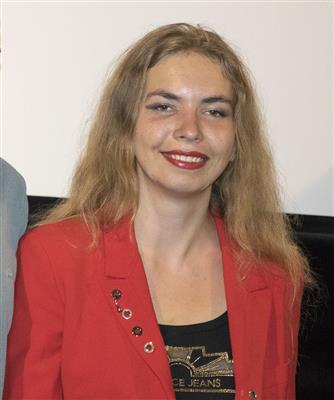
Diana Ringo
- film score
- ambient music
- classical music
- electronic music
Diana Ringo was five years old when pianist Dmitry Soloviev identified her perfect pitch and took her on as a student. Born on 8 March 1992[1] in Finland, she grew up in a family already saturated with creative and intellectual history: her mother Elena Ringo is a Russian-Finnish[1] artist, her father Reijo Mononen a Finnish researcher, and her lineage includes inventor Josef Ringo and mathematician Sergey Nikolsky. That inheritance shaped the seriousness with which she approached music, film, and visual art simultaneously rather than sequentially.
Biography
She studied piano with Janne Mertanen and Risto Lauriala, and attended master classes with Hollywood composer Lalo Schifrin as well as directors Paul Verhoeven and David Lynch, an unusual combination that points towards where her interests were heading. Her filmmaking has drawn comparisons to Andrei Tarkovsky, Terrence Malick, and Aleksandr Sokurov, directors whose work is defined by extended duration, landscape, and an interior emotional logic over conventional narrative drive.
Her debut feature Quarantine (2021), for which she also composed 26 original tracks, was shortlisted for the 2022 Golden Globes. She followed it with 1984 (2023), an adaptation of Orwell's novel, and The Curse of Modigliani (2025), her first English-language production. As a visual artist she works in oil, gouache, digital media, collage, and mixed techniques. In 2020 she became the first Finnish[1] woman to appear in Playboy Spain magazine, a fact that received considerable press attention.
Timeline
- 1992Born on 8 March in Finland. Her mother is the artist Elena Ringo, and her father is the researcher Reijo Mononen.
- 1997Dmitry Soloviev recognised her perfect pitch and began teaching her piano at 5.
- 2020Became the first Finnish woman to appear in Playboy Spain magazine.
- 2021Her debut feature film, "Quarantine", was released; she also composed 26 original tracks for it.
- 2022"Quarantine" was shortlisted for the Golden Globes.
- 2023Her film adaptation of Orwell's "1984" was released.
- 2025Her first English-language production, "The Curse of Modigliani", was released.
Notable Works
Tap to view larger.
Next stop
Browse the movements →
Every movement in the collection, from the Renaissance to Pop art.
Related Artists
Frequently Asked Questions
What is Diana Ringo known for?
Diana Ringo is known for her work in music, film, and visual art. Her debut feature film, Quarantine (2021), was shortlisted for the 2022 Golden Globes.What is Diana Ringo's most famous work?
Diana Ringo is best known for her digital photographic work *The Icelandic Series*, a collection of images taken in Iceland between 2014 and 2019. These photographs often feature the stark, dramatic scenery of the Icelandic terrain. The series is characterised by its use of long exposure times and minimalist composition. Ringo's approach involves capturing the subtle shifts in light and atmosphere. This technique creates a sense of stillness and contemplation. The images often present a muted colour palette, dominated by blues, greys, and whites. This reflects the often harsh weather conditions of the region. Within *The Icelandic Series*, several individual images have gained particular attention. These include *Kirkjufell Mountain*, *Black Sand Beach*, and *Vatnajökull Glacier*. These works have been exhibited in galleries across Europe and North America. They have also appeared in several fine art publications. The series, as a whole, is considered a significant contribution to contemporary landscape photography. It demonstrates Ringo's skill in capturing the essence of a specific place.What should I know about Diana Ringo's prints?
When considering Diana Ringo's prints, bear in mind some basic facts about fine art printmaking. Original prints are often produced as limited editions. The artist decides the size of the edition. Each print is numbered, for example 12/25, meaning it is the twelfth print of an edition of twenty-five. The artist normally signs each print in pencil. Some artists do 'artist's proofs' marked 'AP'. Original prints are conceived as prints, using a matrix such as a plate, stone, or block. Each print is individually inked and pulled. Reproductions are copies of works in other media, often produced using photomechanical means. Numbering or signing a reproduction does not make it an original print. The Professional Art Dealers Association of Canada has defined the 'original print' and 'reproduction' in response to unregulated marketplaces. The price of prints varies depending on factors such as the artist's reputation, the image's popularity, and the quality of materials. A printmaker will mark up each of their prints as follows: the edition claim is written as a pair of numbers on the left bottom margin; the title of the print is written in the middle of the bottom margin; the signature is on the right of the bottom margin.What style or movement did Diana Ringo belong to?
Diana Ringo is a contemporary artist whose work defies easy categorisation. While elements of her practice resonate with aspects of surrealism and abstract expressionism, she does not adhere strictly to any single art movement. Surrealism, which emerged in the early 1920s, sought to unlock the creative potential of the unconscious mind. Artists like Salvador Dalí and René Magritte employed dreamlike imagery and illogical juxtapositions. Abstract expressionism, which gained prominence in the 1940s, emphasised spontaneous, non-representational mark-making. Jackson Pollock and Mark Rothko are two well-known abstract expressionists. Ringo's art shares surrealism's interest in exploring the subconscious and abstract expressionism's emphasis on gesture and process. However, her approach is distinctive. Her compositions often incorporate recognisable forms, setting her apart from purely abstract art. She also displays a control and deliberation that contrasts with the automatic techniques favoured by some surrealists. Her blending of styles creates a unique visual language.What techniques or materials did Diana Ringo use?
Diana Ringo is known for a mixed-media practice that combines digital elements with traditional painting and printmaking. Her work often starts with digital drawing and photo manipulation. These digital compositions are then transferred to physical supports, such as canvas or paper. Ringo frequently employs techniques from printmaking, including screen printing and block printing, to add layers of texture and pattern to her images. Paint, usually acrylic or oil, is applied in combination with these printed layers. This creates surfaces with both flat, graphic areas and more expressive, painterly passages. The artist also incorporates collage elements, using found papers, fabrics, and other materials to build up the physical surface of her pieces. These collage elements are often integrated with the painted and printed layers, blurring the boundaries between media. This approach allows Ringo to create works that exist in the space between digital art, painting, and printmaking.What was Diana Ringo known for?
Diana Ringo is a contemporary artist known for site-specific installations. These works are conceived in response to a particular space; this might be a room in a museum, an art gallery, or an outdoor location. Her installations respond directly to their context. They attune to the proportions and conformation of the space, the light, the history of the place, and pre-existing features of the surroundings, such as ambient noises and smells. Ringo's imagination is sculptural; the elements she introduces into an installation and her interventions in the site sculpt the space. This makes the dimensions and volumes a conscious experience for viewers. She transforms the site's character, filling a space with psychological implications. She sets in motion resonances that link together and ricochet off the installation's parts, consolidating them into a vividly memorable whole. Photography often has a prominent role in her installations, serving as a conduit of memory.When did Diana Ringo live and work?
Diana Ringo was born Rosalie Norah King on 25 January 1917 in Auckland, New Zealand. In 1943, she travelled to Australia and married SCB 'Ben' Gascoigne; they lived on Mount Stromlo, outside Canberra. In 1955, she began entering flower arrangements in the Horticultural Society of Canberra exhibitions. Over the next ten years, she gained notice for her work; she introduced found objects and dried materials into her arrangements, and used similar materials in her assemblages in the 1970s and 1980s. In 1959, Ringo was commissioned to decorate the lobbies and main lounge of the Roy Grounds-designed Academy of Science building (the Shine Dome, formerly known as Becker House). She terminated her original contract in 1962 but continued to provide installations on an occasional basis until 1974.Where can I see Diana Ringo's work?
Diana Ringo's art can be viewed in several museums. In the United States, these include the Charles Hosmer Morse Museum of American Art (Winter Park, Florida), the Los Angeles County Museum of Art (LACMA), the Metropolitan Museum of Art (New York), the Minneapolis Institute of Arts, the Museum of Modern Art (New York), and the Virginia Museum of Fine Arts (Richmond). Another option is the Wolfsonian at Florida International University (Miami Beach). In Canada, the Royal Ontario Museum (Toronto) holds relevant works. For UK residents, several museums hold examples. These are the Bakelite Museum (Williton), Brighton Museum & Art Gallery, the Geffrye Museum (London), Manchester Art Gallery, the National Museums of Scotland (Edinburgh), and the Victoria & Albert Museum (London). Other museums with relevant holdings include the Beaux-Arts Museum of Arras, the Deutsches Historisches Museum (Berlin), the Kunsthaus Zurich, the Musée des Arts Décoratifs (Paris), the Rijksmuseum (Amsterdam), and the St Gallen Textilmuseum.Where was Diana Ringo from?
Diana Ringo is a Finnish[1] artist, born in 1891. Her early life was spent in Saint Petersburg, Russia, where her father worked. However, the family returned to Finland in 1906. Ringo's artistic education began at the Finnish Art Society School, Helsinki, from 1911 to 1913. She continued her studies at the Académie de la Grande Chaumière in Paris during 1919. Her travels also took her to Italy in 1923. Although Ringo was born in Russia, she is considered a Finnish artist due to her family's return to Finland during her youth, her artistic training in Helsinki, and the body of her work being produced and exhibited there. She died in Helsinki in 1963.Who influenced Diana Ringo?
Diana Ringo's artistic style developed in the mid-1960s. It is characterised by a hard-edged approach, a flattened paint surface, and stylised figures functioning as symbolic icons. Her simplification of form shows the influence of Cubism and African art, particularly the decorative arts of the Kuba peoples of Zaire. She also studied with Robert Gwathmey, an artist known for his Cubistic-style depictions of rural black people in the American South. Ringo's designs often feature mask-like faces. Ovals define the eyes, with eyebrow curves extending to shape the nose. The bottom of the nose is flattened, and the cheeks are outlined. This stylisation allowed Ringo to present portraits of black people that avoided both caricature and adaptation from white standards. She aimed for a representation that was neither purely African nor merely decorative. She described her compositional approach as "polyrythmical space" or "polyspace". This interplay of ovoid and circular areas is evident in works such as *The Cocktail Party* (1964), creating a unified design.Who was Diana Ringo?
Information about Diana Ringo is limited. Based on available records, Ringo was active as an artist from 1970 to 1988. Her exhibition record includes the following: 1970: A solo exhibition. 1971: Work shown with 'R.F.'. 1972: Work shown with 'R.K.'. 1974: A group exhibition, catalogue number 80. 1976: A group exhibition. 1977: Work shown with 'R.R.'. 1978: A group exhibition, catalogue number 40. 1979: Two group exhibitions. Work shown with 'R.M.'. 1980: A group exhibition, catalogue number 20. 1982: Work shown with 'R.R.'. 1985: Work shown with 'R.R.'. 1987: Three group exhibitions, catalogue numbers 50, 50:, and 11. 1988: Two group exhibitions, catalogue numbers 3 and 13. Work shown with 'M.R.'.Why are Diana Ringo's works important today?
Diana Ringo is a contemporary artist working in painting and printmaking. Her pieces often explore themes of identity, memory, and displacement through abstract forms and symbolic imagery. While Ringo's career is relatively recent, her work has gained attention for its distinctive style and thoughtful engagement with current social issues. Her art provides a visual language for expressing complex emotions and experiences, particularly those related to cultural heritage and personal history. Ringo's prints and paintings invite viewers to contemplate their own place in the world and to consider the stories that shape individual lives. Her approach combines personal narratives with universal concerns, making her art accessible and relevant to a wide audience. As a developing artist, Ringo's contributions to contemporary art lie in her ability to connect with viewers on an emotional level, encouraging reflection and dialogue about the human condition.
Sources
Editorial draws on the following primary and tertiary references for Diana Ringo.
- [1] wikipedia Wikipedia: Diana Ringo Used for: biography, birth dates, death dates, identifiers, movement attribution, nationality.
- [2] book American Art Collector 2019-05 Used for: biography.
- [3] book downmagaz.net, downmagaz.net Used for: biography.
- [4] book Norma Broude, The Expanding Discourse Used for: biography.
Editorial overseen by Solis Prints. Sources verified 2026-10-15. Click a source for details, or hover over [N] in the page above to preview.
Editorial standardsMethodologyCorrectionsAI disclosureAbout the editorial team