

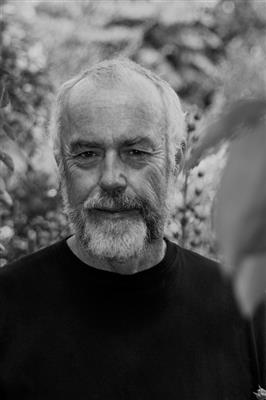
Daniel Dezeuze
Before he became a painter, Daniel Dezeuze completed a doctorate in Comparative Literature at the Sorbonne in 1970. The detour through language proved formative: his art would spend the next five decades asking what painting actually is once you strip away the canvas, the stretcher, and the frame.
Biography
Born in 1942[1] in Alès in the Gard, Dezeuze studied Spanish literature in Montpellier and spent extended periods in Spain, Mexico and Canada before settling in Paris. In 1966 he was among the founders of Supports/Surfaces, the French[1] group that set out to deconstruct painting by examining each of its physical components in isolation. Where American minimalism stripped art of emotion, Supports/Surfaces stripped it of its infrastructure, and Dezeuze was among the most rigorous practitioners.
His flexible wooden ladders of the 1970s are among the movement's defining objects: painting reduced to its skeletal support, leaning against gallery walls with no image to carry. He went on to work in gauze, polyethylene and found objects, making pieces whose physical lightness matched a growing conceptual playfulness. Later series include his Peintures qui perlent, painted wooden cubes and beads fixed to rigid frameworks, and works he groups under Arms, Gathering Devices and Receptacles, a category concerned less with painting's anatomy than with humanity's oldest tool-making instincts.
A 2017 retrospective at the Musée de Grenoble surveyed the full range of this career. His work is held at the Carré d'Art in Nîmes and the Musée Paul Valéry in Sète, among other public collections.
Timeline
- 1942Born in Alès in the Gard, France.
- 1966Became a founder of Supports/Surfaces, a French group focused on deconstructing painting.
- 1970Completed a doctorate in Comparative Literature at the Sorbonne in Paris.
- 1970Created flexible wooden ladders, reducing painting to its skeletal support.
- 1970Began working in gauze, polyethylene and found objects.
- 2017A retrospective exhibition of his work was held at the Musée de Grenoble.
Notable Works
Tap to view larger.
Next stop
Browse the movements →
Every movement in the collection, from the Renaissance to Pop art.
Related Artists



Frequently Asked Questions
What is Daniel Dezeuze known for?
Daniel Dezeuze is known for deconstructing painting by examining its physical components in isolation. His flexible wooden ladders from the 1970s are among the defining objects of the Supports/Surfaces movement.What is Daniel Dezeuze's most famous work?
It is difficult to name Daniel Dezeuze's single 'most famous work'. He is best known as a member of the Supports/Surfaces group of French[1] artists, who questioned the nature of painting in the late 1960s and early 1970s. Dezeuze's works from this period often involved deconstructing the traditional canvas. He created pieces using simple materials such as wood, netting, and fabric. These were often displayed unstretched or unframed. This approach challenged the commercialisation of art and questioned the illusionistic nature of painting. His work aimed to expose the structural components of art, rather than creating an illusion. Later, Dezeuze explored other media, including watercolour and drawing, and incorporated representational elements into his art.What should I know about Daniel Dezeuze's prints?
Daniel Dezeuze is associated with the Supports/Surfaces group of French[1] artists, active in the late 1960s and early 1970s. The group questioned traditional artistic conventions. In general, prints are considered original when the artist creates the master image, oversees the printing, and approves the finished product. Each print in a numbered edition is considered an original, individually inked and pulled from the matrix (plate, stone, screen, or block). The artist determines the edition size, and numbering accounts for all prints (for example, 12/25 means it is print number 12 from an edition of 25). However, the definition of an original print can be ambiguous. The market considers individual execution to be the most important criterion for originality. Some variation is acceptable in prints, so long as the principle of originality is protected. Many well-known photographers do not print their own photographs; however, a signature acknowledges the work conforms to their idea.What style or movement did Daniel Dezeuze belong to?
Daniel Dezeuze is associated with the Supports/Surfaces group, which emerged in France during the late 1960s. This movement questioned the fundamental conventions of painting. Rejecting traditional easel painting, Supports/Surfaces artists deconstructed the components of a painting: the support (canvas), the stretcher, and the surface. They separated these elements and experimented with them individually. Dezeuze, for example, worked with simple materials such as wooden frames, netting, and fabric. The group's activities coincided with a period of social and political upheaval in France, including the events of May 1968. Supports/Surfaces shared a critical stance towards established institutions and traditional artistic practices. Their work can be seen as a form of artistic and political activism, challenging the commercialisation and commodification of art. While the group was active for a relatively short time (roughly 1969-1972[1]), it had a significant impact on the development of contemporary art in France and beyond. Supports/Surfaces contributed to a broader re-evaluation of the nature of painting and its relationship to the social and political context.What techniques or materials did Daniel Dezeuze use?
Daniel Dezeuze is associated with the Supports/Surfaces group, and his practice often involves a deconstruction of traditional painting. Rather than using canvas stretched on a frame, he often employs simple, industrial materials. Dezeuze's work frequently incorporates elements such as wooden stretchers, mesh, and cloth. These materials are sometimes combined with simple processes; for instance, folding, crumpling, or staining. His methods draw attention to the physical properties of the materials themselves, rather than creating an illusionistic image. Technique, for many modern painters, is more than just a method of execution. It involves the artist's intentions and a recognition of the physical constraints of the medium. Dezeuze's choices reflect a desire to move away from traditional painting techniques and explore the essential components of the art object. By using non-traditional materials and simple processes, Dezeuze challenges conventional notions of painting and its construction.When did Daniel Dezeuze live and work?
Daniel Dezeuze is a French[1] artist born in 1942[1] in Nîmes. He is associated with the Supports/Surfaces group, which emerged in France during the late 1960s. Dezeuze studied at the École des Beaux-Arts in Montpellier from 1962 to 1964. He then moved to Paris. There, he continued his studies at the École Nationale Supérieure des Beaux-Arts until 1967. His early work involved the use of simple materials. These included canvas, wood, and netting. Dezeuze explored the basic elements of painting and sculpture. He questioned traditional artistic conventions. His practice often involved deconstructing the art object. Dezeuze continues to live and work in France. His work has been exhibited internationally. It remains relevant to discussions about the nature of art and its relationship to society.Where can I see Daniel Dezeuze's work?
Daniel Dezeuze's work has been featured in numerous exhibitions, primarily in France. In 1980, his art was part of the "Ateliers 81" exhibition at the Musée d'Art Moderne de la Ville de Paris. The museum hosted his work again in 1983, as part of "True et troc, leçons de choses". Dezeuze had one-man shows at Galerie Farideh Cadot, Paris, in 1981, 1983, and 1985. His art was the subject of a solo exhibition at the Musée de Toulon (December 1982 to January 1983). His pieces have appeared in group shows such as the 1984 "French[1] Spirit Today" (Fisher Art Gallery, University of Southern California, Los Angeles, then the Museum of Contemporary Art, La Jolla, California) and the 1985 "Manipulated Reality: Image and Object in New French Sculpture" (Frederick S. Wight Art Gallery, University of California, Los Angeles). Also in 1985, his work was included in "Soyons sérieux" at the Espace Lyonnais d'Art Contemporain, Lyon. These are selected examples; more exhibition details are available in museum catalogues and art publications.Where was Daniel Dezeuze from?
Daniel Dezeuze is a French[1] artist. He was born in 1942[1] in Alès, a town in the Gard department of southern France. Dezeuze is associated with the Supports/Surfaces group. This was a French art movement active from 1966 to 1972. Other artists linked to the group include Louis Cane, Marc Devade, Noël Dolla, and Claude Viallat. Their work questioned the fundamental conventions of painting. They moved away from traditional canvas supports. They experimented with materials and techniques. Dezeuze's art often incorporates simple, everyday materials. These include things such as wood, fabric, and netting. His work frequently involves deconstruction and rearrangement. He challenges traditional ideas about art and its creation. He continues to live and work in France.Who did Daniel Dezeuze influence?
Daniel Dezeuze is associated with the Supports/Surfaces group, active in France from 1969 to 1972. This group questioned the nature and function of painting, moving away from traditional easel painting. Their experimental methods included using non-traditional materials and exploring the physical properties of the canvas itself. Identifying direct individual influence is difficult, but Dezeuze's approach to deconstructed painting and his emphasis on materials resonated with other artists exploring similar ideas in the late 20th century. His work contributed to a broader shift in art towards process-based and conceptual practices. Artists associated with Arte Povera in Italy, for example, shared an interest in humble materials and a rejection of traditional artistic conventions. Dezeuze's influence is thus best understood as part of a wider international movement that questioned the established norms of painting and sculpture.Who influenced Daniel Dezeuze?
The question of artistic influence was a live issue in the mid-19th century. Writers and artists struggled with the idea that originality was next to impossible; as one writer put it, 'The imitator’s imitator finds his own imitators.' Some theorists claimed that true artists were never influenced, and that 'all flourishing is spontaneous, individual'. However, others took a more practical approach. In Balzac’s *Lost Illusions*, a character named Daniel advises an aspiring novelist, Lucien, who is imitating Walter Scott. Daniel suggests that Lucien develop his own individual style, rather than simply copying Scott. He goes on to disparage Scott, claiming that Scott’s heroines all derive from Samuel Richardson’s Clarissa Harlowe. Lucien then responds to Daniel's warning against copying Scott by copying Daniel instead. In this way, originality can define itself as the unique intersection of multiple influences, a combination that one artist alone can accomplish.Who was Daniel Dezeuze?
Daniel Dezeuze (born 1942[1]) is a French[1] artist associated with the Supports/Surfaces group. This artistic movement emerged in France during the late 1960s. Dezeuze studied at the École Nationale Supérieure des Beaux-Arts in Paris. He is known for his rejection of traditional painting techniques. Instead, he explored the basic elements of art: the support (the canvas) and the surface (the paint). His early works often involved deconstructing the canvas, removing it from the stretcher, and working directly with the raw material. Dezeuze's practice included using simple materials such as fabric, wood, and netting. He often employed techniques such as folding, cutting, and staining. His goal was to challenge the conventions of painting and to question the role of the artist. Supports/Surfaces questioned the commercialisation of art and the established art world. The group exhibited together from 1969 to 1972, promoting a radical approach to art making. Dezeuze continues to exhibit his work internationally.Why are Daniel Dezeuze's works important today?
Daniel Dezeuze came to attention as part of the Supports/Surfaces group in France during the late 1960s and early 1970s. This collective questioned the nature and function of painting, moving away from traditional canvas and exploring materials like fabric, netting, and simple frames. Dezeuze's work is significant because it challenges conventional ideas about art. He deconstructs painting to its basic elements, examining the support structure and surface. His pieces often feature raw, un stretched canvas or simple constructions, which invite viewers to consider the physical properties of the artwork itself. This approach connects to broader discussions about the art object and its relationship to the gallery space. His practice also relates to conceptual art movements that question artistic conventions. By stripping away ornamentation and focusing on essential forms, Dezeuze prompts reflection on the definition and value of art. His work remains relevant in contemporary discussions about minimalism, post-structuralism, and the ongoing evolution of artistic media.
Sources
Editorial draws on the following primary and tertiary references for Daniel Dezeuze.
- [1] wikipedia Wikipedia: Daniel Dezeuze Used for: biography, birth dates, death dates, identifiers, movement attribution, nationality.
- [2] book Aubert, Nathalie; Fraiture, Pierre-Philippe; McGuiness, Patrick, From Art Nouveau to Surrealism Used for: stylistic analysis.
- [3] book guggenheim-anglesofvisionfr00denn Used for: biography.
- [4] book guggenheim-emergingartists100wald Used for: biography.
- [5] book guggenheim-twopri00weis Used for: biography, stylistic analysis.
- [6] book Post-impressionism : cross-currents in European painting Used for: biography.
- [7] book Post-impressionism : cross-currents in European painting Used for: biography.
Editorial overseen by Solis Prints. Sources verified 2026-08-29. Click a source for details, or hover over [N] in the page above to preview.
Editorial standardsMethodologyCorrectionsAI disclosureAbout the editorial team