

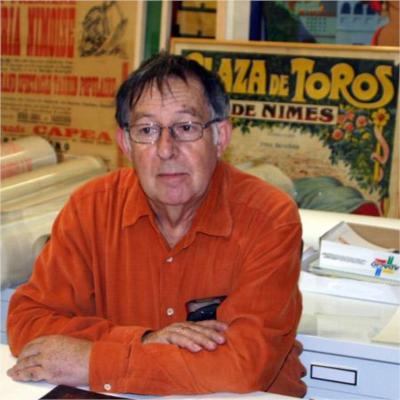
Claude Viallat
Claude Viallat arrived at his signature motif almost accidentally and then spent the next half-century repeating it. The form is a kind of elongated bone or bean shape, applied by stamp or stencil to raw, unstretched canvas, dyed rope, fishing nets, tent fabric, anything but a standard prepared ground. Born in Nîmes in 1936[1] and trained at the École des Beaux-Arts in Montpellier and then Paris, Viallat became a founding voice of the Supports/Surfaces movement, the French[1] post-1968 avant-garde that demanded painting examine its own physical conditions rather than sustain illusions.
Biography
Supports/Surfaces was never a manifesto organisation so much as a loose convergence of positions, underwritten by French[1] Marxist-materialist theory and the writing of critics such as Marcelin Pleynet. What united the group was a refusal of the easel painting convention: no stretcher, no priming, no deliberate composition. Viallat took this further than most, dyeing canvas with a process closer to textile production than traditional painting, then leaving it to bleach in the sun or deteriorate in the rain. Works like Détérioration (1972) and Solarisation (1972) title themselves after natural processes the artist set in motion but could not control.
His first solo show was at Galerie A in Nice in 1966; the pivotal Support-Surface exhibition at the ARC/Musée d'Art Moderne de la Ville de Paris in 1970 brought the movement international attention. Throughout, the repeated bean motif served a clear function: identical form deployed across infinitely varying surfaces made the support, not the mark, the point of comparison.
Viallat has continued working in this vein for decades, producing polychrome quadriptychs, dyed rope installations, and large-scale fabric works that remain consistent in their material directness.
Timeline
- 1936Born in Nîmes.
- 1966Had his first solo show at Galerie A in Nice.
- 1968Became a founding voice of the Supports/Surfaces movement in France.
- 1970Participated in the Support-Surface exhibition at the ARC/Musée d'Art Moderne de la Ville de Paris, bringing the movement international attention.
- 1972Created works such as "Détérioration" and "Solarisation", using natural processes to affect the canvas.
Next stop
Browse the movements →
Every movement in the collection, from the Renaissance to Pop art.
Related Artists



Frequently Asked Questions
What is Claude Viallat known for?
Claude Viallat is known for his signature motif, a kind of elongated bone or bean shape. He applied this form by stamp or stencil to raw, unstretched canvas, dyed rope, fishing nets, and tent fabric.What is Claude Viallat's most famous work?
Claude Viallat, born in Nimes in 1936[1], is associated with the Supports/Surfaces group. This movement questioned traditional approaches to painting. Viallat studied at the Beaux-Arts in both Montpellier and Paris. While it is difficult to name one single most famous work, several pieces from the early 1970s are well documented. These include "Repetition de formes"-jaune or sur blanc, "Deperdition"-triptych gris sur toile blanche, and Polychromed Quadryptich, all from 1971. These works employed dye on canvas or stained canvas techniques. Also of note are "Deterioration" (1972), a dyed canvas intentionally exposed to rain, and "Solorisation" (1972), a canvas discoloured by the sun. These pieces demonstrate Viallat's interest in the effects of natural processes on his art. His work has been exhibited extensively, including solo shows at Galerie Jean Fournier in Paris and inclusion in the VI and VII Biennales de Paris.What should I know about Claude Viallat's prints?
Claude Viallat is known for prints that explore colour and form, often using stencils and repeated motifs. His approach aligns with contemporary printmaking traditions, where the artist's choice determines the edition size, not technical limitations. Usually, printmakers limit their editions, and this practice is upheld by conventions within the art world. These conventions aren't legally enforced but are subject to trade description laws, requiring accurate representation of the artwork. If a print is sold commercially, the description must be truthful. Typically, an artist numbers each print, indicating its place within the total edition. This is usually written on the bottom left margin of the print. The artist also titles the work in the centre and signs on the right. These markings are done in pencil. Some of his prints include lithographs and screenprints (also known as serigraphs), demonstrating a range of printmaking techniques.What style or movement did Claude Viallat belong to?
Claude Viallat is associated with the Supports/Surfaces group, which emerged in France during the late 1960s and continued into the 1970s. This movement questioned traditional approaches to painting. Supports/Surfaces artists deconstructed the conventional understanding of a painting. They analysed its basic components, such as the canvas (the support) and the applied materials (the surfaces). Viallat's work, in particular, often involved staining or printing simple shapes onto un-stretched canvas. He eliminated the idea of a central image. The group rejected the illusionistic space of traditional easel painting. They favoured a more direct and material approach. Their work often incorporated industrial materials and processes. The movement was linked to post-structuralist theory and a critique of institutional structures within the art world. Supports/Surfaces aimed to create a more open and democratic form of art, moving away from established conventions.What techniques or materials did Claude Viallat use?
Claude Viallat is associated with Supports/Surfaces, a French[1] art movement that questioned traditional painting techniques. Viallat often worked with unstretched canvas, freeing his practice from the constraints of the frame. Rather than preparing the canvas in a conventional manner, Viallat allowed the material to soak up the paint. This approach made the canvas absorb the priming, rather than simply acting as its support. Viallat is known for using a limited range of colours, sometimes restricting his palette to red, white, blue and black. He also incorporated non-art materials into his work; this was a fundamental characteristic of Art Brut. These "materials of fortune" could include leaves, volcanic stone, pumice, cement, sea-shells, leather, string, bread, vegetable peels, coal and glass shards. Tools might range from a spoon handle to a ball-point pen, and supports could be the wood panelling of a room, wrapping paper, blotting paper or fabrics.What was Claude Viallat known for?
Claude Viallat, born in Nimes in 1936[1], is known for his association with the Supports/Surfaces group, which emerged in France during the late 1960s. He studied at Beaux-Arts in Montpellier and later in Paris, from 1955 to 1958. Viallat's work often involves the use of simple, repeated forms and the exploration of colour on un-stretched canvas. His pieces from the early 1970s, such as "Repetition de formes" (1971) and "Deperdition" (1971), exemplify his approach to applying dye to canvas. He also experimented with materials like polychromed ropes, as seen in his 1971-72 works. Viallat's art examines the fundamental elements of painting, challenging traditional notions of composition and presentation. He had one-man exhibitions at Galerie A, Nice, in 1966 and at Galerie Jean Fournier, Paris, in 1968 and 1971. He participated in group exhibitions such as Impact in 1966 at Musee Municipal d'Art Moderne, Ceret, and Sigma in 1969 at Galerie des Beaux-Arts, Bordeaux.When did Claude Viallat live and work?
Claude Viallat was born in Nîmes, France, on 18 March 1936[1]. He is associated with the Supports/Surfaces group. Viallat studied at the École des Beaux-Arts in Montpellier from 1955 to 1959. Afterwards, he attended the École des Beaux-Arts in Paris in 1962 and 1963. He later taught at the École des Beaux-Arts in Nice and then at Nîmes. His work developed away from conventional painting. In 1966, he began working without the stretcher, which allowed him to fold, crumple, and stain the canvas. He developed a non-figurative, all-over style, using a stencil-like form that is sometimes described as resembling the shape of a bone or a net. He has continued to exhibit regularly in France and internationally.Where can I see Claude Viallat's work?
You can view Claude Viallat's work in various locations. Several museums in Paris hold his pieces, including the Musée National d’Art Moderne, Centre Georges Pompidou, Musée d’Orsay, Musée du Louvre, and Musée d’Art Moderne de la Ville de Paris. Other French[1] museums with his work include the Musée d’Art Moderne et Contemporain in Strasbourg, and the Château la Coste Art Centre in Provence. You can also find his pieces in the collections of the Musée des Beaux-Arts in Nantes; Musée Fabre in Montpellier; and Musée National Fernand Léger in Biot. These museums feature a range of art, and checking their current exhibitions or catalogues may help you locate Viallat's work when planning a visit.Where was Claude Viallat from?
Claude Viallat was born in Nîmes, France, in 1936[1]. He received his artistic training at the Beaux-Arts in Montpellier, and later at the Beaux-Arts in Paris in 1958. Viallat's early exhibitions included a one-man show at Galerie A, Nice, in 1966, followed by another at Galerie Jean Fournier, Paris, in 1968. His work was also featured in group exhibitions, such as 'Impact' at the Musée Municipal d'Art Moderne, Céret, France, in 1966, and 'Sigma' at the Galerie des Beaux-Arts, Bordeaux, in 1969. Viallat participated in the VI Biennale de Paris in 1969, and in 1970, his art was part of 'Support-Surface' at the ARC, Musée d'Art Moderne de la Ville de Paris. His pieces, often dye on canvas, were displayed at Galerie Jean Fournier, Paris, and the Grand Palais, Paris, during the early 1970s.Who did Claude Viallat influence?
Claude Viallat, born in Nîmes in 1936[1], is associated with the Supports/Surfaces group, which sought to move away from traditional easel painting. His practice of using unprimed canvases and colour-impregnated fabric supports aimed to subvert established artistic norms. Viallat himself acknowledged the influence of Henri Matisse. He cited Matisse's paper cut-out, *La Vague*, as a key prototype. In *La Vague*, the figure and ground are reversible; Viallat saw this as a model for designing with voids or gaps, rather than solid forms. Beyond his own artistic output, Viallat's theories and methods likely affected other artists associated with Supports/Surfaces. The group emerged in the late 1960s, so any influence would be seen from the 1970s onward.Who influenced Claude Viallat?
Claude Viallat's influences included various figures and movements. Soto mentioned Mondrian, Malevich, Klee, and Albers as important to him. Soto wanted to bring movement to Mondrian's works but realised Mondrian had resolved that issue already with *Broadway Boogie-Woogie*. Moholy-Nagy was also significant, though Soto thought his work was incomplete due to his early death. Soto also found inspiration in Calder, Marcel Duchamp, and Gabo, using their released elements to construct his own world and attempt to answer the questions they posed. Though he admired Rothko's seriousness, he preferred Barnett Newman's nonhierarchical structures and nonrelational colour field painting, which he found less pretty. Soto acknowledged the influence of music on pictorial creativity since the nineteenth century, a connection shared by Rothko.Why are Claude Viallat's works important today?
Claude Viallat, born in Nîmes in 1936[1], is associated with the Support/Surface movement in France. This short-lived, yet influential, group of artists, active from 1969 to 1972, questioned traditional painting practices. Viallat, along with artists like Louis Cane and Daniel Dezeuze, explored the fundamental elements of art. The Support/Surface artists moved away from stretched canvases, illusion, and staging. Instead, they focused on the materials and processes of creation. Viallat's works often feature repeated shapes and colours on unstretched canvases or other supports. Some critics have noted a connection between Viallat's work and structuralist ideas that were current in Paris at the time. An interview with Viallat in Beaux-Arts Magazine (1988) discusses his "Matissean" approach. He founded Support/Surface to subvert easel painting traditions, creating colour-impregnated works on various unprimed fabrics. Viallat has spoken of Matisse’s paper cut-out work La Vague, where figure and ground are reversible, as an important prototype. His works design by voids or gaps, rather than positive forms.
Sources
Editorial draws on the following primary and tertiary references for Claude Viallat.
- [1] wikipedia Wikipedia: Claude Viallat Used for: biography, birth dates, death dates, identifiers, movement attribution, nationality.
- [2] book Bock Weiss, Catherine C.(Author), Artist Resource Manuals : Henri Matisse : A Guide to Research Used for: stylistic analysis.
- [3] book guggenheim-amsterdamparisdu00solo Used for: biography, stylistic analysis.
- [4] book guggenheim-anglesofvisionfr00denn Used for: biography.
- [5] book guggenheim-invested00blis Used for: biography.
- [6] book Nathalia Brodskaya, The Fauves Used for: biography, stylistic analysis.
Editorial overseen by Solis Prints. Sources verified 2026-09-30. Click a source for details, or hover over [N] in the page above to preview.
Editorial standardsMethodologyCorrectionsAI disclosureAbout the editorial team