



Dan Witz
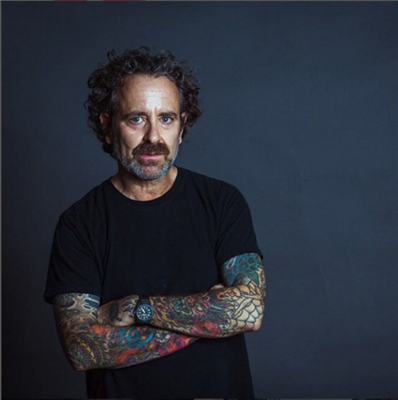
Few artists can claim to have invented a genre, but Dan Witz has a reasonable case. In the late 1970s, while still a student at Cooper Union in New York, he began pasting small, precisely painted hummingbird images onto walls across the Lower East Side. There was no category for what he was doing: street art as a distinct practice did not yet exist. He was simply treating the city as an extension of his studio, years before anyone thought to give it a name.
Biography
Born in Chicago in 1957[1], Witz studied at the Rhode Island School of Design before completing a BFA at Cooper Union in 1980. He developed a parallel practice from the start, illegal paste-ups on the street and painstaking realist oil paintings in the studio, and maintained both for decades. His studio work in the 1990s focused on mosh pits and hardcore concert crowds: dense, physically compressed figures caught in states of abandon, painted with the same meticulous attention he brought to his outdoor work.
In the 2000s his street practice shifted toward trompe-l'oeil optical interventions. Working with layered prints and painted additions, he created false recessed windows and doorways in sealed urban walls, each containing a figure glimpsed behind bars or through glass. The illusion holds at a glance and breaks only on close inspection. The caged and imprisoned figures that populate these pieces were an explicit commentary on mass incarceration, asking whether people pass by the suffering embedded in plain sight without stopping to look.
His 2010 monograph *In Plain View: 30 Years of Artworks Illegal and Otherwise* (Gingko Press) documented the full arc of the work. That same year he appeared in Banksy's documentary *Exit Through the Gift Shop*. He has received fellowships from the New York Foundation for the Arts (1992, 2000) and a National Endowment for the Arts grant in 1983. He lives and works in Brooklyn.
Timeline
- 1957Born in Chicago.
- 1980Completed a BFA at Cooper Union in New York.
- 1983Received a National Endowment for the Arts grant.
- 1992Received a fellowship from the New York Foundation for the Arts.
- 2000Received a fellowship from the New York Foundation for the Arts.
- 2010His monograph *In Plain View: 30 Years of Artworks Illegal and Otherwise* was published.
- 2010Appeared in Banksy's documentary *Exit Through the Gift Shop*.
Notable Works
Tap to view larger.
Next stop
Browse the movements →
Every movement in the collection, from the Renaissance to Pop art.
Related Artists
_%E2%80%93_LOC.jpg)


Frequently Asked Questions
What is Dan Witz known for?
Dan Witz is known for his early street art and his trompe-l'oeil optical interventions. His street practice began in the late 1970s, and in the 2000s, he shifted toward creating false recessed windows and doorways in urban walls. These pieces often contained figures glimpsed behind bars or through glass, commenting on mass incarceration.Who was Dan Witz?
Dan Witz is an artist who began pasting small, precisely painted hummingbird images onto walls across the Lower East Side in the late 1970s. He studied at the Rhode Island School of Design before completing a BFA at Cooper Union in 1980. He lives and works in Brooklyn.What was Dan Witz's art style?
Dan Witz's art style includes both illegal paste-ups on the street and painstaking realist oil paintings in the studio. In the 1990s, his studio work focused on mosh pits and hardcore concert crowds, painted with meticulous attention. His street work in the 2000s involved trompe-l'oeil optical interventions using layered prints and painted additions.When was Dan Witz born?
Dan Witz was born in 1957[1].
Sources
Editorial draws on the following primary and tertiary references for Dan Witz.
- [1] wikipedia Wikipedia: Dan Witz Used for: biography, birth dates, death dates, identifiers, movement attribution, nationality.
- [2] book Ansel Adams; Beaumont Newhall; Nancy Newhall; Louise Dahl-Wolfe; Aaron Siskind; Richard Avedon; Harry Callahan; Lee Friedlander; Tina Modotti; W. Eugene Smith; Paul Strand; Edward Weston; Garry Winogrand; Amy Rule, Ansel Adams; Beaumont Newhall; Nancy Newhall; Louise Dahl-Wolfe; Aaron Siskind; Richard Avedon; Harry Callahan; Lee Friedlander; Tina Modotti; W. Eugene Smith; Paul Strand; Edward Weston; Garry Winogrand; Amy Rule - Original sources _ art and ar Used for: biography, stylistic analysis.
- [3] book Nicolas Lampert, A People’s Art History of the United States_ 250 Years of Activist Art and Artists Working in Social Justice Movements (New Press People's History) Used for: biography, stylistic analysis.
- [4] book guggenheim-emergingartists100wald Used for: biography.
- [5] book guggenheim-newhorizonsiname00denn Used for: biography.
- [6] book guggenheim-nineyoungartists00solo Used for: biography.
- [7] book Cuttler, Charles D, Northern painting from Pucelle to Bruegel: fourteenth, fifteenth, and sixteenth centuries Used for: biography.
- [8] book The Editors of New York Magazine, The Encyclopedia of New York Used for: stylistic analysis.
Editorial overseen by Solis Prints. Sources verified 2026-10-16. Click a source for details, or hover over [N] in the page above to preview.
Editorial standardsMethodologyCorrectionsAI disclosureAbout the editorial team