



Colette Pope Heldner
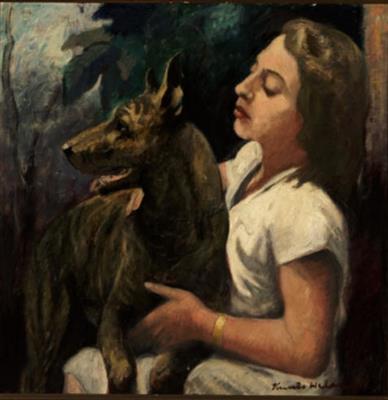
Dorothy Colette Pope was born in Waupaca, Wisconsin in 1902[1] and moved to Minnesota to study painting, where she met her instructor Knute Heldner. She married him, took his name, and in 1923[1] the couple relocated to New Orleans, a city whose French Quarter, bayous, and moss-draped courtyards would define the subject matter of her painting career.
Biography
The Heldners arrived during a period of unusual artistic energy in New Orleans. The informal grouping of painters now known as the French Quarter School was drawn to the city's historical atmosphere and particularities of southern light: narrow streets, ironwork balconies, the slow water of the bayous. Colette Heldner's landscapes and street scenes sit squarely within the American[1] Impressionist tradition, characterised by soft tonal shifts and attention to atmospheric colour rather than topographical precision. She and Knute were active participants in the New Orleans art scene for decades, occasionally making trips to Paris.
Her place within the broader American[1] Impressionist canon received formal recognition in 2005, when her work was included in the Morris Museum of Art's exhibition "In a New Light: America's Brush with Impressionism" in Augusta, Georgia. It was a fitting retrospective context for a painter whose career had unfolded largely outside the major metropolitan art markets of New York and Chicago, rooted instead in the regional particularity of Louisiana.
She died in New Orleans in May 1990[1], aged 87, having spent more than six decades painting the city that had adopted her.
Timeline
- 1902Born Dorothy Colette Pope in Waupaca, Wisconsin.
- 1923Relocated to New Orleans with her husband, Knute Heldner, at 21.
- 1923Began painting scenes of the French Quarter, bayous, and courtyards of New Orleans at 21.
- 1990Died in New Orleans at 87, after a long painting career.
Notable Works
Tap to view larger.
Next stop
Browse the movements →
Every movement in the collection, from the Renaissance to Pop art.
Related Artists
_%E2%80%93_LOC.jpg)



Frequently Asked Questions
What is Colette Pope Heldner known for?
Colette Pope Heldner is known for her paintings of New Orleans, particularly scenes of the French Quarter, bayous, and moss-draped courtyards.What is Colette Pope Heldner's most famous work?
Colette Pope Heldner is best known for her paintings of the bayous and people of Louisiana. Although she produced a variety of works throughout her career, her depictions of the 'Bonne Femme' (Cajun woman) became her signature style. Heldner's 'Bonne Femme' paintings often feature older Cajun women, typically wearing traditional clothing and set against the backdrop of the Louisiana wetlands. These works are characterised by their focus on the faces and figures of her subjects, and the use of colour to capture the atmosphere of the bayou. Her interest in the subject matter began after she moved to New Orleans in the 1930s with her husband, artist Knute Heldner. The couple travelled extensively through the region, and Colette became fascinated by the local culture and environment. She saw the beauty in the everyday lives of the Cajun people, and she wanted to capture that on canvas. Her 'Bonne Femme' paintings are celebrated for their honest and sympathetic portrayal of these women, and for their contribution to the preservation of Cajun culture.What should I know about Colette Pope Heldner's prints?
Colette Pope Heldner (1902[1]-1990[1]) was an American[1] artist, born in Buhl, Idaho. She is best known for her depictions of Louisiana, particularly the bayous and the culture around New Orleans. Heldner studied at the Minneapolis School of Art. She then travelled to Europe in the 1920s, where she studied further in Paris and Munich. In 1924[1], she married artist Knute Heldner. They moved to New Orleans in 1934. There, she found her characteristic subject matter: the landscape and people of the Louisiana bayou. She became known for her paintings of the 'swamp women' of Louisiana. These works often portray women working or relaxing in the bayou environment. Prints of Heldner's work offer an accessible way to appreciate her vision. Her paintings capture the atmosphere of the Louisiana wetlands. They also provide a glimpse into the lives of its inhabitants. Her work is collected both by individuals and institutions. Examples can be found in the New Orleans Museum of Art and the Louisiana State Museum.What style or movement did Colette Pope Heldner belong to?
It is difficult to assign Colette Pope Heldner to a single movement. Some classify her as an Expressionist, on account of her subjective and emotional responses to her subjects. Others consider her a Modernist, because she broke from academic tradition. Expressionism originated in the early 20th century. It is characterised by the desire to present the world from a subjective perspective, distorting it radically for emotional effect and to evoke moods or ideas. Modernism is a broader category, and can include artists from the late 19th to the late 20th century, who experimented with new subjects and new ways of seeing. Modernists often explored abstraction and new media while questioning traditional values.What techniques or materials did Colette Pope Heldner use?
Oil-based pencils produce generous colour and sharpen nicely. They can be harder to apply but are manageable when establishing colour and building layers. Water-soluble pencils have wax-based or oil-based cores, which allow for a watercolour effect. They can be used dry like a traditional coloured pencil, or water can be applied to create a looser, flowing effect, which is especially nice for slightly blurred backgrounds. When selecting pastels, it is important to understand the different qualities of each type of pastel. There are three main types: soft, hard, and pastel pencils. Beginners should collect a large assortment of artist’s-quality soft pastels (70 or more) and a smaller selection of hard pastels. Smooth Bristol paper is a hot-pressed paper that accepts many layers of colour. It allows you to build up your colours with a lot of layering and burnishing, which involves using strong pressure to create a polished, painterly surface.When did Colette Pope Heldner live and work?
Colette Pope Heldner was born in New Orleans in 1902[1]. She is known for her paintings of Louisiana subjects. Heldner studied at the Minneapolis School of Art and Design, and later at the Académie Julian in Paris. She returned to New Orleans and established herself as a painter. She married artist Knute Heldner in 1924[1]. They travelled and painted together, often depicting scenes of rural Louisiana, particularly the bayous and fishing communities. Heldner's work often featured the 'Louisiana swamp women' or 'moss women' as they were sometimes known: female figures set within the bayou. She also painted portraits, cityscapes, and scenes of everyday life in New Orleans. Colette Pope Heldner died in 1990[1], at the age of 88. Her paintings continue to be exhibited and collected, and she is recognised as an important figure in Louisiana art.Where can I see Colette Pope Heldner's work?
To view Colette Pope Heldner's work, you might visit several museums in the United States, and some in Canada and the United Kingdom. These include the Los Angeles County Museum of Art (in Los Angeles), the Metropolitan Museum of Art (New York), the Minneapolis Institute of Arts, and the Museum of Modern Art (New York). Other options are the Royal Ontario Museum (Toronto), the Virginia Museum of Fine Arts (Richmond), and the Wolfsonian at Florida International University (Miami Beach). Finally, there is the Charles Hosmer Morse Museum of American[1] Art (Winter Park, Florida). In the United Kingdom, you could try the Bakelite Museum, the Brighton Museum & Art Gallery, the Geffrye Museum, the Manchester Art Gallery, the National Museums of Scotland, or the Victoria & Albert Museum (London).Where was Colette Pope Heldner from?
Colette Pope Heldner was born in Roumania. Her birth name was Stella Popea. She studied art in Bucharest, then later in Paris at the Académie Julian. After her time in France, she travelled to the United States. She lived for a time in New York City, where she worked as a dress designer. Later, Heldner moved to New Orleans, Louisiana, where she became a well-known figure in the local art scene. She married artist Knute Heldner. Together, they ran an art gallery in the French Quarter. Her paintings often depicted scenes of Louisiana, including bayous and swamp life. She was known for her colourful style and depictions of the local culture.Who did Colette Pope Heldner influence?
It is difficult to identify specific individuals directly influenced by Colette Pope Heldner. More information is needed to address this question fully. However, some sources discuss the nature of artistic influence in general. For example, one source notes how Frankenthaler was inspired by Jackson Pollock's techniques, leading to her stain paintings. Morris Louis, in turn, built upon Frankenthaler's innovations. Another source mentions Youngerman's development being affected by artists such as Albert Pinkham Ryder, Marsden Hartley, Arthur Dove, and Georgia O'Keeffe. These examples suggest that influence can take various forms, from adopting techniques to sharing thematic interests. Another passage considers how Asger Jorn's work shows the effect of Klee. It argues that European art retained an interest in figuration and iconography, especially in forms compatible with improvisation. This contrasts with American[1] art's movement towards abstraction.Who influenced Colette Pope Heldner?
Colette Pope Heldner (1902[1]-1990[1]) was a painter known for her depictions of Louisiana, especially the bayous and its people. Her artistic style shows the influence of several sources, combining academic training with regional subjects. Heldner studied at the Minneapolis School of Art and Design. Later, she attended the Académie Julian in Paris; there, she was exposed to European modernism and traditional academic techniques. This Parisian experience provided a foundation for her later work. Her subject matter was shaped by her environment after she moved to New Orleans in the 1930s. The local culture, with its distinctive architecture and inhabitants, became central to her art. She often painted scenes of daily life in the French Quarter and the surrounding areas, capturing the atmosphere of the region. Her work, while representational, also shows an awareness of impressionism in its use of colour and light. Heldner synthesised her formal training with the specific character of Louisiana, creating a unique artistic identity.Why are Colette Pope Heldner's works important today?
Colette Pope Heldner's art is important today for several reasons. As an artist working in the first half of the 20th century, she faced challenges in a male-dominated art world. Examining her career provides insights into the historical experiences of women artists, and the obstacles they overcame. Even when women artists exhibited continually, had collectors, and sold work, their contributions were sometimes sidelined by critical silence. This makes it all the more important to respect the chances women artists took at a time when no one took women artists or women’s issues seriously, and, perhaps especially, for the mistakes they weren’t afraid of making. Interest in artists such as Heldner is not merely whimsical nostalgia. Many see her work as part of a living tradition that holds important lessons for contemporary design and art history. Studying her paintings allows for a re-evaluation of artistic journeys, and a rethinking of established narratives.
Sources
Editorial draws on the following primary and tertiary references for Colette Pope Heldner.
- [1] wikipedia Wikipedia: Colette Pope Heldner Used for: biography, birth dates, death dates, identifiers, movement attribution, nationality.
- [2] book Ernst Hans Gombrich, Fritz Saxl, Aby Warburg _ an intellectual biography Used for: biography.
- [3] book guggenheim-guhe00solo Used for: biography.
- [4] book guggenheim-peggygu00alle Used for: biography.
- [5] book guggenheim-solomonrguggenhe1948reba Used for: biography.
- [6] book Gombrich, E. H. (Ernst Hans), 1909-2001, New light on old masters Used for: biography.
Editorial overseen by Solis Prints. Sources verified 2026-08-31. Click a source for details, or hover over [N] in the page above to preview.
Editorial standardsMethodologyCorrectionsAI disclosureAbout the editorial team