



Claude Tousignant
- Plasticien
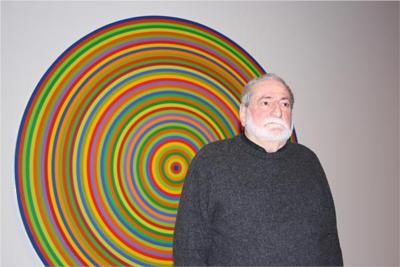
In 1962, Claude Tousignant painted a circle. It sounds unremarkable, but the decision to commit entirely to concentric rings of alternating colour was one of the defining moves in Canadian[1] abstraction, and he has held to it for more than sixty years. Born in Montreal on 23 December 1932[1], Tousignant trained at the School of Art and Design at the Montreal Museum of Fine Arts under Arthur Lismer and Gordon Webber, then spent a year in Paris at the Académie Ranson in 1951. He came back to Canada with a sharper sense of what he wanted to strip away.
Biography
Tousignant was a second-generation Plasticien[1], part of the Montreal geometric abstraction movement that positioned itself against both Abstract Expressionism's emotional excess and figuration's narrative weight. For him, colour and optical sensation were not in service of something else, they were the thing itself. His target paintings work through the physiological mechanism of the eye: complementary colours oscillate against each other in the concentric rings, creating a perceptual shimmer that has nothing to do with representation and everything to do with sensation.
American critics sometimes grouped his circle paintings alongside Op Art, but Tousignant's targets predate much of that movement's international visibility and come from a distinctly French-Canadian[1] context, shaped by the Plasticiens' engagement with European geometric painting rather than by New York.
By the early 1980s he had shifted again, moving to monochromatic shaped canvases that stand away from the wall, playing the edge of the canvas against the shadow it casts. The work has remained consistently non-referential throughout. His honours include the Prix Paul-Émile-Borduas (1989), Quebec's highest visual arts prize, and election as an Officer of the Order of Canada.
Timeline
- 1932Born in Montreal on 23 December.
- 1951Studied at the Académie Ranson in Paris for one year.
- 1962Painted a circle, marking a move towards concentric rings of alternating colour in his work.
- 1980Moved to monochromatic shaped canvases that stand away from the wall.
- 1989Received the Prix Paul-Émile-Borduas, Quebec's highest visual arts prize.
Notable Works
Tap to view larger.
Next stop
Browse the movements →
Every movement in the collection, from the Renaissance to Pop art.
Related Artists


Frequently Asked Questions
What was Claude Tousignant's art style?
Tousignant's art style is rooted in geometric abstraction, specifically as a second-generation Plasticien[1]. His work focuses on colour and optical sensation, moving away from representation and narrative. He is known for his target paintings featuring concentric rings of colour and later for his monochromatic shaped canvases.What is Claude Tousignant known for?
Claude Tousignant is known for his concentric circle paintings, which he began creating in 1962. These target paintings explore the physiological effects of colour, using complementary colours to create optical sensations. Later in his career, he shifted to monochromatic shaped canvases.When was Claude Tousignant born?
Claude Tousignant was born in 1932[1].Who was Claude Tousignant?
Claude Tousignant is a Canadian[1] abstract artist known for his geometric paintings, particularly his concentric circle paintings. Born in Montreal, he trained at the Montreal Museum of Fine Arts and the Académie Ranson in Paris before returning to Canada to develop his distinctive style. He is considered a second-generation Plasticien[1], part of the Montreal geometric abstraction movement.
Sources
Editorial draws on the following primary and tertiary references for Claude Tousignant.
- [1] wikipedia Wikipedia: Claude Tousignant Used for: biography, birth dates, death dates, identifiers, movement attribution, nationality.
- [2] book guggenheim-guggenheimintern1964allo Used for: biography.
- [3] book guggenheim-twopri00weis Used for: biography.
- [4] book Masterpieces of western art : a history of art in 900 individual studies from the Gothic to the present day Used for: biography.
Editorial overseen by Solis Prints. Sources verified 2026-10-07. Click a source for details, or hover over [N] in the page above to preview.
Editorial standardsMethodologyCorrectionsAI disclosureAbout the editorial team