



Clarence White
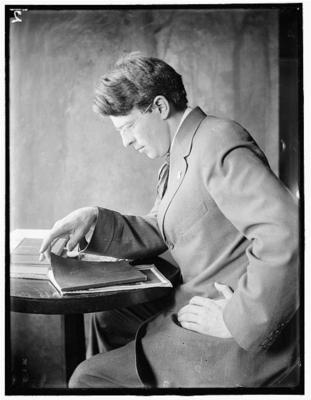
When Clarence White co-founded the Photo-Secession with Alfred Stieglitz in 1902[1], he was already working in a manner that set him apart from most of his contemporaries: soft-focus compositions drawn from Japanese printmaking and Whistler's tonal principles, images of domestic life in rural Ohio that treated photography as a medium for feeling rather than record-keeping. Works like *The Bubble* (1898) and *Drops of Rain* (1903) have an intimacy and formal intelligence that still feel considered more than a century later.
Biography
Born in West Carlisle, Ohio, in 1871[1], White was largely self-taught in his early years, working as a bookkeeper while building a serious photographic practice. His friendship with Stieglitz opened doors to the international Pictorialist movement, and his images were exhibited and reproduced widely in the journal *Camera Notes*. The relationship fractured after 1910[1], but by then White had established his own institutional foothold: in 1914 he opened the Clarence H. White School of Photography in New York, America's first institution to teach photography as fine art.
The school's influence on twentieth-century photography is difficult to overstate. Margaret Bourke-White, Dorothea Lange, and Ralph Steiner all passed through it. White actively encouraged women at a time when many of his peers did not, and he placed compositional rigour at the centre of his pedagogy rather than any single technical orthodoxy.
He died of a heart attack in Mexico City in 1925[1], aged 54, while leading a student tour. He was inducted into the International Photography Hall of Fame in 1986. His platinum and palladium prints, made with a 6½-by-8½-inch view camera, remain among the most technically accomplished of the Pictorialist era.
Timeline
- 1871Born in West Carlisle, Ohio.
- 1898Created the photograph "The Bubble".
- 1902Co-founded the Photo-Secession with Alfred Stieglitz.
- 1903Created the photograph "Drops of Rain".
- 1910His relationship with Stieglitz fractured.
- 1914Opened the Clarence H. White School of Photography in New York.
- 1925Died of a heart attack in Mexico City, aged 54, while leading a student tour.
Notable Works
Tap to view larger.
Next stop
Browse the movements →
Every movement in the collection, from the Renaissance to Pop art.
Related Artists
_%E2%80%93_LOC.jpg)



Frequently Asked Questions
What is Clarence White known for?
Clarence White is known for his soft-focus compositions, drawn from Japanese printmaking and Whistler's tonal principles. His images of domestic life in rural Ohio treat photography as a medium for feeling rather than record-keeping. He also founded the Clarence H. White School of Photography, which had a significant influence on twentieth-century photography.Who was Clarence White?
What was Clarence White's art style?
White's art style involved soft-focus compositions influenced by Japanese printmaking and Whistler's tonal principles. His photographs often depicted domestic life and aimed to convey feeling rather than simply record reality. He used a 6½-by-8½-inch view camera to produce platinum and palladium prints.How did Clarence White die?
Clarence White died in 1925[1] at the age of 54.
Sources
Editorial draws on the following primary and tertiary references for Clarence White.
- [1] wikipedia Wikipedia: Clarence White Used for: biography, birth dates, death dates, identifiers, movement attribution, nationality.
- [2] book Ansel Adams; Beaumont Newhall; Nancy Newhall; Louise Dahl-Wolfe; Aaron Siskind; Richard Avedon; Harry Callahan; Lee Friedlander; Tina Modotti; W. Eugene Smith; Paul Strand; Edward Weston; Garry Winogrand; Amy Rule, Ansel Adams; Beaumont Newhall; Nancy Newhall; Louise Dahl-Wolfe; Aaron Siskind; Richard Avedon; Harry Callahan; Lee Friedlander; Tina Modotti; W. Eugene Smith; Paul Strand; Edward Weston; Garry Winogrand; Amy Rule - Original sources _ art and ar Used for: biography.
- [3] book Masterpieces of western art : a history of art in 900 individual studies from the Gothic to the present day Used for: biography.
- [4] book Landauer, Susan, The not-so-still life : a century of California painting and sculpture Used for: biography.
Editorial overseen by Solis Prints. Sources verified 2026-08-31. Click a source for details, or hover over [N] in the page above to preview.
Editorial standardsMethodologyCorrectionsAI disclosureAbout the editorial team