



Cimabue
- Trecento
Around 1280, a painting of the Madonna enthroned was carried through the streets of Florence in a public procession: such was the city's pride in what Cimabue had made. Dante immortalised this moment in the Purgatorio, noting that the painter's fame had briefly eclipsed his abilities. It was the kind of celebrity few medieval artists ever enjoyed, and it shaped how later generations understood the history of painting.
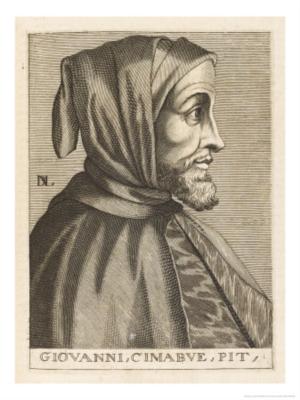
Biography
Cenni di Pepo, called Cimabue, worked in Florence and Assisi during the second half of the 13th century. His "Santa Trinita Madonna" (c. 1280-1290, Uffizi Gallery) remains the defining example of his style: a Byzantine gold-ground composition in which the rigid formulas of the Eastern tradition are gently softened. The throne recedes into space, the angels occupy a logical arrangement, and the Madonna's face carries individual weight.
His crucifix in Arezzo (c. 1268-1271) is the most completely preserved of his surviving works, though floods damaged the famous painted cross in Santa Croce, Florence in 1966. In Assisi, his frescoes of the evangelists and apocalyptic scenes in the Upper Church remain partially legible despite severe deterioration from chemical changes in the pigments.
Vasari credited Cimabue as the teacher of Giotto di Bondone, and while the relationship is disputed, the pedagogical claim captures something true: Cimabue pushed at the conventions that constrained Byzantine painting, and the next generation shattered them.
Timeline
- 1251Born Cenni di Pepo in Florence.
- 1268Painted a crucifix for Arezzo (c. 1268-1271); it is the most completely preserved of his surviving works.
- 1280A painting of the Madonna enthroned was carried through Florence in a public procession.
- 1280Painted the "Santa Trinita Madonna" (c. 1280-1290) now in the Uffizi Gallery.
- 1290Painted frescoes of the evangelists and apocalyptic scenes in the Upper Church, Assisi.
- 1302Died in 1302, aged 51.
Notable Works
Tap to view larger.
Next stop
Browse the movements →
Every movement in the collection, from the Renaissance to Pop art.
Related Artists


Frequently Asked Questions
What is Cimabue known for?
Cimabue is best known for his Maesta, originally on the altar of the church of Santa Trinita in Florence. Maesta means "majesty", and refers to a painting of the Madonna and Child in which Mary sits on a throne and is surrounded by angels.What style or movement did Cimabue belong to?
Cimabue's work sits at the intersection of the Byzantine style and the emerging Gothic style in Italy; this combination is sometimes called the "Greek manner". The influx of Byzantine artists into Italy, caused by the Crusader occupation of Constantinople, brought Eastern cultural influences. This "Greek manner" then mixed with the Gothic style from the north, creating a new Italian[1] style that paved the way for the Renaissance. Cimabue's paintings, such as the *Madonna Enthroned*, retain features common to Byzantine icons, such as standardised folds in garments, gold halos, similar poses, and gold-leaf backgrounds. However, Cimabue introduced subtle differences. Faces are fuller and more expressive, and his frescoes, such as *Madonna in Majesty* (painted for the Basilica of St Francis in Assisi), possess an intimacy absent from Byzantine icons. The figures are more realistic, with fleshier forms. Cimabue began to move away from the formalism of Byzantine art, incorporating emotion and perspective into his paintings. He started to introduce a more lifelike treatment to traditional subjects, rather than depicting everything as flat. His *Maestà*, originally in the church of Santa Trinita in Florence, displays sweetness and dignity, surpassing the rigid figures of Byzantine icons.What techniques or materials did Cimabue use?
Cimabue, a Florentine painter of the late 13th century, worked in both wall and panel painting, following Byzantine artistic traditions. For panel paintings such as *Madonna Enthroned* (c. 1280-90), he applied tempera to panels prepared with gesso, sometimes reinforced with linen. The process involved several steps. After drawing the design, the background was filled with gold leaf over red sizing. Underpainting, often using green earth pigment (terra verde), came next. The image itself was built up using multiple layers of thin tempera, applied with very fine brushes. This painstaking method demanded precision, as corrections were difficult. Cimabue’s move toward naturalism set him apart. He subtly individualised facial features and used tone to create drapery and solidity, moving away from the flatter shapes common in Gothic painting. Though many works attributed to Cimabue are unsigned or damaged, his impact on art during this period is evident.Where can I see Cimabue's work?
Cimabue's paintings can be viewed in several locations in Italy. The Galleria degli Uffizi, in Florence, holds the 1280 painting *Madonna and Child Enthroned with Eight Angels and Four Prophets* (also known as *Maestà*). Another work, *Crucifix*, completed circa 1287 to 1288, is housed at the Basilica di Santa Croce, also in Florence. Other paintings by Cimabue are held outside of Florence. The *Madonna and Child Enthroned with Two Angels*, from around 1300, can be seen at Santa Maria dei Servi, in Bologna. The Opera del Duomo, in Pisa, holds *St John the Baptist*, which dates to 1301. It was once assumed that Cimabue was Giotto's master; however, some now suggest that they were simply rivals. Dante referenced both artists in his poem, *The Divine Comedy*.Where was Cimabue from?
Giovanni Cimabue (circa 1240-1302[1]) was from Florence. Sometimes called the first light of painting, Cimabue came from a noble family. Details of his biography are scarce. Giorgio Vasari wrote about Cimabue, but some details, such as his instruction in the Gondi chapel, are doubted by modern scholars, as the chapel did not exist at the time. Some historians suggest Cimabue was instructed by Greek painters in the subterranean church beneath the sacristy of S. Maria Novella. Cimabue's workshop in Florence was considered the finest. He also worked in Tuscany, Assisi and Rome. Cimabue moved away from Byzantine art conventions; he incorporated emotion and perspective into his paintings. Rather than depicting everything as flat, he introduced a more lifelike treatment to traditional subjects. A mosaic of St John in Pisa Cathedral has been confirmed as his work. Other works attributed to him include Madonna in Majesty (Maestà), originally located on the high altar of the church of Santa Trinità in Florence.Who influenced Cimabue?
For centuries, art historians considered Cimabue the master of Giotto. This has since been questioned, and some now propose that they were simply rivals. Dante referenced both artists in his narrative poem, *The Divine Comedy*. Dante wrote, 'Of painters, Cimabue deemed his name unrivaled once; now Giotto is in fashion and has eclipsed his predecessor’s fame.' Regardless, Cimabue's movement toward naturalism likely inspired Giotto. Cimabue's key works include the *Madonna and Child Enthroned with Eight Angels and Four Prophets (Maestà)*, which he painted around 1280 and which is held in the Galleria degli Uffizi, Florence, Italy. He also painted a *Crucifix* between 1287 and 1288, now located in the Basilica di Santa Croce, Florence, Italy. Around 1300, he painted *Madonna and Child Enthroned with Two Angels*, which is now in Santa Maria dei Servi, Bologna, Italy. In 1301, he painted *St. John the Baptist*, which is held at the Opera del Duomo, Pisa, Italy.Who was Cimabue?
Cenni di Pepo (circa 1240-1302[1]), called Cimabue (meaning "bull-headed"), was an Italian[1] artist active in Florence, Tuscany, Assisi and Rome. Cimabue was among the first to move away from the conventions of Byzantine art. He lived during the Gothic period. Although little is known about his life, his Florence workshop was considered the best. He is considered the leading Italian painter of his generation, according to an early account written over 200 years after his death. Many works are attributed to Cimabue, but these are often unsigned, damaged, or credited to Duccio. The mosaic of St John in Pisa Cathedral is confirmed as his work. Paintings such as *Madonna in Majesty* (1285-6), now in the Galleria degli Uffizi, Florence, demonstrate his subtle individualisation of facial features. He also used tone to represent drapery. Cimabue adhered to Byzantine tradition, but he also added hints of emotion and perspective to his paintings. Rather than painting everything as a flat surface, he began to treat traditional subjects in a more lifelike way.What was Cimabue's art style?
Cimabue's art style is Gothic and Byzantine. His "Santa Trinita Madonna" is a Byzantine gold-ground composition in which the rigid formulas of the Eastern tradition are gently softened.How did Cimabue die?
Cimabue died in 1302[1] at the age of 51.
Sources
Editorial draws on the following primary and tertiary references for Cimabue.
- [1] wikipedia Wikipedia: Cimabue Used for: biography, birth dates, death dates, identifiers, movement attribution, nationality.
- [2] book Susie Hodge, Art Used for: biography, stylistic analysis.
- [3] book Susie Hodge, Art: Everything You Need to Know About the Greatest Artists and Their Work Used for: biography.
- [4] book Beckett, Wendy, The story of painting Used for: stylistic analysis.
Editorial overseen by Solis Prints. Sources verified 2026-10-18. Click a source for details, or hover over [N] in the page above to preview.
Editorial standardsMethodologyCorrectionsAI disclosureAbout the editorial team