



Christopher Wilmarth
By the time Christopher Wilmarth died in Brooklyn in November 1987[2], aged 44, major American[2] museums had been collecting his sculptures for nearly two decades. The Whitney, the Museum of Modern Art, the Walker Art Center, and the Philadelphia Museum of Art had all acquired his work before he turned 30. That he was barely known outside specialist circles at his death says something about both the difficulty of his material and the deliberate distance he placed between himself and the art market.
Biography
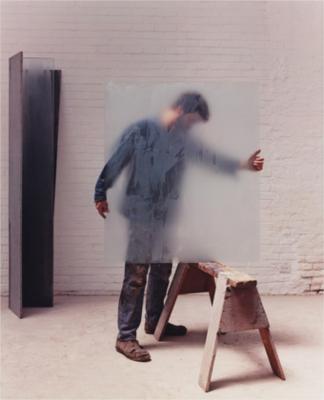
Wilmarth was born in Sonoma, California in 1943[2] and arrived in New York in the 1960s, working briefly as an assistant to sculptor Tony Smith before completing his BFA at Cooper Union in 1966[2]. The material he settled on was industrially etched glass, paired with steel. His central concern was with how glass transforms light: thicker sections block it, thinner ones transmit it, and the etching introduces a milkiness that makes the sculptures appear to breathe. He described them as places to generate experiences with light, and spoke of them as physical poems, a phrase rooted in his sustained reading of the French Symbolist poet Stephane Mallarme.
In 1978[2], disillusioned with galleries, he withdrew from all dealer representation and opened his own space, The Studio of the First Amendment, where he staged three exhibitions over four years. He produced only around 150 sculptures in his entire career.
My Divider (1972[2]-73), a glass and steel construction held at the Nasher Sculpture Center in Dallas, is among the most frequently cited works, its painterly etched surface set against dark steel plates in a way that resists any simple reading.
Timeline
- 1943Born in Sonoma, California.
- 1966Completed his BFA at Cooper Union in New York.
- 1972Created "My Divider", a glass and steel construction.
- 1978Withdrew from gallery representation, disillusioned with the art market.
- 1978Opened his own space, The Studio of the First Amendment.
- 1987Died in Brooklyn, New York, aged 44.
Notable Works
Tap to view larger.
Next stop
Browse the movements →
Every movement in the collection, from the Renaissance to Pop art.
Related Artists
_%E2%80%93_LOC.jpg)



Frequently Asked Questions
What is Christopher Wilmarth known for?
Christopher Wilmarth is known for his sculptures using industrially etched glass paired with steel. His central interest was in how glass transforms light, with thicker sections blocking it and thinner sections transmitting it.What is Christopher Wilmarth's most famous work?
It is difficult to name one single work as Christopher Wilmarth's "most famous". His practice involved series of works, and his reputation rests on his overall contribution to modern sculpture. Wilmarth is best known for his subtle combinations of etched glass and steel. These works often evoke poetic or emotional states through abstract forms. He gained recognition in the 1970s and 1980s for his distinctive approach to sculpture, which bridged the gap between minimalism and more expressive, personal content. While no single piece eclipses his other creations, certain works are particularly noted. "Gnomon's Parade" (1979[2]), at the Walker Art Center, Minneapolis, is a large scale example of his mature style. His series inspired by poems of Mallarmé are also well regarded. These pieces show his interest in the interplay between language, form, and light.What should I know about Christopher Wilmarth's prints?
When considering Christopher Wilmarth's prints, bear in mind the distinction between an original print and a reproduction. An original print is conceived and executed solely as a print, often in a limited, numbered, and signed edition. Each print is created individually from a matrix (plate, stone, screen, or block). The artist determines the edition size, and numbering (e.g., 12/25) accounts for all prints. Reproductions, on the other hand, are copies of artworks originally created in another medium, such as painting or watercolour, and are usually produced using photomechanical means. Numbering or signing a reproduction does not make it an original print. The Professional Art Dealers Association of Canada (PADAC) defines an original print as an image conceived as a print and executed solely as a print, usually in a numbered edition, and signed by the artist. Each print in the edition is an original, printed from a matrix created for that purpose.What style or movement did Christopher Wilmarth belong to?
Christopher Wilmarth, active in the mid- to late-20th century, produced work that has connections with several artistic tendencies. He is often associated with post-Minimalism, an art movement that emerged in the 1960s as a reaction against the austerity of Minimalism. Wilmarth's sculptures often incorporated industrial materials, such as steel and glass, but he combined these with more expressive, even lyrical, forms. This juxtaposition of hard-edged materials and soft, flowing lines is a characteristic of post-Minimalism. Some critics have also noted the influence of abstract expressionism on Wilmarth's work, particularly in his exploration of light and shadow, and his emphasis on personal expression. However, unlike the abstract expressionists, Wilmarth maintained a strong focus on the physical properties of his materials, and his sculptures often have a strong geometric structure. His work resists easy categorisation, occupying a space between Minimalism, abstract expressionism, and other movements.What techniques or materials did Christopher Wilmarth use?
Christopher Wilmarth was known for his innovative use of materials, combining industrial and artistic elements. He frequently worked with glass, particularly etched or sandblasted plate glass, which he often paired with steel or bronze supports. Wilmarth's process often involved layering glass sheets to create depth and shadow. He manipulated the surfaces of the glass through etching, sometimes using hydrofluoric acid, to create translucent or opaque areas. This allowed him to control the light and create subtle tonal variations. In addition to glass and metal, Wilmarth also experimented with other materials such as wire cable and fabric. His approach was characterised by a desire to explore the interplay between light, shadow, and form. He aimed to create works that were both visually striking and emotionally resonant, often evoking a sense of melancholy or introspection.What was Christopher Wilmarth known for?
Christopher Wilmarth (1943[2]-1987[2]) was an American[2] sculptor known for his subtle, abstract works in glass and steel. He often combined etched or sandblasted glass with metal supports, creating pieces that explored light, shadow, and form. Wilmarth's early education included studies at Cooper Union in New York. By the late 1960s, he had begun to develop his signature style, using industrial materials in a refined, poetic manner. His sculptures often evoke a sense of quiet contemplation. Throughout his career, Wilmarth received several awards and fellowships, including a Guggenheim Fellowship in 1975[2]. His work has been exhibited in major museums, such as the Museum of Modern Art, the Whitney Museum of American Art, and the Hirshhorn Museum and Sculpture Garden. Major exhibitions of his work occurred both during and after his lifetime. These presentations helped to solidify his position as a significant figure in late 20th-century sculpture.When did Christopher Wilmarth live and work?
Christopher Wilmarth was born in Los Angeles in 1943[2]. He died in Tijuana, Mexico, in 1987[2]. Wilmarth received a B.A. in 1962[2] and an M.A. in 1964 from the University of California, Los Angeles (UCLA). At UCLA, he studied with Stanton Macdonald-Wright and William Brice. He also studied privately with Antonio Valles and Daniel Zenteno. In 1966, Wilmarth travelled to Spain, then moved to La Paz, Mexico, where he founded El Centro de Arte Regional. He taught at the University of California Extension, San Diego, from 1964 to 1966; at El Centro de Arte from 1966 to 1969; at California State, Northridge, from 1969 to 1970; at California State, Sacramento, from 1970 to 1972; and at the University of California, Santa Cruz, from 1972 to 1997. He travelled frequently.Where can I see Christopher Wilmarth's work?
Christopher Wilmarth's sculptures and prints can be viewed in several public collections. The permanent collection of the Museum of Modern Art (MoMA) in New York includes examples of his work. The Whitney Museum of American[2] Art, also in New York, holds a number of Wilmarth's pieces. These holdings offer opportunities to study the artist's development and his contribution to modern sculpture. Other institutions with works by Wilmarth include the Hirshhorn Museum and Sculpture Garden in Washington, D.C., and the Philadelphia Museum of Art. These collections allow a wider audience to engage with his art. Wilmarth's estate sometimes organises exhibitions, so checking their website or contacting art galleries that specialise in American modernism may provide information on further viewings. Examining museum websites before visiting is advisable, as artworks on display can change.Who did Christopher Wilmarth influence?
It is difficult to identify Christopher Wilmarth's direct influence on later artists. The Exxon National exhibitions of the late 1970s and early 1980s included many artists developing unique approaches to abstraction and figuration. Pegan Brooke, for example, drew inspiration from Klee early in her career before encountering Incan and Mayan sites, which led her to a more direct interpretation of the environment. Similarly, Heidi Gliick and Scott Davis incorporated geometry and pure form into their paintings, albeit with new delicacy, poetry, whimsy, and wit. Denise Green, Aaron Karp, and Tom Lieber explored personal experience, systematic imagery, painterly processes, and optical effects in their work, diverging from the reductive idioms of the Minimalists. Lieber, inspired by Rothko and Philip Guston, integrated reflections of the human form into abstract fields, creating a hallucinatory presence reminiscent of Giacometti. These artists demonstrate a broader trend towards diverse approaches in installation, painting, sculpture, and photography, making it hard to isolate Wilmarth's specific impact.Who influenced Christopher Wilmarth?
It is difficult to identify specific individuals who directly influenced Christopher Wilmarth, based on the material provided. Mentorship is acknowledged as a general positive force, and teachers are thanked for their inspiration and guidance. One passage mentions Luca Signorelli, an Italian Renaissance master, as a primary source of inspiration for a different artist's work on the apocalypse. Signorelli's fresco cycle in the Orvieto Cathedral (1499-1504[2]) made a strong impression. His work visualised the end of the world, including earthquakes, tidal waves, and demons torturing people. Another passage cites the importance of artistic practice and image creation, rather than specific influences. It claims that inspiration and vision are timeless, and that artists are colleagues co-existing in the light of each other's gifts. This suggests that influence can come from many sources, past and present.Who was Christopher Wilmarth?
Christopher Wilmarth (1943[2]-1987[2]) was an American[2] sculptor and printmaker known for his abstract works in glass and steel. Born in Brooklyn, New York, Wilmarth studied at the Cooper Union School of Art and Architecture, where he explored various media before focusing on sculpture. He gained recognition in the 1970s for his distinctive style, which combined industrial materials with poetic forms. His sculptures often featured curved or fragmented glass panels held in place by metal frames, creating a play of light and shadow. Wilmarth's work explored themes of transparency, reflection, and the relationship between interior and exterior space. His prints, like his sculptures, often incorporated abstract shapes and subtle gradations of tone. Throughout his career, he exhibited widely in the United States and abroad, and his works are included in numerous public collections.Why are Christopher Wilmarth's works important today?
Christopher Wilmarth (1943[2]-1987[2]) is known for his sculptures and prints that merge steel, glass, and light. His works often evoke a sense of poetic abstraction, drawing inspiration from the Symbolist poetry of Stéphane Mallarmé and Arthur Rimbaud. Wilmarth's innovative use of materials is a significant aspect of his art. He combined industrial materials like steel with the fragile and translucent qualities of glass, creating a dialogue between strength and delicacy. His manipulation of light, allowing it to interact with the glass surfaces, adds another dimension to his pieces, producing subtle shifts in colour and form. His practice also included printmaking, where he explored similar themes and material contrasts. These prints often served as studies for his sculptures, or as independent works that demonstrate his command of line and form. Wilmarth's work encourages viewers to consider the relationship between material, light, and space. His exploration of abstract forms, combined with his sensitivity to materials, makes his art relevant to contemporary discussions about sculpture and its potential for poetic expression.
Sources
Editorial draws on the following primary and tertiary references for Christopher Wilmarth.
- [1] museum Harvard Art Museums Used for: museum holdings.
- [2] wikipedia Wikipedia: Christopher Wilmarth Used for: biography, birth dates, death dates, identifiers, movement attribution, nationality.
- [3] book guggenheim-emergingartists100wald Used for: biography.
- [4] book guggenheim-newhorizonsiname00denn Used for: biography.
- [5] book Landauer, Susan, The not-so-still life : a century of California painting and sculpture Used for: biography.
Editorial overseen by Solis Prints. Sources verified 2026-08-31. Click a source for details, or hover over [N] in the page above to preview.
Editorial standardsMethodologyCorrectionsAI disclosureAbout the editorial team