



Christian Wilhelm Allers
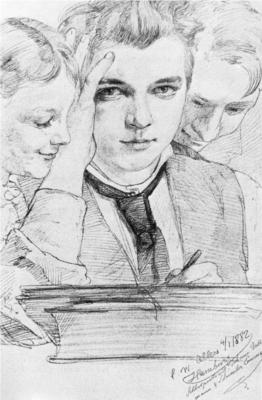
Christian Wilhelm Allers made his name with meticulous social observation: his 1888[1] collection Club Eintracht, documenting bourgeois Hamburg society in precise pencil with pastel and oil colour, went through multiple editions and established him as one of Germany's more sought-after illustrators. Born in Hamburg in 1857[1], he trained as a painter and built a career across more than twenty books and print series, covering naval life, portraiture, and everyday German[1] scenes with a detail that stopped just short of pure documentary.
Biography
The more interesting chapters of his life unfolded abroad. In the early 1890s he settled on Capri, where he built a villa and became part of the island's community of international artists. Travel took him further still: he spent over a decade moving through New Zealand, Samoa, and Australia, working under the pseudonym W. Andresen, producing records of Pacific and antipodean life that reflected his persistent interest in human figures in their environments. He was not a pure naturalist in the strict sense; contemporary sources note that he sometimes added figures to scenes they never actually occupied, lending his work a constructed quality that complicated its documentary ambitions.
In autumn 1902[1], accusations of homosexuality and pederasty on Capri forced him to flee before trial. He was sentenced to four and a half years in absentia and never returned to Germany under his own name. He died in Karlsruhe in 1915[1], a figure whose undeniable technical facility sits alongside a biography that resists easy summary.
Timeline
- 1857Born in Hamburg.
- 1888Published "Club Eintracht", a collection documenting Hamburg society.
- 1890Settled on Capri and became part of the international artist community.
- 1902Fled Capri due to accusations of homosexuality and pederasty.
- 1902Sentenced in absentia to four and a half years.
- 1915Died in Karlsruhe.
Notable Works
Tap to view larger.
Next stop
Naturalism →
Explore the artists and ideas of Naturalism.
Related Artists


Frequently Asked Questions
What is Christian Wilhelm Allers known for?
Christian Wilhelm Allers is known for his meticulous social observation, particularly in his 1888[1] collection *Club Eintracht*. He produced over twenty books and print series, covering naval life, portraiture, and everyday German[1] scenes with a detail that stopped just short of pure documentary.What is Christian Wilhelm Allers's most famous work?
It is difficult to name one single work as Christian Wilhelm Allers's most famous. He was a popular artist in his own lifetime, but not one whose work is now widely known or critically studied. Allers was a German[1] genre painter and illustrator, who was born in Hamburg in 1857[1] and died in Karlsruhe in 1915[1]. He studied at the Karlsruhe Academy. He is associated with light, humorous, or sentimental subjects. He produced illustrations for books and magazines, as well as independent prints. He lived in Italy for a time, and many of his works depict Italian life. He is known for portraiture, often of military figures. He is also known for scenes of leisure and everyday life.What should I know about Christian Wilhelm Allers's prints?
Christian Wilhelm Allers (1857[1]-1915[1]) was a German[1] painter and printmaker, active in the late 19th and early 20th centuries. During this period, original prints became a major artistic medium. Artists began signing their prints, differentiating them from commercial reproductions. This signature testified to the authenticity of the print and the artist's approval of a particular proof. Artists also controlled quality by limiting the size of print editions and numbering them. This influenced the price, reflecting the number of works available and preventing printing after the plate degraded. High-quality, handmade papers also contributed to the aesthetic value of prints. Prints allowed artists to reach a wider audience, as they could be produced and distributed at a lower cost than other art forms. Dealers recognised the value of prints as a popular art form and encouraged painters and sculptors to create them.What style or movement did Christian Wilhelm Allers belong to?
Christian Wilhelm Allers is generally associated with Naturalism[1], an artistic movement that gained traction during the 19th century. Naturalism, in this context, is understood as an artistic style with philosophical underpinnings that set it against Romanticism and its idealism. Naturalism wasn't a homogeneous movement with a single idea of nature. Instead, it shifted over time, responding to immediate goals and specific tasks, interpreting life through particular phenomena. The interest in naturalism arose from the discovery of a trait or tendency in reality that artists wanted to emphasise, either to promote or to challenge it. Naturalism wasn't aimed at representing reality as a whole, but focused on social life. Writers like Stendhal and Balzac aimed to depict the new and changing society, leading them towards naturalism and influencing their conception of artistic truth. The social consciousness of the 1830s generation, its sensitivity to social interests, and its awareness of social changes made its writers creators of the social novel and modern naturalism.What techniques or materials did Christian Wilhelm Allers use?
Information regarding Christian Wilhelm Allers's specific techniques and materials is scarce. However, some general information about printmaking techniques can provide a context. Woodcut is a relief printmaking technique where an image is transferred from raised areas of a wood block onto paper. The artist cuts away areas of the block with tools, leaving the desired image raised. Ink is applied to the raised sections, and when the block is pressed onto paper, the incised areas appear white. Colour woodcuts often involve using a separate block for each colour. Metal engraving, derived from goldsmithing, involves gouging lines into a metal plate, usually with a burin. The plate's surface is inked, then wiped clean, leaving ink only in the grooves. Damp paper is placed on the plate, and both are run through a press under high pressure to transfer the ink, creating raised lines on the paper. Etching, another intaglio process, also has origins in metalwork. In hard-ground etching, a metal plate is coated with acid-resistant wax. The image is scratched into the wax, exposing the metal. An acid bath then bites into the exposed lines, creating grooves for the ink. Etchings are printed similarly to engravings.What was Christian Wilhelm Allers known for?
Christian Wilhelm Allers was an artist working within the naturalistic style. Naturalism[1] as an artistic style is linked to realism as a philosophical attitude. Naturalism isn't a homogeneous concept of art based on one idea of nature; it shifts with the times. It always aims at a particular goal, concerned with a concrete task. The generation of 1830 recognised that society's structure had changed completely. They reacted in an activistic fashion, and their naturalistic approach derived from this. Naturalism isn't aimed at 'nature' or 'life' in general, but at social life. Writers of the time, such as Stendhal and Balzac, portrayed the new, changed society. The aim of giving expression to its novelties led them to naturalism. Naturalism remains the art of a small minority among artists and the public. It was the object of attack from the Academy, the University, and critics. Hostility intensified as the aims of the movement became more specific. Naturalism represents a constant wrestling with the spirit of romanticism. The difference between naturalism and romanticism consists of the application of the principles of the exact sciences to the artistic portrayal of facts.When did Christian Wilhelm Allers live and work?
Christian Wilhelm Allers was a German[1] artist and illustrator who lived from 1857[1] to 1915[1]. He was born in Hamburg on 6 August 1857[1] and died in Karlsruhe on 19 August 1915. Allers trained as a lithographer before studying art. He is known for his genre paintings, portraits, and illustrations, many of which captured scenes of everyday life, often with a humorous touch. He travelled extensively in Europe and North Africa, recording his observations in sketches and watercolours. These travels provided material for his popular illustrated books, which include *La Bella Napoli* (1889), *Capri* (1891), and *Sicilia* (1894). Allers achieved considerable success during his lifetime. His work provides a record of the social customs and types of the late 19th and early 20th centuries.Where can I see Christian Wilhelm Allers's work?
Christian Wilhelm Allers's works can be viewed in several museums and galleries, primarily in Germany, but also in the United States. These include the Nationalgalerie, the Brücke Museum, and the Kunsthalle in Bremen. You can also find his pieces at the Ludwig Museum in Cologne, the Folkwang Museum in Essen, and the Kunsthalle in Hamburg. Other German[1] locations include the Niedersächsisches Landesmuseum in Hanover, the Städtische Kunsthalle in Mannheim, and the Bayerische Staatsgemäldesammlungen in Munich. Outside of Germany, Allers's art is held by the Minneapolis Institute of Arts, the Museum of Modern Art in New York, and the Staatliche Museen in Berlin. Additionally, his works are present in the collections of the Art Institute of Chicago, the Detroit Institute of Arts, and the National Gallery of Art in Washington, DC. Some pieces are held by Galerie Valentien in Stuttgart, and Galerie Welz, in Salzburgo.Where was Christian Wilhelm Allers from?
Christian Wilhelm Allers was German[1]. During the medieval era, the German lands saw an influx of talent from across Europe. This mixing of influences helped develop a unique artistic identity in the region. One notable figure was Albrecht Dürer (1471-1528[1]), from Nuremberg. Dürer's father, a master-goldsmith, had immigrated from Hungary. Dürer apprenticed in Nuremberg and later travelled to Switzerland and Italy, absorbing various artistic styles. He returned to Nuremberg, opened his workshop, and produced woodcuts and other works. Other artists associated with Dürer include Hans Süss (also known as Hans von Kulmbach), who was born around 1480 and died in Nuremberg in 1522. Georg Pencz, born around 1500, was another Nuremberg artist who was part of Dürer's circle in the early 1520s. These artists, along with others, contributed to the artistic environment of Nuremberg and the broader German region.Who influenced Christian Wilhelm Allers?
Although difficult to pinpoint exactly, some general trends in German[1] art may have influenced Christian Wilhelm Allers. The Nazarenes, for example, sought moral regeneration through art by attempting to revive a lost Golden Age. Caspar David Friedrich represents a note of isolated introspection characteristic of much German art. Philipp Otto Runge combined a scientific bent, a sense of religious obligation, and a powerful impulse toward historical speculation. In general, German Romanticism, around 1800, exerted a fertile influence. The years immediately after World War I bear spiritual similarities to the early Romantic period, with a sense of having reached a zero point from which to start afresh. Both periods nurtured the hope of salvation through communality, expressed in the arts by tightly woven associations. Art in both eras assumed a messianic function and aimed to convert all levels of society. Similarly, the absorption of the sciences into art was influential upon both the Romantics and the artists growing to maturity during and immediately after World War I.Who was Christian Wilhelm Allers?
Christian Wilhelm Allers was a Hamburg-born painter and illustrator, known for his social observation and depictions of everyday life. He is also known for his time spent abroad, particularly in Capri, New Zealand, Samoa, and Australia.Why are Christian Wilhelm Allers's works important today?
Christian Wilhelm Allers was a German[1] genre painter and illustrator, active in the late 19th and early 20th centuries. His importance today stems from his detailed documentation of everyday life during a period of significant social and political change in Europe. Allers's prints offer insight into the customs, costumes, and characters of his time. His work provides a visual record of German society, particularly the lives of ordinary people. His illustrations capture scenes from military life, leisure activities, and various professions. Although Allers may not be as well known as some of his contemporaries, his images have value as historical documents. They provide information about a specific time and place. His prints are collected by those interested in social history, military history, and the history of illustration. Allers's art allows us to see the past in a way that written accounts cannot fully convey.
Sources
Editorial draws on the following primary and tertiary references for Christian Wilhelm Allers.
- [1] wikipedia Wikipedia: Christian Wilhelm Allers Used for: biography, birth dates, death dates, identifiers, movement attribution, nationality.
- [2] book de.downmagaz.net, de.downmagaz.net Used for: stylistic analysis.
- [3] book G-Geschichte 2020-10 Used for: stylistic analysis.
- [4] book guggenheim-expger00neug Used for: biography.
- [5] book Masterpieces of western art : a history of art in 900 individual studies from the Gothic to the present day Used for: biography.
- [6] book Victoria Charles, Rokoko Used for: stylistic analysis.
- [7] book Landauer, Susan, The not-so-still life : a century of California painting and sculpture Used for: biography.
Editorial overseen by Solis Prints. Sources verified 2026-10-15. Click a source for details, or hover over [N] in the page above to preview.
Editorial standardsMethodologyCorrectionsAI disclosureAbout the editorial team