



Charly Palmer
When Time magazine commissioned Charly Palmer for its July 2020 cover on racial justice and the Black Lives Matter movement, the selection acknowledged both his technical skill and the decades he had spent painting Black American[1] life. The cover ran under the heading "America Must Change" and paired portraits with American iconography in a manner that drew immediate attention.
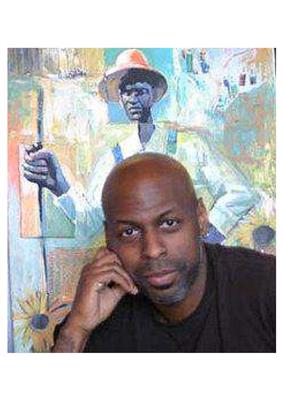
Biography
Palmer was born in Fayette, Alabama, in 1960[1] and raised in Milwaukee, Wisconsin. He studied at the School of the Art Institute of Chicago and the American[1] Academy of Art, developing a practice primarily in acrylics that moves between portraiture, landscape, and thematic social commentary. His subjects are frequently drawn from African American history and culture, rendered with directness and warmth.
His commercial work has been wide-ranging. He created the official poster for the 1996 Olympics in Atlanta and a subsequent Winter Olympics poster for Nagano in 1998. On the publishing side, he has illustrated children's books including Mama Africa!: How Miriam Makeba Spread Hope with Her Song and The Teachers March!, receiving the Coretta Scott King/John Steptoe Illustrator Award in 2018. He also provided cover art for John Legend's 2020 album Bigger Love.
Palmer's work appears in the African American[1] Museum of Southern New Jersey and galleries across the United States. In 2024 he received an NAACP Image Award for Outstanding Literary Work in non-fiction for the co-authored volume The New Brownies Book: A Love Letter To Black Families.
Timeline
- 1960Born in Fayette, Alabama.
- 1996Created the official poster for the Atlanta Olympics.
- 1998Created a Winter Olympics poster for Nagano.
- 2018Received the Coretta Scott King/John Steptoe Illustrator Award for illustrating the children's book The Teachers March!
- 2020Created the cover for Time magazine's July issue on racial justice and Black Lives Matter.
- 2020Provided cover art for John Legend's album Bigger Love.
- 2024Received an NAACP Image Award for Outstanding Literary Work in non-fiction for co-authoring The New Brownies Book: A Love Letter To Black Families.
Notable Works
Tap to view larger.
Next stop
Browse the movements →
Every movement in the collection, from the Renaissance to Pop art.
Related Artists
_%E2%80%93_LOC.jpg)


Frequently Asked Questions
What is Charly Palmer known for?
Charly Palmer is known for his paintings of Black American[1] life and his Time magazine cover on racial justice and the Black Lives Matter movement. He also created the official poster for the 1996 Olympics in Atlanta.What should I know about Charly Palmer's prints?
Charly Palmer's prints are sold as limited editions, a common practice among printmakers. The artist determines the edition size, not the medium. Each print in a limited edition is numbered, titled, and signed, usually in pencil. The numbering indicates the specific print number in relation to the total edition size (e.g., 35/100 means it is the 35th print of 100). Some artists also create artist's proofs, marked as AP. These conventions help assure buyers of the print's value and authenticity. The Professional Art Dealers Association of Canada defines an original print as an image conceived and executed solely as a print, usually in a numbered edition and signed by the artist. Each print is individually inked and pulled, making it a multi-original medium. Reproductions, on the other hand, are copies of artworks originally created in another medium, such as painting. Numbering or signing a reproduction does not make it an original print.What style or movement did Charly Palmer belong to?
It is difficult to place Charly Palmer within a single artistic movement. His work incorporates elements of several styles and traditions. Palmer's art often features portraiture and figurative subjects rendered in a distinctive, textural manner. His approach combines bold colour choices with collage elements and mixed media. This creates surfaces with depth and tactile qualities. Some observers have noted connections between Palmer's work and the practices of the Black Arts Movement. This movement, active in the 1960s and 1970s, promoted Black identity, culture, and political expression. Palmer's art frequently engages with themes of race, history, and social justice. It also celebrates Black life. Ultimately, Palmer's style is best understood as a synthesis of different influences. These include modernism, abstraction, and the traditions of African-American[1] art. His individual approach resists easy categorisation.Where can I see Charly Palmer's work?
To view works by Charly Palmer, you could visit several museums with collections of modern and contemporary art. These include institutions in the United States, such as the Los Angeles County Museum of Art (LACMA) at 5905 Wilshire Boulevard, Los Angeles; the Metropolitan Museum of Art at 1000 Fifth Avenue, New York; the Minneapolis Institute of Arts at 2400 Third Avenue South, Minneapolis; the Museum of Modern Art at 11 West 53rd Street in New York; and the Virginia Museum of Fine Arts at 200 N. Boulevard, Richmond. Other US venues include the High Museum in Atlanta and the Art Institute of Chicago. Palmer's art has also been shown at the Contemporary Arts Museum in Houston. Outside the United States, museums that sometimes exhibit similar artists are the Royal Ontario Museum in Toronto, the Musée des Arts Décoratifs in Paris, and the Hara Museum of Contemporary Art in Tokyo.Who did Charly Palmer influence?
It is difficult to identify specific artists directly influenced by Charly Palmer, as artistic influence is often complex and multifaceted. However, we can examine Palmer's artistic style and themes to consider potential areas of influence. Palmer's work often features textured surfaces, bold colours, and figures rendered with a sense of emotional depth. These characteristics may resonate with artists interested in contemporary figuration and portraiture. His focus on Black history and culture could also inspire artists exploring similar themes in their own work. Furthermore, Palmer's success as a commercially successful artist may influence emerging artists seeking to navigate the art market. His story could serve as an example for artists from under-represented backgrounds, demonstrating that it is possible to achieve recognition and success in the art world. Ultimately, the extent of Palmer's influence will become clearer as more art historians analyse his position in contemporary art. Further research is needed to determine the specific impact of his work on other artists.Who influenced Charly Palmer?
Without direct statements about Charly Palmer's influences, we can discuss the general influences on art school teaching, which may have shaped his development. Art schools in the English-speaking world moved towards incorporating contemporary art into their curricula, moving away from ignoring or lagging behind current trends. This shift allowed students to contribute more immediately to avant-garde culture. Abstract painting from Corsham, abstract sculpture from Saint Martin’s (influenced by Anthony Caro), and the Young British Artists from Goldsmiths College exemplify this. In the US, significant artists working in art schools on the west coast included Michael Asher, John Baldessari, Chris Burden, Mike Kelley, Paul McCarthy, and Nancy Rubins. Black Mountain College, founded in 1933, also had a formative effect on education. Some members of the Bauhaus, including Josef and Hanni Albers and Walter Gropius, emigrated to the US and influenced the college's early days. The pioneers of this new movement considered the knowledge of classical canons of literature and philosophy, history and mathematics to be insufficient. They regarded life as a continuous stream of change whose invaluable potential for innovation and creativity could be exploited with common knowledge and, above all, with artistic reasoning and action.Who was Charly Palmer?
Charly Palmer is an American[1] artist known for his mixed-media paintings. Born in 1960[1] in Fayette, Alabama, he was raised in Milwaukee, Wisconsin. Palmer now lives and works in Atlanta, Georgia. Palmer studied art and design at the American Academy of Art in Chicago, and he has a background in illustration and graphic design. His work often explores themes of identity, race, and memory. He frequently uses collage techniques, incorporating found objects and layering paint to create textured surfaces. Palmer's style is characterised by bold colours and expressive figures. His subjects range from historical figures to everyday people. He has created several series of works focusing on African American history and culture. One example is his "Civil Rights" series. Palmer gained wider recognition after his painting "A Dream Deferred" was featured on the cover of *Time* magazine in July 2020. The artwork accompanied an article about the state of race relations in the United States. Palmer continues to exhibit his work in galleries and museums across the United States.Why are Charly Palmer's works important today?
Charly Palmer's art is important because it engages with themes of identity, race, and historical memory. Palmer explores the complexities of the African American[1] experience through portraiture and figuration. His approach often incorporates collage and mixed media, adding layers of meaning to his compositions. Palmer's work joins a larger artistic conversation that addresses social and political issues. Artists such as Lorna Simpson, Melvin Edwards, and Jaune Quick-to-See Smith have used their art to reveal histories of oppression and challenge cultural stereotypes. Simpson examines representations of gender and race, while Edwards uses the metaphor of lynching to provoke thought about racism's legacy. Quick-to-See Smith addresses the invisibility of Native American artists and challenges assumptions about identity. Palmer's art contributes to a dialogue about cultural heritage, historical references, and contemporary struggles for civil rights. Like other artists who explore identity politics, Palmer prompts viewers to confront uncomfortable truths and reconsider established values.What was Charly Palmer's art style?
Charly Palmer's practice is primarily in acrylics. His work moves between portraiture, what could be considered conventional landscapes, and thematic social commentary.When was Charly Palmer born?
Charly Palmer was born in 1960[1].
Sources
Editorial draws on the following primary and tertiary references for Charly Palmer.
- [1] wikipedia Wikipedia: Charly Palmer Used for: biography, birth dates, death dates, identifiers, movement attribution, nationality.
- [2] book downmagaz.net, downmagaz.net Used for: biography.
- [3] book guggenheim-australianvision00wald Used for: biography.
- [4] book guggenheim-refigur00kren Used for: biography.
Editorial overseen by Solis Prints. Sources verified 2026-10-16. Click a source for details, or hover over [N] in the page above to preview.
Editorial standardsMethodologyCorrectionsAI disclosureAbout the editorial team