



Charles M. Russell
- American Renaissance
Charles Marion Russell left St. Louis at sixteen with a fixed idea about where he wanted to be: Montana. He had grown up sketching cowboys and Native Americans in the margins of his schoolbooks, modelling clay animals at every opportunity, and reading everything he could find about the frontier West. Arriving in 1880[1], he spent the better part of a decade working as a wrangler and night herder on cattle ranches, absorbing the life he would spend the rest of his career painting.
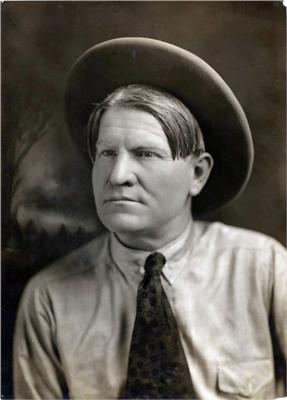
Biography
The winter of 1886[1]-1887[1] provided his breakthrough. When a ranch owner asked about the condition of his cattle, Russell responded not with a letter but with a small watercolour: a lone, emaciated steer in deep snow under a sky heavy with threat, titled *Waiting for a Chinook*. The owner displayed it in a Helena shop window. Commissions followed. Between 1888 and 1889, Russell lived among the Blood Indians, gaining direct knowledge of Native American[1] culture that would inform his work for the rest of his life and distinguish it from competitors who painted from imagination or photograph alone.
He settled in Great Falls, Montana, in 1892[1] and married Nancy Cooper in 1896. She was eighteen, he was thirty-two, and the marriage transformed his career. Where Russell had been content to give paintings away at the bar, Nancy organised exhibitions across the United States and in London, negotiated commissions, and turned a working cowboy artist into an international name. His output over a lifetime ran to approximately 4,000 works in oil, watercolour, and sculpture: cowboys, Native Americans, and Western landscapes executed with the authority of someone who had actually done the work.
Russell died in Great Falls on 24 October 1926[1]. His 1918[1] painting *Piegans* sold for $5.6 million in 2005. The C.M. Russell Museum Complex in Great Falls holds more than 2,000 works and artefacts, including his studio, preserved as he left it.
Timeline
- 1864Born Charles Marion Russell in the United States.
- 1880At 16, Russell left St. Louis for Montana.
- 1886Created the watercolour "Waiting for a Chinook", depicting a lone steer in the snow.
- 1888Lived among the Blood Indians for over a year, gaining knowledge of Native American culture.
- 1892Settled in Great Falls, Montana.
- 1896At 32, Russell married Nancy Cooper.
- 1918Painted "Piegans".
- 1926Russell died in Great Falls, Montana, on 24 October.
Notable Works
Tap to view larger.
Next stop
Browse the movements →
Every movement in the collection, from the Renaissance to Pop art.
Charles M. Russell prints
Hand-finished archival prints from Charles M. Russell's body of work.
 Indian Hunters' Return - Charles M. Russell
From £28.00
Indian Hunters' Return - Charles M. Russell
From £28.00
 Indian Squaw - Charles M. Russell
From £28.00
Indian Squaw - Charles M. Russell
From £28.00
 At Rope's End - Charles M. Russell
From £28.00
At Rope's End - Charles M. Russell
From £28.00
 Smoking Them Out - Charles M. Russell
From £28.00
Smoking Them Out - Charles M. Russell
From £28.00
 When Sioux and Blackfeet Meet - Charles M. Russell
From £28.00
When Sioux and Blackfeet Meet - Charles M. Russell
From £28.00
 The Renegade - Charles M. Russell
From £28.00
The Renegade - Charles M. Russell
From £28.00
Related Artists


Take Charles M. Russell home.
See all Charles M. Russell prints →Frequently Asked Questions
What is Charles M. Russell known for?
Charles M. Russell is known as a titan of Western art. Even his small-scale pieces often reach high prices at auction.What is Charles M. Russell's most famous work?
It is difficult to name a single work as Charles M. Russell's 'most famous'. He was a prolific artist who produced many paintings, drawings, and sculptures of the American[1] West. Russell's work is known for its depictions of cowboys, Native Americans, and wildlife, and for its accurate portrayal of the landscapes of the West. Some of his well-known pieces include 'The Buffalo Hunt' (1899[1]), a dynamic depiction of a Native American hunting party, and 'When Blackfeet and Sioux Meet' (1908), which portrays a tense encounter between two tribes. 'Loops and Swift Horses are Surer than Lead' (1916) is another recognised painting, showing cowboys roping a steer. These works, among others, have contributed to Russell's reputation as one of the foremost artists of the American West.What should I know about Charles M. Russell's prints?
Charles M. Russell (1864[1]-1926[1]) was an American[1] artist known for his paintings and sculptures of the Old West. He documented the lives of cowboys, Native Americans, and the disappearing frontier. Although he is most famous for his oil paintings, prints of his work made his art accessible to a wider audience. Prints of Russell's art were produced using various methods, including photogravure and chromolithography. These techniques allowed for the reproduction of his artworks with reasonable accuracy and detail. Some prints were created during Russell's lifetime, while others were produced posthumously. Original prints of Russell's work can be valuable, especially those in good condition and with proper documentation. Collectors should look for details such as the printer's mark, the date of publication, and any information about the provenance of the print. The market for Russell's prints can fluctuate, so consulting with an expert is advisable before making a purchase.What style or movement did Charles M. Russell belong to?
Charles M. Russell (1864[1]-1926[1]) is generally associated with American[1] Western art. However, his work also has connections to other movements and styles. Some consider Russell a representational artist, because he depicted scenes and figures from the American West in a realistic manner. He captured details of cowboy life, Native American culture, and western wildlife. Other art historians place him within the broader category of American Scene painting; this movement gained traction during the 1930s. Artists like Thomas Hart Benton, Grant Wood, and John S. Curry focused on native elements and regional subjects in their work. Russell's art shares some qualities with Romanticism, particularly in its idealised view of the West and its inhabitants. Romanticism often evokes a longing to escape civilisation. Some see parallels between Russell's depictions of the American West and Romantic artists like Eugène Delacroix or Paul Gauguin, who sought inspiration in non-Western cultures.What techniques or materials did Charles M. Russell use?
Charles Marion Russell (1864[1]-1926[1]) was a painter, sculptor, and writer of the American[1] West. He is known for his action-oriented paintings of cowboys, Native Americans, and wildlife. Russell was self-taught. He began drawing and sculpting as a child. His early work included illustrations for books and magazines. He also produced illustrated letters to friends. Russell worked in several media. These included watercolour, pen and ink, oil paint, and clay. He sometimes combined media, for example, watercolour washes over pen and ink drawings. He often painted on commission for wealthy patrons. These commissions allowed him to experiment with technique and subject matter. Russell’s sculptures were often small bronzes. These sculptures frequently depicted animals, such as bears and horses. He created wax models for his bronzes before casting them in metal. Some were cast at Roman Bronze Works in New York. Russell’s style is realistic, but it is also romantic. His paintings and sculptures capture the spirit of the American West. They often depict dramatic events, such as cattle drives, battles, and hunts.When did Charles M. Russell live and work?
Charles Marion Russell, often known as C.M. Russell, was an American[1] artist who specialised in depictions of the Old West. Born in 1864[1], Russell spent much of his life capturing the spirit and scenery of the American West in his paintings and sculptures. His work often featured cowboys, Native Americans, and wildlife, reflecting his deep connection to the region and its history. Russell created many paintings, drawings, and sculptures throughout his career. He gained recognition for his authentic portrayals of Western life. He lived and worked primarily in Montana, where he established his studio and became a prominent figure in the art community. He died in 1926[1] in Great Falls, Montana.Where can I see Charles M. Russell's work?
The C.M. Russell Museum in Great Falls, Montana, holds a significant collection of his works. The museum is located at 400 13th Street North. Russell's art also appears at auction. The C.M. Russell Museum holds "The Russell" auction, an annual fundraising event. This takes place on the museum's campus in Great Falls. The Russell includes historically significant pieces by Charles M. Russell, alongside pieces by contemporary Western artists. A sealed bid sale of historical works, including some by Russell, has also been held. The Coeur d’Alene Art Auction has specialised in classical Western and American[1] art, including Russell's. The auction has been held in Reno, Nevada, and also as part of Western Art Week in Great Falls, Montana. The Briscoe Western Art Museum in San Antonio, Texas, has hosted exhibitions that might include Russell.Where was Charles M. Russell from?
Charles M. Russell, a Montana artist of international acclaim, was born in 1864[1] and died in 1926[1]. He is associated with Great Falls, Montana, where the C.M. Russell Museum is located. Russell is known for over 4,000 works of art that celebrate the American[1] West. The C.M. Russell Museum in Great Falls holds exhibitions of his work. A recent exhibition marked the centenary of Russell's display at the 1919[1] Victory Stampede in Calgary, Alberta. The show included 21 paintings and eight bronzes, tracked down by curators. The Victory Stampede, part of the Calgary Exhibition, honoured the traditions of ranching and cowboying. Russell's art captured scenes of the roundup, range riders, and the challenges of frontier life. His images presented the West as a place of manageable hardship, a comforting escape from modernity.Who did Charles M. Russell influence?
Charles M. Russell's art and persona had an effect on many artists of the American[1] West. He was a member of the Salmagundi Club; its membership included artists such as Frank Tenney Johnson, Maynard Dixon, Carl Rungius, and Philip R. Goodwin. Several members of the Taos Society of Artists also belonged to the Salmagundi Club; Joseph Henry Sharp and Eanger Irving Couse donated paintings to the club. Russell's work also appeared at the Biltmore Salon, in Los Angeles, in the 1920s. The Painters of the West association, including Victor Clyde Forsythe, Jack Wilkinson Smith, and Frank Tenney Johnson, operated the Salon. His legacy continues through institutions such as the C.M. Russell Museum in Great Falls, Montana. The museum has authenticated newly discovered Russell watercolours, adding to the catalogue raisonné.Who influenced Charles M. Russell?
It is difficult to identify specific artists who directly influenced Charles M. Russell. However, some sources suggest possible influences from different artistic movements and styles. One source mentions the impact of Rembrandt's drawings, particularly their emotional force and psychological depth. The artist found a connection with Rembrandt's "nervous sketches", possibly due to a desire for quick results and limited experience in draftsmanship. Another artist mentioned is Vincent van Gogh, specifically his drawings. The analytical nature of Van Gogh's ink drawings and their texture taught the artist about expressing three-dimensional quality through lines and using the medium in new visual relations. These influences may have helped shape the artist's approach to art-making, particularly in drawing and expressing emotion. However, without more specific information, it is hard to say definitively which artists had the most impact on his work.Who was Charles M. Russell?
Charles Marion Russell (1864[1]-1926[1]) was an American[1] artist. He created more than 2,000 works of art: paintings, bronzes, and illustrations. Russell is best known for his depictions of the Old West. He documented the lives of cowboys, Native Americans, and the disappearing frontier. Born in St. Louis, Missouri, Russell had a fascination with the West from a young age. He travelled to Montana at sixteen. He worked as a cowboy for over a decade, gaining first-hand experience of ranch life. This time provided him with material for his later art. Russell began to create art seriously in the 1880s. He gained recognition for his accurate and romantic portrayals of Western life. His art captured the spirit of the West. He often depicted scenes of action, such as cattle drives, hunting expeditions, and conflicts between settlers and Native Americans. Russell's work is admired for its detail and authenticity. His art provides a valuable record of a bygone era. He died in Great Falls, Montana, in 1926[1].Why are Charles M. Russell's works important today?
Charles Marion Russell (1864[1]-1926[1]) was an American[1] artist known for his paintings and sculptures of the Old West. His importance now rests on his accurate depictions of a disappearing way of life. Russell's work provides insight into the daily lives of cowboys, Native Americans, and early settlers. He documented their activities, clothing, and surroundings with a keen eye for detail. His art acts as a historical record, preserving scenes and stories from a bygone era. Many appreciate Russell's ability to capture the spirit of the West. He portrayed the freedom, adventure, and challenges of frontier life. His paintings often feature dramatic action, such as cowboys wrangling cattle or encounters between settlers and Native Americans. These images have become iconic representations of the American West. Collectors and museums value Russell's art for its artistic quality and historical significance. His works are exhibited in major museums, such as the Amon Carter Museum of American Art, and are sought after by private collectors. Russell's art continues to educate and inspire, offering a window into a formative period in American history.
Sources
Editorial draws on the following primary and tertiary references for Charles M. Russell.
- [1] wikipedia Wikipedia: Charles M. Russell Used for: biography, birth dates, death dates, identifiers, movement attribution, nationality.
- [2] book 2019-05-01 Used for: biography, stylistic analysis.
- [3] book downmagaz.net, downmagaz.net Used for: biography, stylistic analysis.
- [4] book 英文杂志全球首发QQ群: 702250665 Used for: biography, stylistic analysis.
Editorial overseen by Solis Prints. Sources verified 2026-09-22. Click a source for details, or hover over [N] in the page above to preview.
Editorial standardsMethodologyCorrectionsAI disclosureAbout the editorial team