



Charles Furneaux
- Volcano school
Charles Furneaux came to Hawaii in 1880[1] and, unlike many visitors, stayed. Born in Boston in 1835[1], he had worked as a drawing instructor in Melrose, Massachusetts before sailing for the Hawaiian Kingdom, where he would spend the rest of his working life. King Kalakaua took notice of his painting and became a patron; in 1885 the king awarded him the Ordre de Kapiʻolani, an honour that placed him in a small circle of foreign artists who had been formally recognised by the Hawaiian crown. Furneaux's portrait of Queen Kapiʻolani in coronation robes, now held at ʻIolani Palace, dates from this period of royal association.
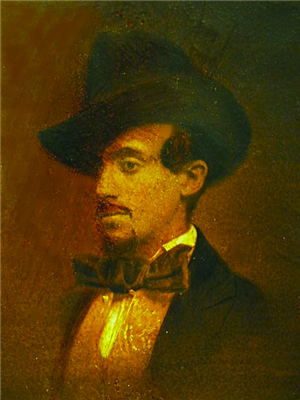
Biography
After relocating to Hilo around 1888[1], Furneaux worked as a consular agent for the United States until annexation in 1898, while continuing to paint. He taught at both Punahou and ʻIolani School and became one of the defining figures of what is now called the Volcano School: a loose group of artists who made the eruptions of Kīlauea their primary subject. The volcanic landscape of the Big Island offered something no mainland artist could easily replicate, and Furneaux's canvases of lava flows and fire-lit nights circulated internationally as records of one of the world's most dramatic natural phenomena.
A fire in 1893[1] destroyed his home and much of his work. In 1999, a Kīlauea painting sold at Christie's Los Angeles for $17,260, a modest auction result by contemporary standards but one that confirms ongoing collector interest. His work is held by the Bishop Museum, the Honolulu Museum of Art, and Mount Holyoke College Art Museum.
Declining eyesight ended his painting in later years. He turned to photography and coffee farming near Olaa, dying there on 7 November 1913[1].
Timeline
- 1835Born in Boston, Massachusetts.
- 1880Moved to the Hawaiian Kingdom from Massachusetts.
- 1885Awarded the Ordre de Kapiʻolani by King Kalākaua.
- 1885Painted a portrait of Queen Kapiʻolani in coronation robes; it is now held at ʻIolani Palace.
- 1888Relocated to Hilo, Hawaii, around this time.
- 1893Lost his home and much of his work in a fire.
- 1898Became a consular agent for the United States until annexation.
- 1913Died near Olaa, Hawaii, on 7 November, aged 78. He had turned to photography and coffee farming due to declining eyesight.
Notable Works
Tap to view larger.
Next stop
Browse the movements →
Every movement in the collection, from the Renaissance to Pop art.
Related Artists
_%E2%80%93_LOC.jpg)


Frequently Asked Questions
What is Charles Furneaux known for?
Charles Furneaux is known as one of the defining figures of the Volcano School. This was a group of artists who primarily painted the eruptions of Kīlauea. His paintings of lava flows and fire-lit nights were circulated internationally.What should I know about Charles Furneaux's prints?
Charles Furneaux was an English artist, who is best known for his depictions of Hawaii. Born in 1835[1], he spent much of his career there, after travelling from Boston to Honolulu in 1880[1]. Furneaux's early life included studies at the Royal Academy in London. He later emigrated to the United States. Before arriving in Hawaii, he worked as a portrait painter in Boston. He was married to the painter Eveline J. Furneaux. Once in Hawaii, Furneaux captured scenes of the islands. His output includes oil paintings and watercolours. These paintings often show the Hawaiian landscape, including volcanoes and coastal views. He also painted portraits of Hawaiian royalty and other prominent figures. His style is characterised by detailed realism and a careful attention to light and shadow. Furneaux's work was popular with tourists and residents alike, and his paintings were often reproduced as prints. These prints made his art accessible to a wider audience. He died in Honolulu in 1913[1], leaving behind a substantial body of work that provides a valuable record of Hawaii during the late 19th and early 20th centuries.What style or movement did Charles Furneaux belong to?
Charles Furneaux (1835[1]-1913[1]) was active as a painter in Hawai'i during the late 19th century. He is generally associated with a representational style of painting. This style is characterised by its realistic depiction of subjects. Furneaux's paintings often feature Hawaiian subjects. These include portraits of native Hawaiians and scenes of island life. His work provides a visual record of Hawai'i during a period of significant cultural and social change. He captured the likenesses of people and places with a degree of accuracy. While not formally aligned with a specific art movement, Furneaux's approach shares similarities with other artists working in a representational manner during this time. His attention to detail and his focus on capturing the likeness of his subjects place him within a broader tradition of realist painting. This tradition valued accurate observation and faithful reproduction of the visible world.What techniques or materials did Charles Furneaux use?
It is difficult to provide a comprehensive list of Charles Furneaux's techniques and materials. However, some general observations about artistic techniques may be helpful. An artist's technique involves more than just the materials used; it includes the manual and mechanical operations that shape raw materials according to artistic intentions. The choice of materials and techniques is an important decision that influences the aesthetic qualities of the artwork. Artists are not always limited by their chosen medium. The "methods" employed are part of the painter's technique. For example, some artists start as craftspeople, then move towards expressing ideas and feelings. Others begin with ideas and feelings, then address the practicalities of craft to express them. Sir Charles Eastlake noted that understanding the careful processes used by great painters should not lead one to mistake the means for the end, but to appreciate the mechanical operations that contribute to the durability of their work.What was Charles Furneaux known for?
Charles Furneaux (1835[1]-1913[1]) was an English artist who spent much of his career in Hawaii. He is best known for his paintings documenting the Hawaiian Islands, its people, and its culture in the late 19th and early 20th centuries. Born in Boston, Lincolnshire, Furneaux studied at the Royal Academy in London. He arrived in Hawaii around 1880[1], initially working as a painter at the Volcano House hotel on the Big Island. This position allowed him to observe and depict the volcanic activity of Kilauea, producing dramatic images that captured the power of nature. Furneaux later moved to Honolulu, where he established himself as a professional artist. He became a popular portrait painter, receiving commissions from Hawaiian royalty and prominent members of society. His portraits offer insights into the appearance and status of his sitters. He also painted scenes of daily life, such as fishing villages and agricultural activities, providing valuable records of a rapidly changing Hawaii. His work is held in several public and private collections, including the Bishop Museum in Honolulu.Where can I see Charles Furneaux's work?
Charles Furneaux was a British artist who spent much of his career in Hawaii. He is best known for his depictions of Hawaiian subjects during the late 19th century. To view Furneaux's work, one should consider both public and private collections. The Bishop Museum in Honolulu holds a number of his paintings. These offer insight into his artistic style and subject matter. The Honolulu Museum of Art also possesses pieces by Furneaux. Their collection provides further opportunity to study his technique. Beyond Hawaii, some of Furneaux's works have appeared in auctions internationally. These sales occasionally offer a chance to view pieces that are otherwise held in private hands. Auction catalogues can be a useful resource for tracking the whereabouts and sales history of his paintings. Researching museum holdings and auction records will provide a comprehensive view of Furneaux's artistic output.Who did Charles Furneaux influence?
Charles Furneaux's direct influence on other artists is not well documented. However, the art world during his lifetime saw many movements and counter-movements, with artists influencing each other in complex ways. During Furneaux's career, Impressionism gained traction, and Post-Impressionism emerged, with figures such as Gauguin, Van Gogh, and Cézanne pushing boundaries. These artists explored colour, form, and personal expression, impacting subsequent generations. For example, Gauguin had disciples such as Charles Laval, whose paintings were often mistaken for Gauguin's. Later, Henri Matisse, initially an Impressionist, experimented with colour, eventually helping to create Fauvism. These shifts suggest a period of intense artistic exchange, where artists built upon or reacted against the ideas of their peers. While Furneaux's specific impact might be difficult to trace, he was part of this broader network of artistic influence.Who influenced Charles Furneaux?
It is difficult to name specific influences on Charles Furneaux. However, some general artistic movements can be discussed. The Pre-Raphaelite Brotherhood, active in England from 1848[1], rejected academic convention. They favoured the detailed observation of nature and literary, often moralising, subjects. Their influences included earlier artists such as Coleridge and Wordsworth. Later in the 19th century, Impressionism developed, especially in France. Impressionist painters such as Camille Pissarro reacted against academic painting. They worked outdoors, exploring light and colour in new ways. Neo-Impressionism, Pointillism, and Symbolism also emerged. Artists like Paul Gauguin, Henri Martin, and Jan Verkade engaged with these movements. Any of these artistic ideas may have had an impact on Furneaux.Who was Charles Furneaux?
Charles Furneaux (1835[1]-1913[1]) was an English artist who spent much of his career in Hawaii. Born in Boston, Lincolnshire, he emigrated to the United States as a young man. He initially worked as a portrait painter in the American[1] West. Furneaux arrived in Hawaii around 1880[1]. He became a prominent figure in the local art scene, creating paintings of Hawaiian subjects. These included portraits of Hawaiian royalty and depictions of island scenery. His style was realistic, reflecting his training as a portraitist. He received commissions from King Kalākaua, further establishing his reputation. Furneaux's work provides a visual record of Hawaii during a period of significant cultural and political change. He captured the likenesses of important figures and documented the appearance of the islands before extensive modernisation. Furneaux died in Honolulu in 1913. His paintings are now held in both public and private collections, including the Bishop Museum and the Honolulu Museum of Art. They remain valuable historical documents and examples of art from the Kingdom of Hawaii period.Why are Charles Furneaux's works important today?
It is difficult to assess the importance of Charles Furneaux's works today based on the material provided. The passages discuss Roger Fry's admiration for Charles Mauron, a French aesthetician and translator. Fry translated Mauron's essay on aesthetics in 1925 and greatly admired his intellect and sensitivity to art. Fry and E.M. Forster considered Mauron's way of perceiving art to be unique. They jointly proposed that Mauron experience Italian art before his eyesight deteriorated further. They believed this trip would be a valuable investment in his intellectual future. The planned trip to Genoa, Florence, Siena, Orme, and Viterbo never occurred. Instead, Fry invited Mauron to a summer event at Pontigny in 1925, where he could meet Charles Du Bos. Mauron and Fry translated each other's works. Mauron had been a research chemist until an accident affected his sight. He later developed psychocriticism.How did Charles Furneaux die?
Charles Furneaux died in 1913[1] at the age of 78.
Sources
Editorial draws on the following primary and tertiary references for Charles Furneaux.
- [1] wikipedia Wikipedia: Charles Furneaux Used for: biography, birth dates, death dates, identifiers, movement attribution, nationality.
- [2] book Landon, Carolyn, Banksia Lady - Celia Rosser, Botanical Artist Used for: biography.
- [3] book Penny Olsen, Collecting Ladies: Ferdinand Von Mueller and Women Botanical Artists Used for: biography.
- [4] book Masterpieces of western art : a history of art in 900 individual studies from the Gothic to the present day Used for: biography.
- [5] book Pre-Raphaelitism and the Pre-Raphaelite Brotherhood (2 Volumes) Used for: biography.
- [6] book Landauer, Susan, The not-so-still life : a century of California painting and sculpture Used for: biography.
- [7] book John Gribbin, The Scientists Used for: biography.
Editorial overseen by Solis Prints. Sources verified 2026-10-16. Click a source for details, or hover over [N] in the page above to preview.
Editorial standardsMethodologyCorrectionsAI disclosureAbout the editorial team