



Cassius Marcellus Coolidge
If any single body of work defines the absurdist underbelly of American[1] popular culture, it is probably Cassius Marcellus Coolidge's Dogs Playing Poker series. Painted in 1903[1] for a Brown and Bigelow advertising campaign promoting cigars, the sixteen oil paintings depicted anthropomorphised dogs gathered around a felt-covered table, bluffing, dealing, and occasionally cheating. Coolidge received a modest commission. He could not have imagined that a century later two of the canvases, "A Bold Bluff" and "Waterloo", would sell together at Doyle New York in 2005 for $590,400.
Biography
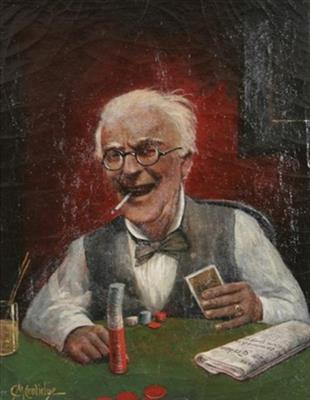
Born on 9 September 1844[1] in Antwerp, New York, Coolidge was largely self-taught, a circumstance that freed him from academic convention and pushed him toward popular illustration, sign painting, and novelty photography. He invented the "comic foreground", the painted board with a face-hole cut out, still found at seaside resorts, and produced a steady stream of calendar art and illustrated books. He often signed his work as "Kash Koolidge", a phonetic joke that tells you everything about his relationship to the fine art establishment.
Coolidge worked squarely in the tradition of genre painting, depicting working-class leisure with an illustrator's eye for narrative detail rather than a painterly concern with light or surface. His dogs are individuated characters: the cheat hiding an ace under the table, the stoic bulldogs, the jaunty terrier. The humour is knowing but affectionate.
He died on 13 January 1934[1] in Brooklyn, New York, having outlived any serious critical consideration of his work. That reassessment came posthumously, as the Poker Dogs migrated from barbershop walls to auction catalogues, gift shops, and internet memes. He remains one of the most reproduced artists in American[1] history, which is either a distinction or a punchline, possibly both.
Timeline
- 1844Born on 9 September in Antwerp, New York.
- 1903Painted the Dogs Playing Poker series for Brown and Bigelow, an advertising campaign promoting cigars.
- 1903Created sixteen oil paintings depicting dogs playing poker.
- 1903Signed his work as "Kash Koolidge", a phonetic joke.
- 1934Died on 13 January in Brooklyn, New York.
Notable Works
Tap to view larger.
Next stop
Browse the movements →
Every movement in the collection, from the Renaissance to Pop art.
Related Artists
_%E2%80%93_LOC.jpg)



Frequently Asked Questions
What is Cassius Marcellus Coolidge known for?
Cassius Marcellus Coolidge is best known for his Dogs Playing Poker series. These sixteen oil paintings, completed in 1903[1], depict anthropomorphised dogs playing poker and were originally part of an advertising campaign for cigars.What is Cassius Marcellus Coolidge's most famous work?
Cassius Marcellus Coolidge is best known for his series of paintings titled *Dogs Playing Poker*. This series, executed in 1903[1], comprises sixteen oil paintings commissioned by Brown & Bigelow to advertise cigars. The paintings depict anthropomorphised dogs engaged in various human activities, with a recurring theme of dogs playing poker. Among the most recognised works from the series are *A Friend in Need*, showing a bulldog passing a card to his partner, and *Poker Game*, illustrating a tense moment during a high-stakes game. Coolidge's *Dogs Playing Poker* paintings have become deeply embedded in popular culture, often reproduced on posters, prints, and other merchandise. While they are not always critically admired within the fine art world, their accessibility and humorous content have made them widely recognisable and commercially successful. The series' enduring appeal lies in its blend of canine charm and familiar human scenarios.What should I know about Cassius Marcellus Coolidge's prints?
Cassius Marcellus Coolidge (1844[1]-1934[1]) was an American[1] artist, mainly active in commercial art. Although he produced a range of paintings, drawings, and prints, he is best known for his series of paintings called *Dogs Playing Poker*. Coolidge did not create fine-art prints in the traditional sense (mezzotints, etchings, photogravures). Instead, his prints are generally photo-reproductions of his paintings, produced using offset lithography. These were aimed at a popular market, rather than collectors of fine art. Some companies specialise in decorative art for commercial markets, creating unlimited edition offset reproductions. These companies license images of still lifes, animals, and similar subjects for hotels, designers, and galleries. The editions are often created in collaboration with the artist. Coolidge's prints are widely available and relatively inexpensive, reflecting their original purpose as mass-produced items. They remain popular as humorous and nostalgic decorations.What style or movement did Cassius Marcellus Coolidge belong to?
Cassius Marcellus Coolidge is not easily categorised within a specific art movement. His famous paintings of dogs playing poker, such as "Dogs Playing Poker", are generally considered part of popular culture and are associated with advertising and commercial art, rather than fine art movements. Some art historians might link Coolidge's work to American[1] Scene painting, which gained traction in the 1930s. This movement focused on depicting everyday life and culture in the United States. Coolidge's paintings certainly portray a specific aspect of American culture, albeit in a humorous and anthropomorphic way. However, his work lacks the social commentary or realism often associated with American Scene painters like Thomas Hart Benton or John Steuart Curry. Others might consider his work as part of the broader category of genre painting, which depicts scenes from everyday life. Ultimately, Coolidge's unique style and subject matter place him in a category of his own, blurring the lines between commercial art, genre painting, and popular culture.What techniques or materials did Cassius Marcellus Coolidge use?
Information about Cassius Marcellus Coolidge's specific techniques is scarce. However, we can discuss general oil-painting methods and materials common at the time, and some materials used by other artists. Oil painters often used canvas, sometimes prepared with a gesso ground. They might also use hardboard panels. For thinning paint, artists employed turpentine or mineral spirits. Mediums, such as linseed oil or damar varnish, could be added to alter the paint's consistency and texture. Some artists would sketch their composition beforehand, using materials as simple as paper and a pencil. J.M.W. Turner, a British artist working earlier in the 19th century, provides an example of period techniques. Turner initially worked in watercolours, developing techniques he later used with oils. He favoured light-toned, absorbent surfaces. For grounds, he used white lead in whole egg medium, or lead white in oil.What was Cassius Marcellus Coolidge known for?
The American[1] artist Cassius Marcellus Coolidge (1844[1]-1934[1]) is best remembered for his series of paintings, commissioned by the advertising firm Brown & Bigelow, which depict dogs playing poker. Although he is primarily known for these works, Coolidge's artistic career encompassed a variety of endeavours. He began as a cartoonist and also produced comic almanacs. Beyond art, he had diverse entrepreneurial pursuits, including owning a drugstore and starting a bank. Coolidge did not invent the concept of animals engaged in human activities. However, his series of paintings, such as *A Friend in Need* and *Poker Game*, achieved considerable popularity and became a recurring motif in popular culture. These paintings usually portray anthropomorphised dogs sitting around a table, smoking cigars, and playing cards. The images are humorous and have a distinctly American character. The paintings' mass reproduction as prints and posters contributed to their widespread recognition.When did Cassius Marcellus Coolidge live and work?
Cassius Marcellus Coolidge was active in the late 19th and early 20th centuries. While specific dates are absent from these passages, they offer a glimpse into the artistic milieu of his time. Coolidge's career overlapped with that of William Michael Harnett (1848[1]-1892[1]), a still-life painter known for his trompe l'oeil works. Harnett's paintings often featured everyday objects, such as newspapers, pipes, and books, arranged on tabletops. The passages mention several of Harnett's works from the 1880s, including 'Still Life' (1887), 'Music and Good Luck' (1888), and 'The Old Cupboard Door' (1889). These works provide a context for understanding the artistic trends and styles that were popular during Coolidge's working life. The passages also allude to the commercial aspect of art during this period, with works being exhibited for sale in department stores and hotels.Where can I see Cassius Marcellus Coolidge's work?
While availability changes, works by Cassius Marcellus Coolidge can sometimes be viewed in museums. In the United States, these include the Charles Hosmer Morse Museum of American[1] Art (Winter Park, Florida), the Los Angeles County Museum of Art (Los Angeles), the Metropolitan Museum of Art (New York), the Minneapolis Institute of Arts (Minneapolis), the Museum of Modern Art (New York), the Virginia Museum of Fine Arts (Richmond), and the Wolfsonian at Florida International University (Miami Beach). In Canada, Coolidge's work can be seen at the Royal Ontario Museum in Toronto. In the United Kingdom, you might find his pieces at the Bakelite Museum (Williton), the Brighton Museum & Art Gallery (Brighton), the Geffrye Museum (London), the Manchester Art Gallery (Manchester), the National Museums of Scotland, Royal Museum (Edinburgh), and the Victoria & Albert Museum (London).Where was Cassius Marcellus Coolidge from?
Cassius Marcellus Coolidge was born in 1844[1] in Antwerp, New York. He is known for his paintings of dogs playing poker. Coolidge did not receive formal artistic training; instead, he worked various jobs, including as a druggist, sign painter, and cartoonist. He is sometimes referred to as 'Cash' or 'Kash' Coolidge. Coolidge moved around the United States, living for periods in Rochester, New York, and later in Cincinnati, Ohio. It was in Cincinnati that he began producing the paintings of dogs in human-like situations that would bring him popular recognition. Coolidge secured a commission from the advertising firm Brown & Bigelow to create a series of these paintings, starting in 1903[1]. While he is most famous for the poker-playing dogs, his wider body of work included comic and genre scenes.Who did Cassius Marcellus Coolidge influence?
It is difficult to identify specific artists who were directly influenced by Cassius Marcellus Coolidge, owing to the passage of time and the nature of his work. However, one can consider Coolidge's impact within the broader context of early 20th-century American[1] art and its subsequent developments. Coolidge's "Dogs Playing Poker" series, while not critically esteemed, achieved considerable popular appeal. This commercial success, alongside his use of anthropomorphic animals in humorous situations, may have had an indirect influence on later artists working in popular illustration and commercial art. The concept of accessibility in art, arguably present in Coolidge's work, can be seen as a precursor to later movements that challenged traditional art hierarchies. The lack of readily available information makes it hard to draw firm conclusions about Coolidge's direct artistic descendants.Who influenced Cassius Marcellus Coolidge?
It is difficult to identify influences on Cassius Marcellus Coolidge. However, a discussion of Edward Hopper's influences may be instructive. Hopper studied with William Merritt Chase and Robert Henri at the New York School of Art. Chase encouraged his students to visit the Metropolitan Museum of Art, where he sometimes lectured. Chase wanted his students to find inspiration in great paintings and defended the assimilation of others' advances. He told his students to get a complete set of photographs of Fortuny's pictures, and Hopper made a pen-and-ink study after Fortuny. Henri gave his students a philosophy, not a specific style. Hopper praised Henri's courage and energy, which he said did much to shape the course of art in America. Hopper claimed first-hand knowledge of Henri's enthusiasm and his power to energise students. Henri, like Chase, encouraged his students to study artists of the past, particularly Manet, Hals, Rembrandt, Goya, Degas, and Daumier. Hopper also liked Kenneth Hayes Miller, his other teacher at the New York School of Art, whom he later credited with having a fine sober influence on much contemporary painting.Who was Cassius Marcellus Coolidge?
Cassius Marcellus Coolidge (1844[1]-1934[1]) was an American[1] artist, though sources do not agree on the details of his life and work. Some list him as an uncredited illustrator, others as a painter of small, sentimental paintings of kittens and puppies, as well as some flower and fruit pieces, and a little sculpture of animals. Coolidge is best known for his series of paintings, *Dogs Playing Poker*. These works, commissioned by Brown & Bigelow to advertise cigars, depict anthropomorphic dogs engaged in various human activities, with several of them playing poker. The series comprises eighteen paintings, completed in the early 1900s, and has become a popular, if somewhat derided, part of American popular culture. Coolidge did not receive formal artistic training. Before taking up painting, he worked a variety of jobs, including as a pharmacist, sign painter, and cartoonist. He is also credited with inventing 'comic foregrounds', novelty photographs where people pose in front of a board with a painted scene, with a hole cut out for their faces.
Sources
Editorial draws on the following primary and tertiary references for Cassius Marcellus Coolidge.
- [1] wikipedia Wikipedia: Cassius Marcellus Coolidge Used for: biography, birth dates, death dates, identifiers, movement attribution, nationality.
- [2] book Alfred Frankenstein, After the Hunt _ William Harnett and Other American Still Life Painters, 1870-1900 Used for: biography, stylistic analysis.
- [3] book Susie Hodge, Artists and Their Pets Used for: stylistic analysis.
- [4] book Doss, Erika, 1956-, Benton, Pollock, and the politics of modernism : from regionalism to abstract expressionism Used for: biography.
- [5] book Doss, Erika, 1956-, Benton, Pollock, and the politics of modernism : from regionalism to abstract expressionism Used for: biography.
- [6] book Masterpieces of western art : a history of art in 900 individual studies from the Gothic to the present day Used for: biography.
Editorial overseen by Solis Prints. Sources verified 2026-09-02. Click a source for details, or hover over [N] in the page above to preview.
Editorial standardsMethodologyCorrectionsAI disclosureAbout the editorial team