



Bui Xuan Phai
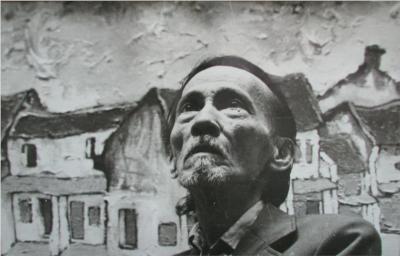
For most of the 1960s and 1970s, Bùi Xuân Phái painted in private. He had been dismissed from his teaching post at the Hanoi College of Fine Arts in 1957[1], after lending public support to the Nhan Van affair, a short-lived campaign for artistic freedom in North Vietnam[1], and his work was barred from official exhibition until 1984. He painted the streets of Hanoi's Old Quarter anyway, on whatever material was to hand: canvas, wooden boards, newspaper.
Biography
Born in Hanoi in 1920[1], Phai studied at the École Supérieure des Beaux-Arts d'Indochine, where he encountered European modernism through the influence of Picasso, Matisse, and Chagall. The narrow lanes and crumbling French-colonial shophouses of the Old Quarter became his central subject, painted in muted ochres and greys with the flat, declarative outlines of someone more interested in memory than documentation.
He also painted Vietnamese cheo and tuong theatre performers, capturing actors mid-makeup in small, intimate oils that work against the heroic grain of the period's official art. His 1972[1] oil Hanoi Old Quarters has since become one of the most reproduced paintings in Vietnamese art history. The affection Hanoi residents felt for his street scenes gave rise to the term pho Phai (Phai's streets), now in general use for any painting of the Old Quarter in his manner.
Phai died in 1988[1], having seen his work officially rehabilitated only four years earlier. Vietnam[1]'s Ho Chi Minh Prize in Literature and Art was awarded to him posthumously in 1996.
Timeline
- 1920Born in Hanoi.
- 1957Dismissed from his teaching position at the Hanoi College of Fine Arts after supporting the Nhan Van affair.
- 1960Painted in private for most of the 1960s and 1970s.
- 1972Painted the oil painting "Hanoi Old Quarters".
- 1984His work was allowed in official exhibitions again.
- 1988Died, aged 68.
Notable Works
Tap to view larger.
Next stop
Browse the movements →
Every movement in the collection, from the Renaissance to Pop art.
Related Artists
Frequently Asked Questions
What is Bui Xuan Phai known for?
Bùi Xuân Phái is known for his paintings of Hanoi's Old Quarter, which became his central subject. His street scenes were so beloved by Hanoi residents that they coined the term pho Phai (Phai's streets) to describe any painting of the Old Quarter in his style. His 1972[1] oil Hanoi Old Quarters has become one of the most reproduced paintings in Vietnamese art history.Who was Bui Xuan Phai?
Bùi Xuân Phái was a Vietnamese artist who was dismissed from his teaching post at the Hanoi College of Fine Arts in 1957[1]. His work was barred from official exhibition until 1984, after he lent public support to a campaign for artistic freedom. Despite this, he continued to paint, often depicting the streets of Hanoi's Old Quarter.What was Bui Xuan Phai's art style?
Bùi Xuân Phái's art style was influenced by European modernism, which he encountered at the École Supérieure des Beaux-Arts d'Indochine. He painted in muted ochres and greys with flat, declarative outlines. His style is characterised as being more interested in memory than documentation.How did Bui Xuan Phai die?
Bui Xuan Phai died in 1988[1] at the age of 68.
Sources
Editorial draws on the following primary and tertiary references for Bui Xuan Phai.
- [1] wikipedia Wikipedia: Bui Xuan Phai Used for: biography, birth dates, death dates, identifiers, movement attribution, nationality.
- [2] book Yan Zhou, A History of Contemporary Chinese Art Used for: stylistic analysis.
- [3] book guggenheim-anglesofvisionfr00denn Used for: biography.
- [4] book guggenheim-onehundredpainti00thom Used for: biography.
- [5] book guggenheim-twopri00weis Used for: biography.
Editorial overseen by Solis Prints. Sources verified 2026-08-26. Click a source for details, or hover over [N] in the page above to preview.
Editorial standardsMethodologyCorrectionsAI disclosureAbout the editorial team