



Boris Schatz
Boris Schatz founded the Bezalel School of Arts and Crafts in Jerusalem in 1905[1] not simply as an art institution but as a political act: a Zionist project to revive ancient Hebrew craft traditions and create a visual culture for a future Jewish homeland. He had met Theodor Herzl in 1903, and within two years had secured backing to open what would become the foundation of Israeli art education.
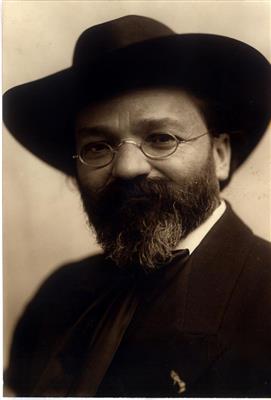
Biography
Before Jerusalem, Schatz's career took an unlikely route. Born in Varniai in the Russian[1] Empire (present-day Lithuania) in 1866[1], he trained at the Vilnius School of Drawing, moved to Paris to study sculpture under Mark Antokolsky, and ended up as court sculptor to Prince Ferdinand I of Bulgaria from 1895[1] to 1905. That decade in Sofia gave him both the technical reputation and the connections that made the Bezalel project possible.
The school's motto, "Art is the bud, craft is the fruit," summed up his approach: fine art and applied craft were inseparable, and both could carry national meaning. Bezalel taught painting and sculpture alongside carpet-making, metalworking, and bookbinding, producing objects that drew on biblical imagery and ancient Near Eastern ornament. Not everyone approved. In his 1935 YIVO speech, Marc Chagall warned that Bezalel had been built by "inexperienced and not-very-artistic hands" and declared it a model to avoid.
The school closed in 1929[1] under financial pressure and reopened in 1935 as the New Bezalel School. Schatz did not see it: he died in Denver on 23 March 1932[1], mid-fundraising tour through the United States. His personal collection later formed a core part of what became the Israel Museum, Jerusalem.
Timeline
- 1866Born in Varniai, Russian Empire (present-day Lithuania).
- 1895Became court sculptor to Prince Ferdinand I of Bulgaria in Sofia.
- 1903Met Theodor Herzl.
- 1905Founded the Bezalel School of Arts and Crafts in Jerusalem.
- 1929The Bezalel School closed due to financial issues.
- 1932Died in Denver, United States, on 23 March. He was on a fundraising tour.
Notable Works
Tap to view larger.
Next stop
Browse the movements →
Every movement in the collection, from the Renaissance to Pop art.
Related Artists



Frequently Asked Questions
What is Boris Schatz known for?
Boris Schatz is known for founding the Bezalel School of Arts and Crafts in Jerusalem. He established the school as a Zionist project intended to revive ancient Hebrew craft traditions and to create a visual culture for a future Jewish homeland.What is Boris Schatz's most famous work?
Boris Schatz (1867[1]-1932[1]) was a Lithuanian-Jewish artist and sculptor, active in the Zionist movement. He is most associated with his foundation of the Bezalel Academy of Arts and Design in Jerusalem in 1906. Schatz envisioned Bezalel as a place to both educate Jewish immigrants in useful trades and to develop a unique national style of art. He hoped this new style would allow artists to create a visual culture for the Zionist project. As part of this goal, Schatz encouraged the school's artists and craftspeople to create works inspired by the Bible, Jewish history, and the Middle Eastern setting. Bezalel became known for pieces in a mix of styles, combining European Art Nouveau and Arts and Crafts motifs with orientalist designs. Though Schatz was forced out of his leadership position in 1926, the Bezalel Academy survives as a major art institution in Israel.What should I know about Boris Schatz's prints?
Boris Schatz (1867[1]-1932[1]) was a Lithuanian-born Jewish artist and sculptor who later became a Zionist activist. He is best known as the founder and director of the Bezalel Academy of Arts and Design in Jerusalem. When considering Schatz's prints, it is important to understand the context of printmaking as a medium. The market distinguishes between an original print and a reproduction, with the former being conceived and executed solely as a print, often in a limited, numbered, and signed edition. Each print in the edition is considered an original, individually inked and pulled from a plate, stone, or screen created for that purpose. Reproductions, on the other hand, are copies of artworks initially created in another medium, such as painting or watercolour, and are typically produced using photo-mechanical means. Numbering and signing a reproduction does not change its fundamental nature as a copy. Factors such as the artist's involvement in the printing process, the quality of materials used, and the size of the edition can all affect the value and collectability. The intent behind the creation of the image is also important: is it meant to replicate another artwork, or is it a unique artistic statement realised through the medium of printmaking?What style or movement did Boris Schatz belong to?
Boris Schatz (1867[1]-1932[1]) was a Lithuanian-Jewish artist and sculptor who later became active in Mandate Palestine. He is most associated with the Art Nouveau movement; it was a style that influenced his artistic output. Art Nouveau, which peaked in popularity between 1890 and 1910, is characterised by its use of long, sinuous, organic lines and was inspired by natural forms, such as flowers and insects. Schatz founded the Bezalel Academy of Arts and Design in Jerusalem in 1906. The Academy taught a mix of Art Nouveau and Zionist-inspired art, with the goal of creating a unique Jewish artistic identity. His work often incorporated Jewish themes and symbols, blending them with the decorative aesthetics of Art Nouveau. This fusion is apparent in pieces such as his sculptures and reliefs, which feature flowing lines and stylised figures reminiscent of the movement.What was Boris Schatz known for?
Boris Schatz (1867[1]-1932[1]) was a Lithuanian-Jewish artist and sculptor who was instrumental in the development of Jewish art and culture in the late 19th and early 20th centuries. He is best known as the founder and director of the Bezalel Academy of Arts and Design in Jerusalem, which he established in 1906. Schatz believed in creating a distinctive Jewish artistic style, one that drew inspiration from both European art traditions and Jewish history and culture. He envisioned Bezalel as a place where Jewish artists could learn traditional crafts, such as metalwork, wood carving, and weaving, and use these skills to create works of art that reflected Jewish identity and heritage. Beyond his role as an educator and administrator, Schatz was himself a sculptor and painter. His artistic output included sculptures of biblical figures and historical scenes, as well as paintings that depicted Jewish life in Eastern Europe and Palestine. His work often carried nationalistic and Zionist themes, reflecting his belief in the importance of creating a modern Jewish culture in the land of Israel.When did Boris Schatz live and work?
Boris Schatz was a Lithuanian-Jewish artist and sculptor who lived from 1867[1] to 1932[1]. Schatz studied art in Warsaw and Paris before moving to Bulgaria in 1889. There, he served as court sculptor to Prince Ferdinand I. He is credited with founding the National Academy of Art in Sofia. In 1906, Schatz established the Bezalel School of Arts and Crafts in Jerusalem. This institution, which he directed for many years, aimed to promote Jewish art and design, drawing inspiration from both European and Middle Eastern traditions. The Bezalel school sought to develop a distinctive Jewish artistic identity and to train artists and craftsmen to create works that reflected their cultural heritage. Schatz's own artistic output included sculptures, paintings, and writings on art and Zionism. He was a strong advocate for the development of art in Palestine and believed that art could play a role in the building of a Jewish national identity.Where can I see Boris Schatz's work?
It is difficult to pinpoint exactly where Boris Schatz's work is currently held. However, several museums contain collections of art and decorative arts from the periods and places in which he was active. These may be good places to start your search. In Europe, these include the Musée des Arts Décoratifs (Paris), the Musée des Beaux-Arts (Nancy), the Brangwyn Museum (Brugge, Belgium), the National Museums of Scotland (Edinburgh), the Victoria & Albert Museum (London), the Kunsthaus Zürich, and the Kunstmuseums in Basle, Berne, and Winterthur. In Spain and Portugal, try the Museu Calouste Gulbenkian (Lisbon), the Museu d’Art Modern (Barcelona), and the Museo Art Nouveau y Art Déco (Salamanca). In North America, possible locations are the Metropolitan Museum of Art (New York), the Museum of Modern Art (New York), the Los Angeles County Museum of Art, the Minneapolis Institute of Arts, the Royal Ontario Museum (Toronto), the Charles Hosmer Morse Museum of American Art (Winter Park, Florida), and the Wolfsonian at Florida International University (Miami Beach).Where was Boris Schatz from?
Boris Schatz was born in Varniai, Lithuania, in 1867[1]. His early education focused on religious studies, but he later pursued artistic training in Warsaw and Paris. In 1906, Schatz founded the Bezalel Academy of Arts and Design in Jerusalem. This institution aimed to create a distinctive Jewish art style, blending European artistic techniques with Jewish themes and motifs. Schatz envisioned Bezalel as a centre for artistic production and a means of promoting Jewish national identity. He served as its director until 1932[1]. Schatz's work included sculpture, painting, and jewellery design. He often depicted biblical subjects and historical figures. His efforts to establish a national art contributed to the development of Israeli art and culture. He died in Denver, Colorado, in 1932, while on a fundraising trip for the Bezalel Academy.Who did Boris Schatz influence?
Boris Schatz, as founder of the Bezalel School of Arts and Crafts in Jerusalem in 1906[1], influenced generations of Jewish artists by promoting a distinctive "Hebrew style" that combined European art nouveau and symbolism with Jewish and Middle Eastern motifs. While Schatz's direct artistic influence is difficult to trace, his institutional impact is clear. The Bezalel School trained numerous artists who went on to develop their own styles, often incorporating elements of Jewish identity and culture into their work. His emphasis on national art also connects to the broader Zionist movement and its cultural expressions. Some scholars see a line from Schatz's work to later Jewish artists such as Ben Shahn, R. B. Kitaj, and Tobi Kahn, all of whom explored Jewish themes in their art. However, this connection is thematic rather than a direct stylistic inheritance. Schatz's main contribution was creating an environment where Jewish artists could explore their heritage, not dictating how they should do so.Who influenced Boris Schatz?
It is difficult to assess the influences on Boris Schatz. Later in life, artists often acknowledge the impact of their cultural origins on their work. One artist noted that, although they had lived and worked in the United States for most of their life, their Russian[1] background was discernible in their painting. They observed that, in the case of Kandinsky, his Russian background became more apparent later in his life; for example, his colours, which always revealed the influence of Byzantine icons, grew even more Russian. This artist felt that this was undoubtedly true in their own case as well. Another artist recalled that the art that helped form them in their college years was the Analytic Cubist work of Braque and Picasso (and even some of the later work), early Kandinsky, and Miro. Along the edges were Matisse and Mondrian. They studied and analysed the structure of their paintings exhaustively. They looked hard at Matisse's Blue Window (1913[1]), Miro's Person Throwing a Stone at a Bird (1926), Cezanne's Card Players (1890-92), and Mondrian's grid paintings, as well as works by Leger, the Renaissance and Quattrocento artists, Old Masters, American masters, and African art; all the art they could find.Who was Boris Schatz?
Boris Schatz (1867[1]-1932[1]) was a Lithuanian-Jewish artist and sculptor, best known as the founder of the Bezalel Academy of Arts and Design in Jerusalem. Born in Varniai, Lithuania, Schatz received traditional Jewish education before studying art in Warsaw and Paris. He was deeply influenced by the Arts and Crafts movement and Zionist ideals, which led him to envision an art school in Palestine that would revive Jewish artistic traditions and create a new national style. In 1906, Schatz realised his vision with the establishment of Bezalel. The academy aimed to train Jewish artists and craftspeople, produce original works of art with Jewish themes, and develop a distinctive visual identity for the emerging Zionist movement. Bezalel's workshops produced a wide range of objects, from paintings and sculptures to metalwork and carpets, that blended European techniques with oriental motifs. Schatz directed Bezalel until 1932. His work and institution played a significant role in the development of Israeli art and culture.Why are Boris Schatz's works important today?
Boris Schatz (1867[1]-1932[1]) was a Lithuanian-Jewish artist and sculptor. He is remembered as the founder of the Bezalel Art School in Jerusalem in 1906. This school was intended to teach European art styles to Jewish students, so they could create a distinctive Jewish art. Schatz was a Zionist, and Bezalel was part of a larger effort to create a modern Jewish culture in Palestine. Schatz's work is important because it represents a fusion of European artistic styles with Jewish and Middle Eastern themes. This fusion was part of a broader trend of Jewish artists incorporating their heritage into their work, during a period of rising antisemitism and European nationalism. The school also played a role in the development of Israeli art and design. Many of its graduates became leading artists and designers in Israel. Bezalel helped to shape the visual culture of the emerging nation.
Sources
Editorial draws on the following primary and tertiary references for Boris Schatz.
- [1] wikipedia Wikipedia: Boris Schatz Used for: biography, birth dates, death dates, identifiers, movement attribution, nationality.
- [2] book Fischer, Lucy, Cinema by Design_ Art Nouveau, Modernism, and Film History (Film and Culture Series) Used for: biography.
- [3] book Fischer, Lucy, Cinema by Design_ Art Nouveau, Modernism, and Film History (Film and Culture Series) Used for: biography.
- [4] book Fischer, Lucy, Cinema by Design_ Art Nouveau, Modernism, and Film History (Film and Culture Series) Used for: biography.
- [5] book guggenheim-artoftomorrowfif1939gugg Used for: biography, stylistic analysis.
- [6] book guggenheim-chagallj00chag Used for: stylistic analysis.
- [7] book guggenheim-solomonrguggenhe00gugg Used for: biography.
- [8] book Masterpieces of western art : a history of art in 900 individual studies from the Gothic to the present day Used for: biography.
Editorial overseen by Solis Prints. Sources verified 2026-10-16. Click a source for details, or hover over [N] in the page above to preview.
Editorial standardsMethodologyCorrectionsAI disclosureAbout the editorial team