



Beatrice Wood
Beatrice Wood once summarised the secret of her longevity as "art books, chocolates, and young men." She died in Ojai, California, in 1998[1] aged 105. Born in San Francisco in 1893[1] to wealthy socialites and trained at the Académie Julian in Paris, she spent her early career as an actress, performing sixty theatrical roles in New York before abandoning the stage for art.
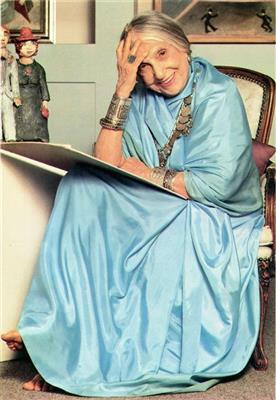
Biography
In 1916[1] she met Marcel Duchamp and Henri-Pierre Roché in New York, and the three became inseparable. They co-edited the short-lived Dada[1] journals The Blind Man and Rongwrong, and Wood was one of the few people who knew in advance that Duchamp had submitted a porcelain urinal to the 1917 Society of Independent Artists under the pseudonym R. Mutt. She later provided the most detailed written account of what happened when it was discovered and rejected. The Arensberg circle, which she moved through freely, called her "Mama of Dada."
Ceramics arrived almost by accident. Around 1940[1], searching for a teapot to match some baroque plates with a luster glaze, she enrolled in a ceramics class at Hollywood High School. That class became a sixty-year obsession. She studied under Gertrud and Otto Natzler and developed a signature approach to metallic luster glazes that brought her work into the collections of the Metropolitan Museum of Art, the Smithsonian, MoMA, and the Brooklyn Museum. In 1948 she moved to Ojai to be near the philosopher J. Krishnamurti, and she remained there for the rest of her life.
Her 1985[1] autobiography, I Shock Myself, was read by James Cameron while developing the 1997 film Titanic, and it partly inspired the character of elderly Rose.
Timeline
- 1893Born in San Francisco to wealthy socialites.
- 1916Met Marcel Duchamp and Henri-Pierre Roché in New York, becoming closely associated with them.
- 1917Co-edited the Dada journals The Blind Man and Rongwrong.
- 1940Enrolled in a ceramics class at Hollywood High School, initiating her career in ceramics.
- 1948Moved to Ojai, California, to be near the philosopher J. Krishnamurti.
- 1985Published her autobiography, I Shock Myself.
- 1997Her autobiography partly inspired the character of elderly Rose in James Cameron's film Titanic.
- 1998Died in Ojai, California, at 105.
Notable Works
Tap to view larger.
Next stop
Dada →
Explore the artists and ideas of Dada.
Related Artists


Frequently Asked Questions
What is Beatrice Wood known for?
Beatrice Wood is known for her ceramics, especially her signature approach to metallic luster glazes. Her work is held in the collections of the Metropolitan Museum of Art, the Smithsonian, MoMA, and the Brooklyn Museum.What is Beatrice Wood's most famous work?
It is difficult to name a single 'most famous work' by Beatrice Wood, as her notability arises from a long, productive, and varied career. She is best known for her ceramics, particularly her lustreware. These ceramic pieces often incorporate iridescent glazes, giving them a distinctive, eye-catching quality. Wood's artistic output also included drawings, paintings, and sculptures. Examples of her work can be found in the collection of the Guggenheim Museum. She was associated with the Dada[1] movement early in her career, and later in life became something of a public figure due to her status as an artist and personality. Her association with the artists Marcel Duchamp and Henri-Pierre Roché, and her later fictionalisation in the novel *Jules et Jim*, added to her notability.What should I know about Beatrice Wood's prints?
Prints are images produced in multiples from a single original. The practice dates to ancient Egypt and China, where stamps impressed patterns on textiles. Printmaking on paper became common in Europe in the late fourteenth century. Woodcuts served as book illustrations, religious icons, and playing cards. Before photography, prints provided image multiples. Printmaking was viewed as a craft for commercial reproduction, but artists such as Durer and Goya made graphics a high art. In the late nineteenth century, prints gained status as an artistic medium, and individual impressions became more important. Artists began signing prints to distinguish original graphics from reproductions. Edition sizes were limited and numbered to control quality and price. Artists also used handmade paper to add aesthetic value. Original prints allowed artists to reach a wider audience at a lower cost. An edition is a number of identical prints from the same block or blocks. Editions can be open or limited. The artist chooses to limit an edition; it is not a technical requirement.What style or movement did Beatrice Wood belong to?
Beatrice Wood is associated with the Dada[1] movement, an international artistic and cultural reaction to the First World War. Dada arose in neutral Zurich in 1916[1], founded by refugees from the war; it soon spread to France, Germany, and the United States. The name 'Dada' itself was a nonsense word, reflecting the movement's rejection of reason and order. Dada artists aimed to shock and denounce what they saw as a descent into madness. Dada encompassed a wide range of artistic expression, including nonsense verse, absurd performances, collage, photomontage, and the use of found objects. Marcel Duchamp, for example, created 'readymades' by designating ordinary manufactured items as art. Dada's rejection of traditional assumptions extended to casual replication of artworks and an embrace of whimsy, playfulness, and sarcasm. As Jean Arp put it, Dada sought 'to destroy the hoaxes of reason and to discover an unreasoned order.'What techniques or materials did Beatrice Wood use?
Beatrice Wood was an American[1] artist known for her ceramics, particularly lustre-glazed earthenware. She also produced drawings and paintings. For her ceramic work, Wood employed a direct, hands-on approach. She favoured simple forms, often inspired by folk art and ancient pottery. Her signature technique involved applying metallic salts to the glaze, creating a distinctive iridescent surface. This lustre effect, reminiscent of Renaissance maiolica, gave her pieces a unique quality. Wood embraced spontaneity and improvisation in her practice, sometimes incorporating imperfections into the finished work. Her approach to painting and drawing was similarly unconstrained. She used a variety of media, including watercolour and ink, to create whimsical and often humorous images.What was Beatrice Wood known for?
The provided passages do not mention Beatrice Wood. They focus instead on Marcel Duchamp and the Dada[1] movement. Duchamp became well-known in New York between 1915[1] and 1923. He, Man Ray, and Picabia formed a Dada group. Dada began in Switzerland and the US as a response to the First World War. It questioned society and defied artistic traditions, aiming to offend. In 1917, Duchamp submitted Fountain , a urinal signed R. Mutt, to an exhibition. Two years later, he added graffiti to a print of the Mona Lisa . During his New York period, he worked on The Bride Stripped Bare by Her Bachelors, Even , also known as The Large Glass ; this was made of oil, varnish, glass, and collage. The work remained uncompleted. From 1923, Duchamp lived in Paris, focusing on chess and writing. He returned to New York in 1942 and helped edit the Surrealist journal VVV , also organising a Surrealist exhibition.When did Beatrice Wood live and work?
Beatrice Wood was born in 1893[1] in San Francisco, California. She had a long and productive career, working until her death in Ojai, California, in 1998[1], at the age of 105. Wood was involved in the Dada[1] movement in New York, and she co-founded *The Blind Man* magazine with Marcel Duchamp and Henri-Pierre Roché in 1917[1]. She was a painter and ceramicist. Wood is best known for her lustre-glaze pottery, which she began producing in the 1930s. Her work often incorporated humour and social commentary. She was also a writer, publishing her autobiography, *I Shock Myself*, in 1985. Wood travelled extensively, drawing inspiration from various cultures and artistic traditions. She remained an active artist throughout her long life, and her work is held in many museum collections.Where can I see Beatrice Wood's work?
Beatrice Wood's artworks can be viewed in several museums internationally. In the United States, these include the Los Angeles County Museum of Art (LACMA); the Metropolitan Museum of Art in New York; the Minneapolis Institute of Arts; the Museum of Modern Art, also in New York; the Virginia Museum of Fine Arts in Richmond; and the Wolfsonian at Florida International University in Miami Beach. The Charles Hosmer Morse Museum of American[1] Art in Winter Park, Florida also holds relevant works. In Canada, the Royal Ontario Museum in Toronto has pieces on display. Museums in the United Kingdom with holdings include the Bakelite Museum in Williton; the Brighton Museum & Art Gallery; the Geffrye Museum and the Victoria & Albert Museum, both in London; the Manchester Art Gallery; and the National Museums of Scotland in Edinburgh. Other museums include the Bauhaus-Archiv in Berlin, the Bauhaus Museum in Weimar, the Zentrum Paul Klee Bern in Switzerland, the Busch-Reisinger Museum in Cambridge, MA, the Utsunomiya Museum of Art in Japan, and the Misawa Bauhaus Collection in Tokyo.Where was Beatrice Wood from?
Beatrice Wood was from San Francisco. She appears to have had a lively youth; one account mentions her as a young San Francisco girl who became involved with both Marcel Duchamp and Henri-Pierre Roché after meeting them in New York. She became Roché's lover first, then Duchamp's after Roché departed. Wood, like Roché, later became a memoirist. Her writing is considered a valuable record of the Arensberg circle's activities. Duchamp had arrived in New York in 1915[1], and was welcomed by Walter Pach, who arranged for Duchamp to stay with Walter and Louise Arensberg. Their apartment soon became a centre for the international avant-garde. Duchamp had already achieved celebrity status in the city, two years earlier, after the 1913 Armory Show, where his painting *Nude Descending a Staircase* caused a sensation.Who did Beatrice Wood influence?
Beatrice Wood belonged to the New York Dada[1] movement. Dada's influence extended to later generations of artists, though not always welcomed. The term Neo-Dada appeared in the late 1950s; however, some artists considered it derogatory. Dada's "anti-art" orientation had an impact on another generation during the Cold War. Robert Rauschenberg encountered Kurt Schwitters' work in 1959[1] and felt it was created specifically for him. The use of raw materials was important to Josef Beuys. Mass media publications supplied Richard Hamilton and James Rosenquist with materials for Pop art. George Grosz's graffiti style influenced Jean-Michel Basquiat. Identifying influence can be a sensitive matter. Some critics and art historians might discover influences that do not exist. Art dealers like to present their artists as influencers, as this can increase sales. Lucy Lippard argued that much contemporary art in America had its own roots, separate from Duchamp or European Dada. She suggested that art historians felt pressure to acknowledge Duchamp as a founding father.Who influenced Beatrice Wood?
Beatrice Wood, born in 1893[1], appears in lists of artists connected to Marcel Duchamp (born 1887), Constantin Brâncuşi (born 1876), and Alexander Calder (born 1898[1]). These artists are also linked to figures such as Sophie Taeuber-Arp (born 1889), Piet Mondrian (born 1872), Joan Miró (born 1893), and Max Ernst (born 1891). Other artists associated with Calder include Fernand Léger (born 1881) and Sonia Delaunay-Terk (born 1885). Brâncuşi is also connected to Henri Matisse (born 1869) and Georgia O’Keeffe (born 1887). Duchamp is linked to Piet Mondrian and Max Ernst. The lists suggest a network of artistic relationships and influences among these figures. Several artists appear repeatedly in these networks, including Paul Cézanne, Vincent van Gogh, Wassily Kandinsky, and Georgia O’Keeffe.Who was Beatrice Wood?
Beatrice Wood (1893[1]-1998[1]) was an American[1] artist and writer associated with the Dada[1] movement. She is best known for her ceramic work and her involvement with avant-garde circles in New York during the 1910s and 1920s. In New York, Wood became involved with Marcel Duchamp and his circle. With Duchamp and Henri-Pierre Roché, she co-edited *The Blind Man*, a short-lived journal that championed Duchamp's 'anti-retinal' approach to art. The journal featured Stieglitz’s photograph of *Fountain*, the rejected readymade sculpture, and an article defending it. Wood's memoirs provide an account of the Arensberg circle, a group of artists and writers who supported modern art. She had affairs with both Roché and Duchamp. Later in life, Wood moved to Ojai, California, where she established a studio and continued to produce ceramic art. She became known for her lustre glazes and her exploration of form. She also wrote an autobiography, *I Shock Myself*, reflecting on her life and artistic journey.
Sources
Editorial draws on the following primary and tertiary references for Beatrice Wood.
- [1] wikipedia Wikipedia: Beatrice Wood Used for: biography, birth dates, death dates, identifiers, movement attribution, nationality.
- [2] book Amedeo Modigliani, Delphi Complete Paintings of Amedeo Modigliani (Illustrated) (Delphi Masters of Art Book 27) Used for: biography.
- [3] book Jed Rasula, Destruction Was My Beatrice Used for: biography, stylistic analysis.
- [4] book guggenheim-acquisitionsof1900reba Used for: biography.
- [5] book guggenheim-guhe00solo Used for: biography.
- [6] book Witham, Larry; , Picasso and the Chess Player Used for: biography, stylistic analysis.
Editorial overseen by Solis Prints. Sources verified 2026-08-22. Click a source for details, or hover over [N] in the page above to preview.
Editorial standardsMethodologyCorrectionsAI disclosureAbout the editorial team