



Bartolome Bermejo
Bartolome Bermejo, who signed his works "Bartolomeus Vermejo Cordubensis," remains one of the most compelling and mysterious figures in Spanish medieval painting. Born in Cordoba around 1440[1], he emerged from the Hispano-Flemish tradition and brought to it a dramatic intensity that no contemporary could match. The scholar Charles Cuttler described him as "the greatest of the Spanish primitives."
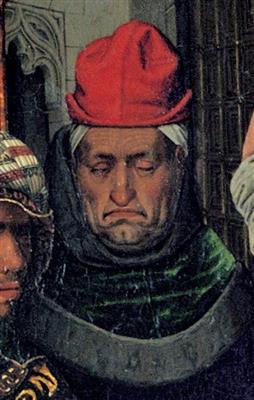
Biography
His earliest documented work, the Santo Domingo de Silos retable of 1474, survives partly in the Prado. It shows already the hard, vigorously crumpled drapery and sombre colouration that distinguish his manner from other Hispano-Flemish painters. Whether he trained in Bruges (his technical affinities with Petrus Christus and Memlinc are considerable) or absorbed Netherlandish naturalism through imported works arriving in Aragon, the question remains unresolved. By 1486 he had settled in Barcelona, collaborating there with Jaime Huguet.
His masterwork is the Pieta of 1490, signed and dated, made for Canon Luis Despla of Barcelona Cathedral. It removes the scene from the usual narrative: Christ's body is held by the Virgin, whose grief dominates the composition, while St Jerome and the portrait of Despla flank them at either side. Behind, a stormy landscape shifts from heavy cloud to a town bathed in reddish light. The dimensions, 74 by 68 inches including frame, give the image a weight that no reproduction quite conveys.
After 1490, Bermejo appears in Barcelona Cathedral's stained glass accounts of 1495. The last documentary trace places him at Vich in 1498. When and where he died is not recorded.
Timeline
- 1440Born in Cordoba. He signed his works "Bartolomeus Vermejo Cordubensis."
- 1474Earliest documented work, the Santo Domingo de Silos retable, was created. Parts of it survive in the Prado.
- 1486Settled in Barcelona, collaborating with Jaime Huguet.
- 1490Completed his masterwork, the Pieta, for Canon Luis Despla of Barcelona Cathedral. It was signed and dated.
- 1495Appears in Barcelona Cathedral's stained glass accounts.
- 1498Last documentary trace places him at Vich.
- 1501Died; the location and cause of death are unrecorded.
Notable Works
Tap to view larger.
Next stop
Northern Renaissance →
Explore the artists and ideas of Northern Renaissance.
Related Artists


%20-%20Self-portrait.jpg)
Frequently Asked Questions
What is Bartolome Bermejo known for?
Bartolome Bermejo is known for bringing a dramatic intensity to the Hispano-Flemish tradition. His masterwork is the Pieta of 1490, made for Canon Luis Despla of Barcelona Cathedral. It depicts Christ's body held by the Virgin, flanked by St Jerome and a portrait of Despla.What is Bartolome Bermejo's most famous work?
It is difficult to identify Bartolome Bermejo's single "most famous" work, as fame is subjective and fluctuates. However, several of his works are well known and frequently discussed. Some of Bermejo's key works include The Holy Trinity, dating to 1577, which is held at the Museo del Prado in Madrid, Spain. El Espolio (The Spoliation, Christ Stripped of His Garments), created between 1577 and 1579, can be found in the Sacristy of Toledo Cathedral, Toledo, Spain. The Adoration of the Shepherds, dating from 1612 to 1614, is also at the Museo del Prado, Madrid. The Opening of the Fifth Seal of the Apocalypse, circa 1608 to 1614, is part of the collection at the Metropolitan Museum of Art, New York, US. Another important work is Baptism of Christ, which he painted from 1608 to 1614, currently located in the Hospital de San Juan Bautista de Afuera, Toledo, Spain.What style or movement did Bartolome Bermejo belong to?
Bartolome Bermejo is considered part of the Hispano-Flemish style, although he cannot be easily related to any Spanish school. His style shows Flemish influence, and some believe he may have trained in Flanders. His painting of St Michael (1474-1477[1]) is reminiscent of similar works by Christus and Memlinc. Further evidence of Flemish influence can be seen in his Descent into Limbo, inspired by Memlinc's Danzig Last Judgment. His dramatic lighting and silhouetting of dark forms, however, are distinct from Flemish art and may reflect the influence of northern Italy. Bermejo's power is evident in his compositional organisation and sense of form. His work also shows the somber colours suited to Spanish expression. Some have also suggested that Bermejo trained in Portugal under Nuno Gonçalvez.What techniques or materials did Bartolome Bermejo use?
Bartolome Bermejo's painting methods involved traditional and innovative elements. He typically worked on panels prepared with a chalk ground. Unusually, he applied a second chalk ground to increase the paint's brilliance. Bermejo sketched the underdrawing with a brush, using thin black paint. He was less concerned with objective detail, light, or perspective, and more interested in the expression of form. His style was rapid, often using single, broken lines to define shapes. His painting technique involved applying a single, thin coat of paint. More layers appear only with red and green glazes over opaque underlayers. This contrasts with the stratified construction of earlier Netherlandish paintings. White paint was used more abundantly to achieve colour effects in a single application. This differed from the traditional method of repeated, transparent underpainting modulations. Bermejo's technique also shows less interest in surface textures and detail, and an unusual selection of unsaturated colours. White was often used graphically, with accented brushstrokes. The texture of these strokes marks the surface in an individual way, contrasting with the smooth finishes of artists such as van Eyck.What was Bartolome Bermejo known for?
Bartolome Bermejo, born in Cordoba around 1440[1], was a Spanish painter who worked in several regions of Spain. He may have trained in Bruges. His painting style shows the influence of Northern artists; some believe he may have travelled in Flanders. Similarities between his St Michael and works by Christus and Memlinc suggest this. The nude figures in Bermejo's Descent into Limbo also show the influence of Memlinc. Some have also suggested a possible period of training in Portugal. Active in Aragon between 1474 and 1477, Bermejo influenced Aragonese painting. In 1486, he collaborated with Jaime Huguet in Barcelona, producing paintings for Sta. Maria del Mar. His noted Pieta, signed and dated 1490, is in Barcelona Cathedral. Documents from 1495 mention his designs for stained glass in the cathedral; one panel from these designs survives in the baptistry. The last document concerning Bermejo dates from 1498, placing him in Vich.When did Bartolome Bermejo live and work?
Bartolome Bermejo was active during the late 15th century. Historical documents place him in Aragon between 1474 and 1477, where he influenced local painting styles. In 1486, he collaborated with Jaime Huguet in Barcelona, producing paintings for Sta. Maria del Mar. Bermejo's signed Pietà, now located in Barcelona Cathedral, is dated 1490. Records from 1495 mention his designs for stained glass in the same cathedral; a panel from these designs is preserved in the baptistry. The last known document concerning Bermejo dates from 1498 and places him in Vich. His painting of St Michael, currently in the Wernher Collection, Luton Hoo, comes from his time in Aragon. In 1474, he is referred to as 'Bartolomé de Cardenas' in a document relating to a retable at Daroca dedicated to S. Domingo de Silos.Where can I see Bartolome Bermejo's work?
Finding the works of Bartolomé Bermejo requires some travel. Few of his paintings are in public collections outside Spain. Many remain in private hands. To see his art, one must often visit specific locations. In Spain, the Museo Nacional del Prado in Madrid holds several works. The Museo de Bellas Artes in Bilbao also has pieces attributed to him. Other Spanish galleries may occasionally display his work as well. For those unable to travel to Spain, some works have made their way into international collections. However, these are less common. Check the collections of major European and North American art museums. Catalogues raisonnés and online art databases can help locate current holdings and exhibition schedules.Where was Bartolome Bermejo from?
Bartolomé Bermejo's origins are somewhat unclear. His signed Pietà, now in Barcelona Cathedral and dated 1490, includes the inscription "Opus Bartolomeus Vermejo Cordubeiensis". This suggests a connection to Córdoba. However, his artistic style shows possible influences from Portugal and Flanders, which raises the possibility of training or travel. Some believe he may have trained in Portugal with Nuno Gonçalvez. Others suggest that Bermejo travelled in Flanders. His Saint Michael, now in the Wernher Collection, has been compared to similar works by Christus and Memlinc. The Descent into Limbo in Barcelona also shows a clear influence from Memlinc's Danzig Last Judgment. Bermejo was active in Aragon between 1474 and 1477, and he worked in Barcelona with Jaime Huguet in 1486, making paintings for Sta. Maria del Mar. The last known document concerning Bermejo dates from 1498 and places him in Vich.Who did Bartolome Bermejo influence?
Bartolome Bermejo worked in Aragon between 1474 and 1477. During this period, he influenced Aragonese painting, which, at the time, had little force. In 1486, Bermejo collaborated with Jaime Huguet in Barcelona, creating paintings for Sta. Maria del Mar. Later, in 1490, he painted his noted Pieta in Barcelona Cathedral. Rodrigo de Osona the Elder, first mentioned in 1464, showed the influence of Jacomart early in his career. His signed Crucifixion of 1476 parallels Bermejo's style, incorporating human drama. Osona added a north Italian-inspired background. His son continued his style, but in a weaker, more Italianate manner, lacking the grandeur of his father. Some believe Bermejo trained in Portugal under Nuno Gonçalvez, known for his Retable of St Vincent. Gonçalvez's naturalism and formal design influenced Portuguese art into the 16th century.Who influenced Bartolome Bermejo?
Bartolomé Bermejo's artistic origins are not definitively known, though some scholars suggest the Master of St Ildefonso influenced his early style. His painting *St Michael* suggests Bermejo travelled in Flanders, as it recalls similar works by Christus and Memlinc. The background wall and drapery in Bermejo's *St George* repeats a motif in Rogier van der Weyden's *Philadelphia Crucifixion*. The nude figures in Bermejo's *Descent into Limbo*, Barcelona were inspired by Memlinc's *Danzig Last Judgment*. These relationships provide a terminus ante quem for Bermejo's travels in the Netherlands. Some believe Bermejo trained in Portugal under Nuno Gonçalves, known for his *Retable of St Vincent*. Bermejo's dramatic lighting and silhouetting of dark forms may be due to northern Italian influence. Bermejo worked in Aragon between 1474 and 1477, and influenced Aragonese painting. In 1486, he collaborated with Jaime Huguet in Barcelona, making paintings for Sta Maria del Mar.Who was Bartolome Bermejo?
Bartolome Bermejo was a Spanish painter active in Aragon and Barcelona. His painting of Saint Michael (now in the Wernher Collection, Luton Hoo) suggests he may have travelled in Flanders, because it recalls similar paintings of Saint Michael by Christus and Memlinc. Active in Aragon between 1474 and 1477, he influenced Aragonese painting. In 1486, he collaborated with Jaime Huguet in Barcelona, producing paintings for Sta Maria del Mar. In 1490, he painted his signed Pietà in Barcelona Cathedral. Documents from 1495 mention his designs for stained glass in the cathedral; one panel survives in the baptistry. The last document mentioning Bermejo dates from 1498, placing him in Vich. His 1490 Pietà, now in Barcelona Cathedral, was made for Canon Luis Despla, who appears kneeling. While Flemish influence is strong, the setting, the dramatic lighting, and the silhouetting are unlike Flemish work and may reflect northern Italian influence. Bermejo designed the work as a drama of movement from head to head, set against a dramatic setting.Why are Bartolome Bermejo's works important today?
Bartolome Bermejo was active in Aragon between 1474 and 1477. He influenced Aragonese painting at a time when it had little force. In 1486, he collaborated with Jaime Huguet in Barcelona, producing paintings for Sta. Maria del Mar. Documents from 1495 mention his designs for stained glass in Barcelona Cathedral; one panel from these designs survives in the baptistry. The last known document concerning Bermejo dates from 1498, placing him in Vich. His painting of St Michael, now in the Wernher Collection, suggests Bermejo travelled in Flanders, recalling similar works by Christus and Memlinc. The hard, crumpled drapery shows attention to naturalistic detail, while the composition raises the work above the average Hispano-Flemish level. The S. Eufrasia in Boston's Isabella Stewart Gardner Museum shows a Flemish figure type, but with sombre colouring suited to Spanish taste. His signed Pietà (1490), made for Canon Luis Despla, is in Barcelona Cathedral. Flemish influence is strong, but the dramatic lighting and silhouetting are unlike Flemish work, perhaps due to northern Italy.
Sources
Editorial draws on the following primary and tertiary references for Bartolome Bermejo.
- [1] wikipedia Wikipedia: Bartolome Bermejo Used for: biography, birth dates, death dates, identifiers, movement attribution, nationality.
- [2] book Penelope J.E. Davies, Walter B. Denny, Frima Fox Hofrichter, Joseph Jacobs, Ann S. Roberts, David L. Simon, Janson's History of Art_ The Western Tradition (8th Edition) Used for: biography, stylistic analysis.
- [3] book Masterpieces of western art : a history of art in 900 individual studies from the Gothic to the present day Used for: biography.
- [4] book Cuttler, Charles D, Northern painting from Pucelle to Bruegel: fourteenth, fifteenth, and sixteenth centuries Used for: biography, stylistic analysis.
- [5] book Charles D. Cuttler, Northern Painting From Pucelle to Bruegel Fourteenth, Fifteenth, and Sixteenth Centuries Used for: biography, stylistic analysis.
Editorial overseen by Solis Prints. Sources verified 2026-09-18. Click a source for details, or hover over [N] in the page above to preview.
Editorial standardsMethodologyCorrectionsAI disclosureAbout the editorial team