

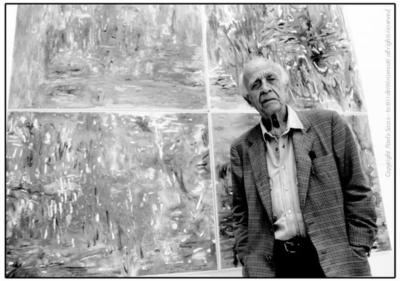
Antonio Corpora
- Tachisme
Antonio Corpora was born in Tunis in 1909[1] to Sicilian parents, and his formation reflects that layered geography: trained at the Tunis Institute of Fine Arts under Armand Vergeaud, then in Paris from 1930[1], where Cubism and Fauvism provided the essential vocabulary, then Rome from 1939, where the post-war cultural moment would define his reputation.
Biography
In 1946[1] he joined the Fronte Nuovo delle Arti, the loose coalition of Italian[1] painters and sculptors that attempted a synthesis of abstraction and figurative practice in the immediate aftermath of the war. The Fronte showed collectively at the 1948 Venice Biennale, where Peggy Guggenheim's presentation of Pollock and de Kooning was shown in the same gardens, before collapsing after a Bologna exhibition drew a public attack from PCI leader Palmiro Togliatti on the incomprehensibility of Italian abstract art.
By 1952[1] Corpora was among the Gruppo degli Otto Pittori Italiani, eight painters who together distanced Italian[1] abstraction from both Social Realism and geometric rigour in favour of a painterly, gestural approach more aligned with the School of Paris than with American Abstract Expressionism.
He showed at the Venice Biennale four times, including a solo presentation in 1960[1]. From 1975 onwards he developed a technique of dripping over linen canvases primed with chalk and sand, building surfaces of bright, irregular colour. He died in Rome in 2004[1], aged 95.
Timeline
- 1909Born in Tunis to Sicilian parents.
- 1930Moved to Paris to study art, where he encountered Cubism and Fauvism.
- 1939Moved to Rome.
- 1946Joined the Fronte Nuovo delle Arti, a coalition of Italian painters and sculptors.
- 1948The Fronte Nuovo delle Arti exhibited at the Venice Biennale.
- 1952Became a member of the Gruppo degli Otto Pittori Italiani.
- 1960Had a solo presentation at the Venice Biennale.
- 1975Began using a dripping technique on linen canvases.
- 2004Died in Rome, aged 95.
Next stop
Browse the movements →
Every movement in the collection, from the Renaissance to Pop art.
Related Artists


Frequently Asked Questions
What is Antonio Corpora's most famous work?
It is difficult to name Antonio Corpora's single most famous work. He produced paintings, watercolours, and prints throughout a long career. Corpora is known as one of a group of Italian[1] artists who moved toward abstraction after the Second World War. His paintings often feature bright colours and dynamic compositions. Corpora's mature style, developed during the 1950s, involved layering colours and creating textured surfaces. His works from this period evoke a sense of movement and energy; they suggest natural forms without directly representing them. Later in his career, Corpora's paintings became more simplified, with larger blocks of colour and a greater emphasis on geometric shapes. He continued to explore colour relationships and abstract forms throughout his life.What should I know about Antonio Corpora's prints?
Antonio Corpora (1909[1]-2004[1]) was an Italian[1] artist associated with abstract expressionism. Information specifically about his prints is scarce, but some general context about fine art prints may be helpful. Printmaking involves creating images that can be multiplied. The materials used, such as paper and ink, influence the final appearance. Inks vary in consistency, colour, and oiliness, affecting how they are absorbed by different papers. Historically, European printmakers in the 15th and 16th centuries used paper made from cotton and linen rags pulped with water. The pulp was then thinly layered on a wire screen and dried. As contact with Asia increased, "Japan paper" (mulberry fibres) and "China paper" became more common. Without specific details on Corpora's printmaking techniques, understanding these basic elements of print production can aid appreciation of his wider artistic output. Additional research into exhibition catalogues or specialist art publications may provide more specific information.What style or movement did Antonio Corpora belong to?
Antonio Corpora is associated with several movements, including Futurism and Spatialism. After World War II, a number of artists in Italy felt the importance of their Futurist experience. They brought it to the world’s attention again through works and exhibitions. In 1946[1], Giovanni Korompay reorganised the Futurist movement; in 1951 he prepared a national exhibition in Bologna. Spatialism proposed to attain a form of art with new media. Technology placed radio, television, black light, radar, and other means at the disposal of artists. The adherents of the movement were artists and writers acutely aware of the evolution of the medium in art. The Spatial Movement, says a manifesto of 1950, consists in the evolution of the medium in art. Some critics regard Spatialism as a manner rather than a method. Yet its impact on autonomous concepts in art must be recognised.What was Antonio Corpora known for?
Antonio Corpora, an Italian[1] artist, is best known for his abstract paintings. Born in Tunisia in 1909[1], Corpora moved to Italy, where he became associated with various artistic movements. Initially, his work showed influences from Cubism and Futurism; however, he later developed a more personal style characterised by lyrical abstraction. Corpora was a member of the *Fronte Nuovo delle Arti*, a group of Italian artists who rejected Fascist cultural policies after the Second World War. This group favoured a socially engaged form of art, although Corpora's contribution remained largely abstract. In the 1950s, Corpora joined *Gruppo degli Otto*, which included Afro Basaldella and Mattia Moreni. This group aimed to promote abstract art internationally. Corpora's paintings from this period often feature bright colours and dynamic compositions, reflecting the influence of American Abstract Expressionism. He exhibited extensively throughout Europe and the United States, securing his position as a significant figure in postwar Italian art. He died in Rome in 2004[1].When did Antonio Corpora live and work?
Antonio Corpora was born in Tunis on 15 August 1909[1]. He died in Rome on 6 September 2004[1]. Corpora was part of the Italian[1] art scene from the late 1940s. He participated in the 25th Venice Biennale in 1950[1], as part of a group of abstractionists that included Birolli, Morlotti, Santomaso, Turcato, and Vedova. Other Italians exhibiting that year were Capogrossi, Fontana, Leoncillo, Licini, Prampolini, Radice, Reggiani, Rho, and Soldati. Corpora participated in the annual Mostra Internazionale dell' Art Club at the Galleria Nazionale d’Arte Moderna, Rome. He was included in the exhibition Arte d'Oggi (Art of Today) in Florence. By 1958, Corpora's work was shown in New York at the World House Galleries.Where can I see Antonio Corpora's work?
It is difficult to pinpoint exactly where one might view Antonio Corpora's work today, as exhibition details are subject to change. However, some museums with collections of related material are worth noting. For example, the Israel Museum in Jerusalem holds Byzantine art. Other sites in Jerusalem include the Museum of the Studium Biblicum Franciscanum, Convent of the Flagellation. In Italy, the Archivio della Badia, Monastery of Monte Cassino, the Biblioteca Ambrosiana in Milan, and the Museo Archeologico in Venice may be of interest. Venice also contains the Biblioteca Nazionale Marciana, the Congregazione Armena Mechitarista, the Museo Correr e Quadreria Correr, and the Museo Marciano. Elsewhere in Italy, one might try the Museo della Cattedrale, in Monopoli, the Museo Regionale, Messina, the Pinacoteca Provinciale, Bari, and the Tesoro della Cattedrale di San Andrea a Veroli. These locations may provide a good starting point for viewing works by Corpora, or works by his contemporaries.Where was Antonio Corpora from?
Antonio Corpora was Italian[1]. More specifically, he was from Italy in the 20th century. Felice Casorati, born in Novara in 1883, came from a family known for its mathematicians and scientists. Casorati spent his childhood in Milan, Reggio Emilia, Sassari and finally Padua, where he devoted himself to musical studies. In 1906, he graduated in law from the university of Padua, but decided to follow a career as an artist. After the death of his father in 1917[1], he moved with his family to Turin, and soon became a central figure in the city’s intellectual circles. In 1935, the studio of Casorati and Enrico Paulucci hosted the ‘Prima mostra collettiva d’arte astratta italiana’, which included works by Licini, Melotti and Fontana.Who influenced Antonio Corpora?
It is difficult to summarise Antonio Corpora's influences. Some sources suggest the early Renaissance masters affected Corpora, particularly Michelangelo, Raphael and Leonardo da Vinci. Others point to a later set of influences, including Gustave Courbet. More recent sources place him in a Futurist context, affected by Umberto Boccioni, Carlo Carrà, Giacomo Balla, Gino Severini, and Ardengo Soffici. These artists explored modern themes of speed, technology and urban life. Corpora's later association with Emilio Vedova suggests an openness to abstract expressionism, and artists such as Lucio Fontana. Without more information, it is hard to be precise about which artists and movements had the most effect on Corpora's practice. It is likely that his influences changed over the course of his career, as he moved from figurative work to abstraction.Who was Antonio Corpora?
Antonio Corpora (1909[1]-2004[1]) was an Italian[1] artist. He is associated with the abstraction movement in post-war Italian sculpture, along with artists such as Pietro Consagra and the Pomodoro brothers, Gio and Arnaldo. However, he was also briefly a member of the Gruppo Origine in 1951[1]. He is also associated with the Fronte Nuovo delle Arti, a group of artists with styles ranging from Cubo-Expressionism to Naturalism. Corpora, along with Afro Basaldella, Birolli, Morlotti, Mattia Moreni, Santomaso, Turcato and Vedova, formed the Gruppo degli Otto in 1952. Corpora's work is characterised by a combination of meticulous craftsmanship and geometric forms. He often used basic shapes, such as cubes, cylinders, and spheres, and then disrupted their polished surfaces to reveal internal structures. These structures, which he referred to as "sign systems", are reminiscent of complex interlocking systems, such as those found in language or organic bodies.Why are Antonio Corpora's works important today?
Antonio Corpora (1909[1]-2004[1]) was an Italian[1] abstract painter associated with the Scuola Romana and later with the Forma 1 group. His art offers insight into the development of abstract art in post-war Italy, specifically how Italian artists synthesised international trends with their own artistic heritage. Corpora's early work showed figurative elements, but he moved towards abstraction in the late 1940s. This shift reflects a broader European movement away from representational art after the Second World War. His association with Forma 1, a group that included artists such as Carla Accardi and Piero Dorazio, placed him at the centre of debates about abstraction and its potential for social engagement. His paintings often feature bright colours and dynamic compositions, reflecting his interest in light and movement. Today, Corpora's works are important for understanding the diverse approaches to abstraction that emerged in Italy during a time of significant cultural and political change. They provide a valuable perspective on the dialogue between Italian and international artistic movements in the mid-20th century.What was Antonio Corpora's art style?
By 1952[1], Corpora's style aligned with the School of Paris, favouring a painterly, gestural approach to abstraction. From 1975 onwards, he developed a technique of dripping over linen canvases primed with chalk and sand, building surfaces of bright, irregular colour.
Sources
Editorial draws on the following primary and tertiary references for Antonio Corpora.
- [1] wikipedia Wikipedia: Antonio Corpora Used for: biography, birth dates, death dates, identifiers, movement attribution, nationality.
- [2] book Pächt, Otto, 1902-1988, Book illumination in the Middle Ages : an introduction Used for: stylistic analysis.
- [3] book Giovanni Battista Piranesi; Sarah E Lawrence; Exhibition Piranesi as Designer (2007, Giovanni Battista Piranesi; Sarah E Lawrence; Exhibition Piranesi as Designer (2007 - 2008, New York, NY; Haarlem); Cooper-Hewitt Museum of Decorative Arts and Design (New York, N.Y.); Teylers Museum - Piranesi as designer ; [on the occasion of Used for: biography, stylistic analysis.
- [4] book guggenheim-guggenheimintern1964allo Used for: biography.
- [5] book Lilian H. Zirpolo, Historical Dictionary of Baroque Art and Architecture Used for: biography.
- [6] book Braun, Emily, 1957-; Asor Rosa, Alberto; Royal Academy of Arts (Great Britain), Italian art in the 20th century : painting and sculpture, 1900-1988 Used for: biography.
- [7] book Masterpieces of western art : a history of art in 900 individual studies from the Gothic to the present day Used for: biography.
Editorial overseen by Solis Prints. Sources verified 2026-09-30. Click a source for details, or hover over [N] in the page above to preview.
Editorial standardsMethodologyCorrectionsAI disclosureAbout the editorial team