



Andrea del Sarto
- High Renaissance
Giorgio Vasari called Andrea del Sarto "the faultless painter" and then spent most of his biography explaining why those faults were, in fact, moral ones. The characterisation has distorted del Sarto's reputation ever since: an artist of extraordinary technical command, consistently presented as a man who squandered his gifts by preferring a quiet life in Florence to the celebrity that awaited him at the French court of Francois I.
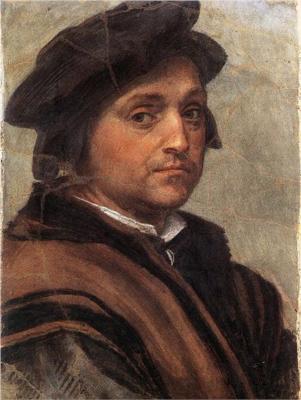
Biography
Born in Florence in 1486[2], del Sarto became the city's leading painter by the early sixteenth century. He combined Leonardo's sfumato with a richer, warmer palette, and his preparatory drawing practice, systematic in its rigour, became a model for later generations. His Madonna of the Harpies (Uffizi, Florence) remains his most recognisable panel painting: the Virgin and Child stand on a pedestal flanked by St Francis and St John the Evangelist, the harpies carved beneath as symbols of her triumph over evil.
The fresco cycle at the Chiostro allo Scalzo, begun around 1510[2] and worked on for almost fifteen years, is his most sustained achievement. Executed in monochrome, the scenes from the life of John the Baptist grow in ambition as the sequence progresses. The Feast of Herod (c. 1523) introduces massive figures moving through deeper space, including a brooding bystander who turns inward even as Salome presents the Baptist's head, creating an unsettling stillness inside the scene's violence.
During the siege of Florence (1529[2]-30), del Sarto is believed to have served in the city's militia. His Last Supper at San Salvi, outside the city walls, survived the surrounding destruction: according to both Vasari and Varchi, the demolition crew abandoned the wall when they saw it. He died of plague in September 1530[2], buried as the republic collapsed around him.
Timeline
- 1486Born in Florence.
- 1510Began the fresco cycle at the Chiostro allo Scalzo; he worked on it for almost fifteen years.
- 1523Painted "The Feast of Herod" at the Chiostro allo Scalzo.
- 1529Served in the city's militia during the siege of Florence.
- 1529Completed "Last Supper" at San Salvi, outside the city walls of Florence.
- 1530Died of plague in Florence, at 44.
Notable Works
Tap to view larger.
Next stop
Browse the movements →
Every movement in the collection, from the Renaissance to Pop art.
Andrea del Sarto prints
Hand-finished archival prints from Andrea del Sarto's body of work.
 Noli Me Tangere - Andrea del Sarto
From £37.00
Noli Me Tangere - Andrea del Sarto
From £37.00
 Madonna and Child with the Infant Saint John in a Landscape - Andrea del Sarto
From £28.00
Madonna and Child with the Infant Saint John in a Landscape - Andrea del Sarto
From £28.00
 The Raising of the Dead Child by the Corpse of San Filippo - Andrea del Sarto
From £28.00
The Raising of the Dead Child by the Corpse of San Filippo - Andrea del Sarto
From £28.00
 The Sacrifice of Abraham - Andrea del Sarto
From £28.00
The Sacrifice of Abraham - Andrea del Sarto
From £28.00
 The Miracle of the Relics of San Filippo - Andrea del Sarto
From £28.00
The Miracle of the Relics of San Filippo - Andrea del Sarto
From £28.00
 Stories of Joseph - Andrea del Sarto
From £28.00
Stories of Joseph - Andrea del Sarto
From £28.00
Related Artists

%20(14598379677).jpg)

%20Bust%20of%20Sebastiano%20del%20Piombo%20by%20Lorenzo%20Moretti%20Larese%20-%20gallerie%20Accademia%20Venice.jpg)

Take Andrea del Sarto home.
See all Andrea del Sarto prints →Frequently Asked Questions
What is Andrea del Sarto known for?
Andrea del Sarto is known for becoming Florence's leading painter by the early sixteenth century. His most recognisable panel painting remains Madonna of the Harpies (Uffizi, Florence).What is Andrea del Sarto's most famous work?
Andrea del Sarto was a prolific Florentine painter of the High Renaissance[2]; consequently, there are several works that might be considered his most famous. These include frescoes as well as panel paintings, and his output spanned both religious and secular subjects. Examples of his paintings include depictions of the Holy Family in Egypt, along with multiple treatments of Moses, such as Moses Striking the Rock. Other religious paintings include The Mystic Marriage of St Catherine. He also painted on mythological themes, as seen in works such as Mercury, Herse, and Aglanrus. Given the breadth of subject matter and the number of surviving works, it is difficult to single out one painting as definitively his most famous.What should I know about Andrea del Sarto's prints?
Andrea del Sarto (1486[2]-1530[2]) was a leading Florentine painter of the early sixteenth century. He combined Leonardo's sfumato technique with a richer range of colours. Giorgio Vasari said that del Sarto's technical perfection was blighted by a lack of spirit; nevertheless, he was highly influential. His practice of making preparatory drawings before painting became standard for later artists. In about 1510[2], del Sarto undertook a commission for a series of frescoes for a cloister telling the story of John the Baptist. The frescoes were designed to look like monochrome statues in niches. The figures assume an architectural function, indexing the space and serving as surrogate columns. All the frescoes were detached in the period 1963-1968[2]. In reducing the number of bystanders, del Sarto created a new type of Pieta in Florentine painting, concentrating solely on the Virgin Mary and the dead Christ accompanied by two angels.What style or movement did Andrea del Sarto belong to?
Andrea del Sarto, born in Florence in 1486[2], was a leading Florentine painter of the early sixteenth century. His career places him at the intersection of the High Renaissance[2] and Mannerism. The High Renaissance, which occurred at the turn of the sixteenth century, saw painting and sculpture reach a peak of technical competence, expression, and proportion. Painters managed forms, colours, tonal effects, perspective, proportion, composition, and anatomy with control and outstanding skill. However, by the 1520s, some artists began abandoning the harmonious ideals of the Renaissance for a more emotional approach. This new style, retrospectively labelled Mannerism, focused on exaggerated figures, colours, and compositions. Del Sarto's later works show the influence of artists such as Raphael and Michelangelo, who represent the High Renaissance. At the same time, the proportions and expressions of faces in some of his paintings reflect the influence of Pontormo, an artist associated with Mannerism. Del Sarto combined Leonardo da Vinci’s sfumato technique with a richer range of colours.What techniques or materials did Andrea del Sarto use?
Andrea del Sarto worked primarily in oil paint. This medium gained popularity because it allowed more freedom compared to tempera. Oil paint facilitated a style that was more volumetric and fluid. With oil paint, pigments are ground into a paste and mixed with oil, usually linseed or walnut oil. Oil dries slowly, allowing artists to work fluidly and apply colours in layers. This also allows for corrections, which are difficult with tempera. Oil paint permits the use of a larger brush, loaded with more paint, and it gives a particular colour and surface through glazing. It also allows a greater range and depth of colour, especially in darker shades, and better control of tonality. Early uses of oil paint were on panels prepared with tempera. As oil became more common, artists began using canvas, which was lighter and easier to store than wood panels. Canvas is more stable than wood, which can separate from the gesso and paint layers due to changes in temperature and humidity. The weave of canvas also provides a surface texture that holds the oil paint well. In his *Holy Family with the Infant St John*, from around 1530[2], sweeping brushstrokes are visible, and layers of colour worked into each other create a light and liquid effect.What was Andrea del Sarto known for?
Andrea del Sarto (1486[2]-1530[2]) was a Florentine painter of the High Renaissance[2] and early Mannerism. He is regarded for his refined technique, his naturalistic figures, and his graceful compositions. Sarto trained with Piero di Cosimo, and was influenced by Leonardo da Vinci, Raphael, and Fra Bartolomeo. Giorgio Vasari, in his *Lives of the Artists*, praised Sarto's technical skills. Vasari noted that Sarto possessed all the qualities needed to be considered a perfect painter, but lacked ambition and divine fire. Sarto excelled in fresco painting; examples can be seen in Florence at Santissima Annunziata and the Chiostro dello Scalzo. His altarpieces, such as the *Madonna of the Harpies* (1517[2], Uffizi), display his skill in combining naturalism with idealised beauty. He was also a gifted draughtsman; many of his drawings survive, offering insight into his working methods. Though admired by his contemporaries, Sarto's reputation declined somewhat in later centuries, but he is now recognised as one of the major artists of the Florentine Renaissance.When did Andrea del Sarto live and work?
Andrea del Sarto was a leading Florentine painter of the early sixteenth century. Born in Florence in 1486[2], he died there in 1530[2]. Two major painters, Fra Bartolommeo and del Sarto, remained in Florence when Raphael and Michelangelo went to work in the Vatican. Around 1510[2], del Sarto received an important commission: a series of frescoes for the cloister of a brotherhood. The walls were to depict the story of John the Baptist, the brotherhood's patron, and four Virtues. Giorgio Vasari wrote that del Sarto's technical perfection was blighted by a lack of spirit. He combined Leonardo’s sfumato technique with a richer range of colours. His practice of making preparatory drawings before starting a painting became standard for later artists.Where can I see Andrea del Sarto's work?
Andrea del Sarto (1486[2]-1530[2]) spent his working life in Florence; consequently, many of his paintings remain there. The Uffizi Gallery holds several important pieces, including the *Madonna of the Harpies* (1517[2]) and his *Self-Portrait* (c. 1528). The Palazzo Pitti also has a collection of his work. These include paintings such as *Assumption of the Virgin* (1526). Outside Florence, the Louvre Museum in Paris possesses his painting *Charity* (1518). The National Gallery in London holds *The Madonna and Child with Saint John the Baptist* (c. 1520). The Metropolitan Museum of Art in New York owns his *Portrait of a Young Man* (c. 1517-18). These collections allow art enthusiasts to view a range of del Sarto's artistic output across Europe and the United States. Frescoes by del Sarto can still be seen in the Chiostro dello Scalzo, Florence.Where was Andrea del Sarto from?
Andrea del Sarto was born and died in Florence (1486[2]-1530[2]). The son of a tailor, Andrea's nickname 'del Sarto' means 'of the tailor'. He trained with Piero di Cosimo in the late 15th-century tradition. Later, he studied the work of Leonardo, Raphael, and Michelangelo. Around 1505[2], Andrea developed his own style, becoming a major representative of the Florentine High Renaissance[2]. Two major painters remained in Florence when Raphael and Michelangelo went to work in the Vatican: Fra Bartolommeo and Andrea del Sarto. Around 1510, Andrea received a commission for a series of frescoes. They were for all four walls of the cloister of a brotherhood that served religious, charitable, and social purposes in Italian[2] cities at the time. The walls were to contain the story of John the Baptist, patron of the brotherhood, and four Virtues simulating statues in niches.Who did Andrea del Sarto influence?
Andrea del Sarto (1486[2]-1530[2]) was an influential Florentine painter of the High Renaissance[2]. He had numerous students and followers who absorbed elements of his style. His most famous pupils were Jacopo Pontormo and Rosso Fiorentino; both were mannerist painters. Giorgio Vasari, the painter and biographer, trained in Andrea's workshop. Other students included Francesco Salviati and Jacone. Later painters who felt Andrea's impact include Agnolo Bronzino, who studied with Pontormo but absorbed Andrea's colourism. Bronzino's cool, hard-edged portraits owe a debt to Andrea's emphasis on precise drawing. Andrea's graceful compositions and sfumato effects influenced many artists in Florence and beyond. His altarpieces, such as the Madonna of the Harpies (Uffizi, Florence), became models of High Renaissance painting. Though he did not establish a formal school, his studio produced some of the most important Florentine artists of the 16th century. His emphasis on naturalism and colour had a considerable impact on the development of Florentine painting.Who influenced Andrea del Sarto?
Andrea del Sarto, born in Florence in 1486[2], was a leading Florentine painter of the early sixteenth century. He trained with Piero di Cosimo in the late 15th-century tradition. Later, he studied the works of Leonardo da Vinci, Raphael, and Michelangelo. His work combined Leonardo’s sfumato technique with a richer range of colours. Giorgio Vasari wrote that Andrea’s technical perfection was affected by a lack of spirit. Andrea del Sarto's early work shows the influence of the Florentine High Renaissance[2]. Around 1517[2], he began to move away from those conventions, toward Mannerism. His brilliance in drawing and painterly techniques influenced Rosso Fiorentino and Pontormo; they, in turn, inspired his late work. Andrea del Sarto died in Florence in 1530[2].Who was Andrea del Sarto?
Andrea del Sarto (1486[2]-1530[2]) was a leading Florentine painter of the early sixteenth century. Born in Florence, his father was a tailor; "del Sarto" is a nickname referring to this. Initially trained in the late 15th-century tradition by Piero di Cosimo, Andrea del Sarto's style evolved after studying works by Leonardo, Raphael, and Michelangelo. This development established him as a significant figure of the Florentine High Renaissance[2]. Around 1517[2], he began to move away from these conventions, shifting towards Mannerism. His skill in both drawing and painting techniques influenced Rosso and Pontormo, who, in turn, inspired his later work. His frescoes depicting the life of St John the Baptist in the Chiostro dello Scalzo (Florence, 1514-1526[2]) are monochrome and create a unified impression. The frescoes were detached between 1963 and 1968. One of his best-known paintings is *Madonna of the Harpies*. He created a new type of *Pietà* in Florentine painting, concentrating on the Virgin Mary and the dead Christ with two angels.
Sources
Editorial draws on the following primary and tertiary references for Andrea del Sarto.
- [1] museum Samuel H. Kress Collection Used for: museum holdings.
- [2] wikipedia Wikipedia: Andrea del Sarto Used for: biography, birth dates, death dates, identifiers, movement attribution, nationality.
- [3] book Virginia Cox, A Short History of the Italian Renaissance Used for: biography.
- [4] book Beard, Lee, 1973- author, Butler, Adam, author; Van Cleave, Claire, author; Fortenberry, Diane, author; Stirling, Susan, author, Beard, Lee, 1973- author, Butler, Adam, author; Van Cleave, Claire, author; Fortenberry, Diane, author; Stirling, Susan, author - The Art Book_ New Edition, Mini Format Used for: biography, stylistic analysis.
- [5] book Masterpieces of western art : a history of art in 900 individual studies from the Gothic to the present day Used for: biography, stylistic analysis.
- [6] book Meiss, Millard, The great age of fresco; discoveries, recoveries, and survivals Used for: biography, stylistic analysis.
Editorial overseen by Solis Prints. Sources verified 2026-09-19. Click a source for details, or hover over [N] in the page above to preview.
Editorial standardsMethodologyCorrectionsAI disclosureAbout the editorial team