



Ambrosius Bosschaert
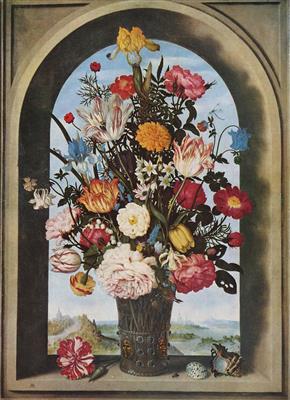
Bosschaert once received a thousand guilders for a single flower painting delivered to the Prince of Orange's chamberlain. That was in 1621, the year he died, and the sum was extraordinary. He had spent his career assembling bouquets that could never exist in nature, composing them from sketches made across different seasons so that tulips, roses, irises and forget-me-nots appeared together in impossible arrangements.
Biography
He was born in Antwerp in 1573 and moved with his family to Middelburg around 1587, likely to escape religious persecution. Middelburg became his base and, largely through his influence, the leading centre for flower painting in the Dutch Republic. His pictures were small, almost always painted on copper, and arranged with a symmetry that doubles as botanical record. He signed them with a stylised A containing a smaller B, a monogram modelled on Albrecht Durer's.
Beyond painting, Bosschaert dealt in other artists' work; records show him acting as agent in the sale of paintings attributed to Paolo Veronese. He was also the founder of a dynasty. Three sons (Ambrosius II, Johannes and Abraham) all became flower painters, and his brother-in-law Balthasar van der Ast trained and worked in his studio, eventually surpassing the sons.
He was one of the first painters to establish floral still life as an independent genre rather than a decorative element in a larger composition. His backgrounds distinguished him from later practitioners: where most Dutch flower painters used dark grounds, Bosschaert placed his bouquets against open windows with landscape views, giving each arrangement a context in the physical world. He died in The Hague in 1621, at forty-eight, on the trip to deliver that expensive painting.
Timeline
- 1573Born
- 1617Painted "Still-Life with flowers"
- 1617Painted “Still-Life with flowers”
- 1618Painted “Vase of Flowers in a Window Niche”
- 1618Painted "Vase of Flowers in a Window Niche"
- 1619Painted "Still life with flowers in a Wan-li vase"
- 1619Painted “Still life with flowers in a Wan-li vase”
- 1621Died
Notable Works
Tap a work to read about it, or to view it larger.
Where to See Ambrosius Bosschaert
16 museums worldwide.
-
 2 works
National Gallery
London, United Kingdom
Daily 10:00–18:00 (Fri until 21:00) · Free
-

-

-
1 works
J. Paul Getty Museum
Los Angeles, United States
-
 1 works
Kunsthistorisches Museum
Vienna, Austria
Tue–Sun 10:00–18:00 (Thu until 21:00); closed Mon (open Mon Jun–Aug) · €21 adults, free under-19
-
 1 works
Los Angeles County Museum of Art
Los Angeles, United States
Mon, Tue, Thu 11:00–18:00; Wed closed; Fri 11:00–20:00; Sat–Sun 10:00–19:00

Next stop
Baroque →
Explore the artists and ideas of Baroque.
Related Artists


Frequently Asked Questions
Ambrosius bosschaert facts?
Ambrosius Bosschaert was born in Antwerp in 1573 and moved with his family to Middelburg around 1587. He signed his paintings with a stylised A containing a smaller B, a monogram modelled on Albrecht Durer's.How did ambrosius bosschaert die?
Ambrosius Bosschaert died in 1621 at the age of 48.What materials did ambrosius bosschaert use?
Ambrosius Bosschaert almost always painted on copper. He arranged his bouquets against open windows with views of the world.What should I know about Ambrosius Bosschaert's prints?
Ambrosius Bosschaert the Elder (1573-1621) was a still-life painter of the Dutch Golden Age. He is known for his detailed depictions of flowers; these were typically painted in oil on copper or panel. Bosschaert did not create prints himself. However, his paintings were reproduced as engravings and etchings by other artists, after his death. These prints made his compositions accessible to a wider audience. One example is a print by Bartholomeus van den Winckel after Bosschaert, now in the collection of the Rijksmuseum, Amsterdam. Similar prints after Bosschaert appear occasionally at auction. These are often unsigned, and can be difficult to attribute definitively. Prints after Bosschaert offer a more affordable way to own an image similar to his paintings. However, they lack the colour and textural qualities of his original oil paintings. When considering a print, examine its condition, paper type, and provenance. These factors affect its value and collectability.What style or movement did Ambrosius Bosschaert belong to?
Ambrosius Bosschaert, active in the early 17th century, is usually associated with the early Baroque period, specifically within the context of Dutch and Flemish painting. The Baroque period, which corresponds roughly to the 17th century, saw a widening of thematic fields in painting. Bosschaert's career occurred during a time of specialisation, when artists focused on specific subjects. He concentrated on still-life painting, especially flowers. This genre gained unprecedented importance during the Baroque era. While still lifes had existed before, they often served as elements within larger compositions, such as kitchen or market scenes. The Baroque period saw the emancipation of the still life as an independent and valid subject. Netherlandish Baroque painting saw the creation of specific schemes within various genres, giving individual objects their own distinct importance. Bosschaert's detailed and realistic depictions of flowers reflect this trend, even if his style predates the later exuberance often associated with the Baroque.What techniques or materials did Ambrosius Bosschaert use?
Ambrosius Bosschaert painted in oils, typically on wood panels. For example, Still Life with Flowers, held at the Fitzwilliam Museum in Cambridge, is oil on panel. The panel has a thin, white ground layer, with a yellow, ochre-coloured imprimatura. The pigments and media that Bosschaert used were in keeping with standard practices of the time. Bosschaert's contemporary, Brueghel, employed a painting method characterised as deliberately slow, which allowed him to achieve a high degree of finish and detail. Brueghel sometimes took months to finish commissions. It is possible that he worked on several paintings at once, allowing the works to dry at various stages. This maintained a crisp appearance, because he avoided applying paint on top of a layer that was still wet. When painting flowers from life, Brueghel had to wait for the flowers to be in season. He also had to have access to them.When was ambrosius bosschaert born?
Ambrosius Bosschaert was born in 1573 in the Netherlands. Ambrosius Bosschaert died in 1621, aged 48.Where can I see Ambrosius Bosschaert's work?
Paintings by Ambrosius Bosschaert are held in various collections. These include the Staatliche Kunstsammlungen in Dresden, and the Hermitage Museum in Leningrad. You can also find his work in the National Gallery[5] of Scotland, in Edinburgh. Other locations include the Detroit Institute of Arts, the National Gallery of Ireland in Dublin, and the Städelsches Kunstinstitut in Frankfurt. Bosschaert's paintings can be seen at the Staatliche Kunsthalle in Karlsruhe, and the Staatliche Kunstsammlungen in Kassel. Works by this artist are also held in the collection of the National Gallery of Victoria, Melbourne, and the Pushkin Museum of Fine Arts, Moscow. These are just some of the places where you can view work by Ambrosius Bosschaert.Where was Ambrosius Bosschaert from?
Ambrosius Bosschaert was from the Netherlands, which in the 16th century consisted of seventeen provinces corresponding to modern Holland, Belgium, and Luxembourg. The area was then under the control of Philip II of Spain. Philip’s repressive measures against Protestants led the northern provinces to break from Spain and form the Dutch Republic. The southern provinces remained under Spanish control and retained Catholicism. This political separation between Holland and Belgium also brought artistic differences. Flemish Baroque painters maintained connections to the Baroque art of Catholic Europe, while Dutch schools developed their own styles, consistent with their religion and political structure. During this period, Netherlandish artists received commissions from Catholic churches for altarpieces and religious works. The rise of Protestantism led to a private art market focused on secular subjects, providing a glimpse into the lives of various levels of society.Who did Ambrosius Bosschaert influence?
Ambrosius Bosschaert's influence is complex. Later Dutch still life was interpreted through the work of Jean-Baptiste-Siméon Chardin, especially in France. Chardin, accepted into the Academy as a painter of animals and fruits, may have encountered Dutch paintings in Parisian collections. Chardin's representations, held in a muted colour range and avoiding excess, had more kinship with the "bourgeois" spirit of the Little Masters of Holland than with the Baroque splendour of court art in Flanders. Chardin broke with the tradition of decorative bouquets and sumptuous tableware by choosing everyday objects, such as kitchen utensils, for the subjects of his still lifes. The illusion of naturalness, simplicity of motifs and composition, and the harmony of colours endowed Chardin’s still lifes with a peaceful atmosphere. These traits owed something to the Haarlem painting tradition, such as the monochromatic compositions of Pieter Claesz. Henri Fantin-Latour was a later painter of expanded-space bourgeois still lifes. The example set by Chardin underlies the work of Fantin-Latour, both in his simple fruit pieces and in his more complex flower-piece table corners. Fantin-Latour was important for Cézanne, particularly for his flower pieces.Who influenced Ambrosius Bosschaert?
Ambrosius Bosschaert would have been exposed to a range of influences, both theoretical and practical. Contemporary art theory emphasised emulation of earlier masters, as well as direct observation of nature. Carel van Mander's 'Grondt' (Groundwork) was the first theoretical treatise published in Dutch. Samuel van Hoogstraten, though critical of van Mander's inspirational rather than didactic approach, was clearly familiar with it. Van Hoogstraten's own teachings encouraged young painters to emulate great masters, competing with both contemporaries and predecessors. He cited Junius, who described emulation as an innate human capacity. Painters were urged to seek inspiration from nature itself. Van Hoogstraten approvingly quoted Dio Chrysostom: "It is impossible for us to excel in anything unless we vie with the most outstanding of all". The concept of "mimesis", or imitation, was central, encompassing both the imitation of nature and the emulation of exemplary works of art.Who is ambrosius bosschaert?
Ambrosius Bosschaert (1573-1621) was a painter who was one of the first to establish floral still life as an independent genre. He assembled bouquets that could never exist in nature, composing them from sketches made across different seasons.
Sources
Editorial draws on the following primary and tertiary references for Ambrosius Bosschaert.
- [1] museum National Gallery Prague Used for: museum holdings.
- [2] museum Mauritshuis Used for: museum holdings.
- [3] museum Cleveland Museum of Art Used for: museum holdings.
- [4] museum Museum of Fine Arts Boston Used for: museum holdings.
- [5] museum National Gallery Used for: museum holdings.
- [6] museum J. Paul Getty Museum Used for: museum holdings.
- [7] book National Gallery of Art, National Gallery of Art - Painting in the Dutch Golden Age - A Profile of the Seventeenth Century Used for: biography.
Editorial overseen by Solis Prints. Sources verified 2026-09-15. Click a source for details, or hover over [N] in the page above to preview.
Editorial standardsMethodologyCorrectionsAI disclosureAbout the editorial team