



Albert Bloch
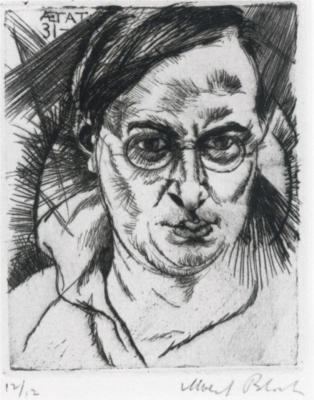
Albert Bloch is the answer to a useful pub-quiz question: the only American[1] artist associated with Der Blaue Reiter. Born in St Louis, Missouri in 1882[1], he began his career drawing comic strips and caricatures, first for the St Louis Star, then from 1905[1] for William Marion Reedy's literary and political weekly The Mirror. It was a good school for economy and observation, if an unlikely prologue to Munich expressionism.
Biography
In 1909[1] he moved to Germany. Within two years he had become part of the circle around Wassily Kandinsky and Franz Marc, the nucleus of Der Blaue Reiter, and he participated in the group's landmark exhibitions of 1911 and 1912. His paintings from this period share the group's appetite for spiritual depth and distorted figuration, though Bloch's imagery retained a distinct folk-art quality, drawn as much from his St Louis childhood as from the German avant-garde.
He stayed in Germany through the First World War and until 1921[1], when he returned to the United States. A year of teaching at the School of the Art Institute of Chicago led to a permanent post at the University of Kansas in Lawrence, where he headed the art department until his retirement in 1947. He died there in 1961[1], having spent the final forty years of his career in the American[1] Midwest, largely outside the critical conversation his early Munich years had earned him.
Timeline
- 1882Born in St. Louis, Missouri
- 1905Drew caricatures for William Marion Reedy's The Mirror
- 1909Moved to Germany
- 1911Participated in Der Blaue Reiter exhibitions
- 1912Participated in Der Blaue Reiter exhibitions
- 1921Returned to the United States
- 1947Retired from the University of Kansas
- 1961Died in Lawrence, Kansas
Notable Works
Tap to view larger.
Next stop
Expressionism →
Explore the artists and ideas of Expressionism.
Albert Bloch prints
Hand-finished archival prints from Albert Bloch's body of work.

Related Artists



Take Albert Bloch home.
See all Albert Bloch prints →Frequently Asked Questions
What style or movement did Albert Bloch belong to?
Albert Bloch is associated with Expressionism[1], a movement that arose before the First World War and continued afterwards. Expressionism sought to express a new form of life, moving from the individual to the typical, and attempting to capture the spirit of the times. Expressionist art often features bold colours, simplified forms, and surface qualities that convey a sense of urgency and emotional experience. Artists sometimes applied paint directly from the tube and explored clashing colours to intensify expression. Key influences included the 15th-century woodcut, with its bold simplicity, and primitive art. Bloch was a friend of Georg Lukács. They had differing opinions on modern art; Bloch supported Expressionism, while Lukács leaned towards Neo-Classicism. Bloch criticised Lukács for ignoring Expressionist visual art and concentrating on theorists, arguing that Expressionism challenged traditional values and drew from folk art. He saw its spatial and temporal fissures as reflecting the transition from one age to the next.What techniques or materials did Albert Bloch use?
Albert Bloch worked with various techniques, including glass painting and printmaking methods such as etching, woodcut and lithography. In glass painting, Bloch developed a specific method using opaque glass. This involved using a single pane, making the artwork movable like a small easel painting. The technique he employed was sandblasting on flashed glass, which typically consisted of a milk glass body covered with a thin coating of another colour, often black or red. Sandblasting was used to grind a relief into the glass, similar to how tombstone carvers engrave names. The glass was covered with a stencil, and the design was cut out to expose the areas to be sandblasted. This process allowed Bloch to create contrasts between the flashed coating and the milk glass body. He also used glass painters' colours, which were made permanent by burning them in a kiln.What was Albert Bloch known for?
Albert Bloch was an American[1] artist and writer, known for his involvement in the Expressionist movement. He had close ties to Der Blaue Reiter, a group of expressionist artists. Bloch's work often explored themes of social commentary and challenged traditional artistic values. He used his art to express the struggles of moving from one era to the next. During his career, Bloch engaged in theoretical collaborations and debates with Marxist critics, defending Expressionism[1] against simplified condemnations. He argued that Expressionism challenged traditional values and drew from folk art, unlike the Neo-Classicism favoured by some critics. As a committed Marxist, Bloch supported artistic experimentation as a way to prepare humanity for the future. He recognised the importance of defending Expressionism against political disavowal, viewing its emphasis on inner life as resistance to the elimination of the individual in modern society.Where can I see Albert Bloch's work?
To view works by Albert Bloch, several museums and foundations maintain collections of Bauhaus art and related materials. These institutions are located worldwide. In Germany, you can visit the Bauhaus-Archiv, Museum für Gestaltung (Berlin), Stiftung Bauhaus Dessau, Stiftung Meisterhäuser Dessau (Dessau), Klassik Stiftung Weimar/Bauhaus-Museum (Weimar), and Bauhaus-Museum Weimar. In Switzerland, the Zentrum Paul Klee Bern holds relevant works. In the United States, consult the Busch-Reisinger Museum (Cambridge, Massachusetts), the Josef and Anni Albers Foundation (Bethany, Connecticut), and the Moholy-Nagy Foundation (Ann Arbor, Michigan). Finally, in Japan, both the Utsunomiya Museum of Art and the Misawa Bauhaus Collection (Tokio) may have pieces available for viewing. Please check each institution's website or contact them directly for current exhibition details and collection access.Where was Albert Bloch from?
Albert Bloch was an American[1] artist born in St. Louis, Missouri, in 1882[1]. He is best known as a member of the expressionist group Der Blaue Reiter (The Blue Rider). This group was co-founded in 1911[1] by Vasily Kandinsky and Franz Marc in Munich. Bloch was the only American artist associated with the group. He studied art in St. Louis and later in Munich, where he encountered the work of German Expressionist artists. His work often explored religious and social themes, using bold colours and distorted forms. After spending many years in Europe, Bloch returned to the United States in 1921 and taught at the University of Kansas until his death in 1961[1].Who did Albert Bloch influence?
It is difficult to identify specific individuals directly influenced by Albert Bloch. However, some connections can be drawn between Bloch and other artists, movements, and trends. Bloch's work incorporated symbolist and Post-Impressionist influences early in his career. He was working during a period when Impressionism and Post-Impressionism were gaining traction, as seen in Vienna's art scene, with exhibitions of French masters and modernists. Later, the American[1] Abstract Expressionists of the 1950s, such as Clyfford Still, are seen to have indirectly drawn from Impressionism. The scale and painterly approach of Monet's late waterlily paintings are often cited as a possible influence on this movement. The acquisition and display of Monet's waterlilies by the Museum of Modern Art in New York in the 1950s further popularised this connection.Who influenced Albert Bloch?
Albert Bloch was associated with the Blaue Reiter group, so it is reasonable to assume he was influenced by its founders. Vasily Kandinsky, who was born in Moscow in 1866, studied art in Munich, and later taught at the Bauhaus. He produced his first abstract painting in 1911[1]; in 1912, he founded the Blaue Reiter group and published a book with the same title. Paul Klee, born in Berne, Switzerland, in 1879, studied at the Academy of Munich. He joined the Blaue Reiter in 1912 and exhibited at the Berlin Autumn Salon in 1913. Both artists were associated with the Sturm group in Berlin as well. Bloch was also acquainted with Albert Gleizes, who was born in Paris in 1881. Gleizes participated in the Cubist movement around 1911 and co-founded the Section d’Or in 1912. He was also a member of the Sturm group in Berlin. From 1915 to 1917, during a journey to the United States, he created Cubist pictures of New York. After 1916, his paintings became abstract.Why are Albert Bloch's works important today?
Albert Bloch was an American[1] artist associated with German Expressionism[1], particularly the group Der Blaue Reiter. His importance today lies in his contribution to the Expressionist movement and his later defence of it against criticism. Bloch was a friend of the Marxist critic György Lukács. Bloch challenged Lukács's negative views of Expressionism, arguing that it was a valid form of resistance against the elimination of the individual in modern society, especially under fascism. Bloch saw Expressionism as challenging traditional values in art and society, drawing from folk art and embracing complex spatial and temporal elements. Interest in Der Blaue Reiter has continued into the twenty-first century, with artists referencing the group's ideas. For example, Chris Ofili created a series of works titled "The Blue Rider" in homage to the group. The Lenbachhaus in Munich commissioned contemporary artists to respond to works by Der Blaue Reiter artists, and Julie Mehretu has expressed interest in Kandinsky’s concept of a 'Great Utopia'. Bloch's work, and his defence of Expressionism, contributes to the continuing interest in the movement.What was Albert Bloch's art style?
His paintings from this period share the group's appetite for spiritual depth and distorted figuration, though Bloch's imagery retained a distinct folk-art quality, drawn as much from his St Louis childhood as from the German avant-garde.How did Albert Bloch die?
Albert Bloch died in 1961[1] at the age of 79.
Sources
Editorial draws on the following primary and tertiary references for Albert Bloch.
- [1] wikipedia Wikipedia: Albert Bloch Used for: biography, birth dates, death dates, identifiers, movement attribution, nationality.
- [2] book guggenheim-artoftomorrowfif1939gugg Used for: biography.
- [3] book guggenheim-solomonrguggenhe00gugg Used for: biography.
- [4] book guggenheim-thirdenlargedcat1938reba Used for: biography.
Editorial overseen by Solis Prints. Sources verified 2026-09-30. Click a source for details, or hover over [N] in the page above to preview.
Editorial standardsMethodologyCorrectionsAI disclosureAbout the editorial team