



Alice Boughton
- pictorialism
When the Pictorialist photographer Alice Boughton made a portrait of Robert Louis Stevenson, it moved John Singer Sargent sufficiently that he produced his own version. That kind of quietly influential career was typical of Boughton: highly regarded in her time, well connected to the leading figures of early art photography, and largely forgotten afterwards.
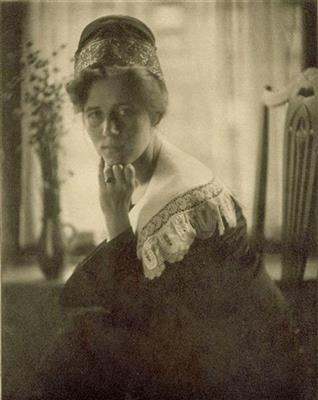
Biography
Born in Brooklyn in 1866[1], she studied at the Pratt School of Art and Design, where she met Gertrude Käsebier, later assisting in Käsebier's studio before opening her own portrait practice on East 23rd Street in Manhattan around 1890[1]. She subsequently studied in Rome and Paris, returning to a studio she would maintain for forty years. Alfred Stieglitz appointed her a Fellow of the Photo-Secession in 1906, and in 1909 Camera Work published six of her photographs alongside an essay of her own.
Her portraits ranged widely. Eugene O'Neill, William Butler Yeats, and Stevenson were among her subjects, as were female nudes in allegorical settings and studies of children. She won an honourable mention at the Turin International Decorative and Fine Arts Exhibition in 1902[1] and documented the Rockefeller family's Kykuit estate at Pocantico Hills. In 1928 she published Photographing the Famous.
When she closed the studio in 1931[1] she discarded thousands of prints before moving permanently to Long Island. She died in 1943[1].
Timeline
- 1866Born in Brooklyn, New York
- 1890Opened portrait practice on East 23rd Street in Manhattan
- 1902Honorable mention at Turin International Decorative and Fine Arts Exhibition
- 1906Appointed a Fellow of the Photo-Secession by Alfred Stieglitz
- 1909Camera Work published six of her photographs and an essay
- 1928Published Photographing the Famous
- 1931Closed her studio and moved to Long Island
- 1943Died in Long Island, New York
Notable Works
Tap to view larger.
Next stop
Browse the movements →
Every movement in the collection, from the Renaissance to Pop art.
Related Artists

_%E2%80%93_LOC.jpg)


Frequently Asked Questions
What is Alice Boughton known for?
Alice Boughton is known for her portrait photography, which included portraits of Eugene O'Neill, William Butler Yeats, and Robert Louis Stevenson. She also produced female nudes in allegorical settings and studies of children. In 1928[1], she published Photographing the Famous.What is Alice Boughton's most famous work?
It is difficult to name one single work as Alice Boughton's 'most famous'. She was a prolific photographer, and her notability rests on a few different aspects of her career. Boughton (1866[1]-1949) was an American[1] photographer known for her involvement in the Photo-Secession movement. She explored a range of styles, including pictorialism[1] and portraiture. Her portraits of literary and theatrical figures, such as Ezra Pound, Robert Louis Stevenson, and Eleonora Duse, gained attention. She also produced allegorical and mythological images, often featuring female nudes in natural settings. These images explored themes of beauty, nature, and the female form. Boughton's work was exhibited in galleries and photography journals during her lifetime. She contributed to the development of artistic photography in the early 20th century.What should I know about Alice Boughton's prints?
When considering Alice Boughton's prints, bear in mind a few aspects of fine-art printmaking. Printmakers often limit the number of impressions (copies) in an edition. This decision is the artist's choice, not a technical requirement. The printmaker marks each print with a fraction, for example, 12/25. The second number (25) is the total edition size. The first number (12) is the print's individual number within that edition. Artists sometimes hold back a percentage as artist's proofs, marked AP. It is common to sign and number editions in pencil. Claims of authenticity add value, so commercial vendors must accurately describe their products. The UK's Trade Descriptions Act of 1968 requires it. An 'original print' is conceived and executed solely as a print, usually in a numbered edition, and signed by the artist. Each print in the edition is an original, printed from a plate, stone, screen or block created for that purpose. There is no one original print from which copies are made. Each print is inked and pulled individually; it is a multi-original medium.What style or movement did Alice Boughton belong to?
Alice Boughton is associated with Pictorialism, a movement that emerged in the late 19th and early 20th centuries. Pictorialist photographers aimed to have photography recognised as fine art, competing with painting, rather than simply serving as a tool for imitation and reproduction. Pictorialists employed various techniques to achieve painterly effects. They favoured soft focus, 'artistic' lenses to create optical effects, and hand-crafted printing processes. Gum bichromate and other pigment processes gave photographs a textured, material quality, setting them apart from mass-produced images. The lack of rigid ornamentation allowed photographers to manipulate images, giving them the quality of original artworks. Pictorialists often chose portraits and landscapes as their subjects, mirroring traditional painting genres. These subjects often avoided contemporary themes, seeking a sense of timelessness. The Association Belge de Photographie (A.B.P.) embraced Pictorialism, holding exhibitions of British art photography as early as 1892[1].What techniques or materials did Alice Boughton use?
Alice Boughton was a photographer, active in the early 20th century. As a photographer, her techniques centred on image capture, darkroom processes, and printing choices. Understanding photographic techniques involves considering the materials used. Painters used natural and chemical pigments in fresco, egg tempera, watercolour, and oil paint. Sculptors traditionally used materials such as wood, marble, and bronze, but contemporary artists also use cardboard, plastic, and everyday household items. Techniques and processes describe the various methods used in the creative process. In painting, knowledge that oil can be applied thickly in impasto or thinly in glazes affects our understanding of the artwork. Brushwork may be fine and disguised, thickly applied with a palette knife, or stencilled. In sculpture, it is important to know the differences between carving and modelling, and about the subtractive/reductive processes (removal of stone and wood) in direct carving, the additive process (modelling in a soft medium such as clay), and casting (lost-wax process), assemblage, and the lack of process involved in readymades and found objects. In architecture, we should be able to recognise whether a building has been erected brick by brick or largely prefabricated off site and moved to the location where they are assembled.What was Alice Boughton known for?
Alice Boughton (1866[1]-1949) was an American[1] photographer known for her association with pictorialism[1], a style that valued artistic effect over strict realism. Boughton began her photography career in the early 1900s. She became a member of Alfred Stieglitz's Photo-Secession, an influential group promoting photography as a fine art. Her work often featured soft focus, evocative lighting, and posed figures, sometimes with symbolic elements. Boughton created portraits, figure studies, and allegorical scenes. Her subjects included dancers, artists, and members of New York's artistic circles. Some of her images drew inspiration from literature, mythology, and classical art. She also experimented with alternative printing processes, such as gum bichromate and platinum prints, to achieve particular tonal qualities. Although she embraced modernism later in her career, Boughton's early pictorialist work remains her most recognised.When did Alice Boughton live and work?
Alice Boughton was an American[1] photographer who lived from 1866[1] to 1949. She is known for her association with the Photo-Secession movement, which promoted photography as a fine art. Boughton began her artistic career studying painting and drawing at the Art Students League of New York. However, she soon became interested in photography, joining the Photo-Secession in 1904[1]. The group had been founded by Alfred Stieglitz. Boughton's work encompassed a range of subjects, including portraits, allegorical scenes, and nudes. Her portraits often featured prominent figures from the artistic and literary circles of her time. She also created photographs inspired by mythology and literature, often using soft focus and evocative lighting to create a sense of atmosphere. Throughout her career, Boughton exhibited her photographs widely, both in the United States and internationally. Her work can be found in the collections of major museums, including the Metropolitan Museum of Art and the George Eastman Museum. She continued to work as a photographer until her death in 1949, leaving behind a substantial body of work that reflects her artistic vision and technical skill.Where can I see Alice Boughton's work?
Alice Boughton's photographs can be viewed in several locations. In the United States, these include the Metropolitan Museum of Art (New York), the Los Angeles County Museum of Art (LACMA), the Minneapolis Institute of Arts, the Museum of Modern Art (New York), the Virginia Museum of Fine Arts (Richmond), the Charles Hosmer Morse Museum of American[1] Art (Winter Park, Florida), and the Wolfsonian at Florida International University (Miami Beach). Outside the United States, Boughton's work can be seen at the Royal Ontario Museum (Toronto). Other museums that may hold her work include the Art Institute of Chicago. In the UK, the Brighton Museum & Art Gallery, the Geffrye Museum (London), the Manchester Art Gallery, the National Museums of Scotland (Edinburgh), and the Victoria & Albert Museum (London) may also hold her work.Why are Alice Boughton's works important today?
Alice Boughton (1866[1]-1949) was an American[1] photographer associated with the Photo-Secession movement. Her work is significant for its exploration of allegorical and Symbolist themes, often featuring female figures in classical or mythical settings. Boughton's images often employ soft focus and evocative lighting, creating a dreamlike atmosphere. This aesthetic aligns with the Pictorialist style, which sought to elevate photography to the status of fine art. Her work provides insight into the artistic trends of the early 20th century, a period when photographers were actively challenging the boundaries of the medium. Her portraits, figure studies, and allegorical scenes reflect an interest in mythology, literature, and the female form. She drew inspiration from sources such as Pre-Raphaelite art. Boughton's photographs offer a glimpse into the cultural and artistic values of her time, particularly regarding representations of women and the pursuit of aesthetic beauty.How did Alice Boughton die?
Alice Boughton died in 1943[1] at the age of 77.
Sources
Editorial draws on the following primary and tertiary references for Alice Boughton.
- [1] wikipedia Wikipedia: Alice Boughton Used for: biography, birth dates, death dates, identifiers, movement attribution, nationality.
- [2] book Penny Olsen, Collecting Ladies: Ferdinand Von Mueller and Women Botanical Artists Used for: biography.
- [3] book Getty, Getty - Julia Margaret Cameron Complete Photographs Used for: biography.
- [4] book Engen, Rodney K, Pre-Raphaelite prints : the graphic art of Millais, Holman Hunt, Rossetti and their followers Used for: biography.
Editorial overseen by Solis Prints. Sources verified 2026-09-30. Click a source for details, or hover over [N] in the page above to preview.
Editorial standardsMethodologyCorrectionsAI disclosureAbout the editorial team