

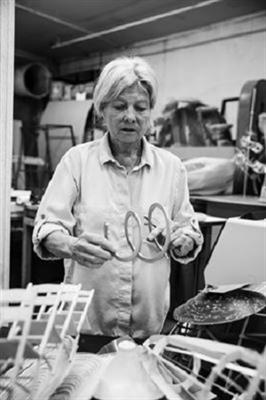
Alice Aycock
In 1972, on a farm in rural Pennsylvania, Alice Aycock constructed a 32-foot wooden maze with concentric rings and no clear exit. Visitors who entered found themselves disoriented, unable to determine the structure's logic from inside it. The experience was the point. 'A Simple Network of Underground Wells and Tunnels' (1975) pushed the idea further: viewers crawled through subterranean chambers without knowing where they would end or how deep they were going.
Biography
Born in Harrisburg, Pennsylvania, in 1946[1], Aycock completed her BA at Douglass College in 1968 and her MA at Hunter College in 1971, studying under Robert Morris. Her master's thesis examined the American[1] experience of the highway system, a subject that already foreshadowed her interest in constructed environments and their psychological effects. She belonged to the generation that came of age alongside land art and Conceptualism, but her ambition was to bring the spectator's body directly into the work.
'The Beginnings of a Complex' (1977) was shown at Documenta 6 in Kassel, cementing her international reputation. Through the 1980s her work increasingly referenced mechanical systems and scientific imagery, producing elaborate installations that looked less like architecture and more like the interior workings of an overscaled dream device. Later sculpture evolved into large-scale swirling metal forms responding to natural forces such as wind and atmospheric turbulence.
Her work is held at the Museum of Modern Art, the Whitney Museum of American[1] Art, the Brooklyn Museum, and the National Gallery. Permanent public installations are sited at Dulles and JFK airports.
Timeline
- 1946Born in Harrisburg, Pennsylvania
- 1968Completed BA at Douglass College
- 1971Completed MA at Hunter College, studied under Robert Morris
- 1972Constructed wooden maze in rural Pennsylvania
- 1975Created 'A Simple Network of Underground Wells and Tunnels'
- 1977Showed 'The Beginnings of a Complex' at Documenta 6 in Kassel
- 1980Work referenced mechanical systems and scientific imagery
- 1980Sculpture evolved into large-scale swirling metal forms
Next stop
Browse the movements →
Every movement in the collection, from the Renaissance to Pop art.
Related Artists



Frequently Asked Questions
What is Alice Aycock known for?
Alice Aycock is known for bringing the spectator's body directly into the work. Her early work included mazes and subterranean chambers designed to disorient the viewer. Later, she produced elaborate installations referencing mechanical systems and scientific imagery, and her sculpture evolved into large-scale swirling metal forms.Who was Alice Aycock?
Alice Aycock, born in Harrisburg, Pennsylvania, in 1946[1], is an artist who studied under Robert Morris and whose master's thesis foreshadowed her interest in constructed environments and their psychological effects. She is part of the generation that came of age alongside land art and Conceptualism.What was Alice Aycock's art style?
Aycock's art style evolved over time, beginning with mazes and subterranean chambers. Later, her work referenced mechanical systems and scientific imagery, producing elaborate installations. Her later sculpture evolved into large-scale swirling metal forms responding to natural forces.When was Alice Aycock born?
Alice Aycock was born in 1946[1].
Sources
Editorial draws on the following primary and tertiary references for Alice Aycock.
- [1] wikipedia Wikipedia: Alice Aycock Used for: biography, birth dates, death dates, identifiers, movement attribution, nationality.
- [2] book guggenheim-anglesofvisionfr00denn Used for: biography.
- [3] book guggenheim-nineartiststheod00solo Used for: biography.
- [4] book guggenheim-transfsi00wald Used for: biography.
Editorial overseen by Solis Prints. Sources verified 2026-10-15. Click a source for details, or hover over [N] in the page above to preview.
Editorial standardsMethodologyCorrectionsAI disclosureAbout the editorial team