

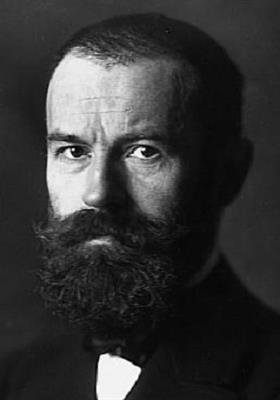
Alfred Roller
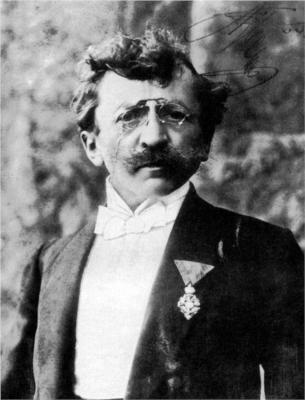
When Gustav Mahler took charge of the Vienna Court Opera in 1897[1], he eventually found in Alfred Roller the designer who could realise his ideas about what opera should look like. Their collaboration, beginning in 1903 with a production of Tristan und Isolde, changed the visual language of opera performance across Europe.
Biography
Roller had come up through the Vienna Secession, which he co-founded in 1897[1]. From 1898 he edited Ver Sacrum, the Secession's journal, designing its first cover in an unconventional square format that arranged image and text into distinct zones. The central image showed a potted shrub breaking free of its container, a metaphor for what the Secession intended to do to Viennese art. He was elected president in 1902 and 1909. That same year he curated the fourteenth Secession exhibition, the celebrated Beethoven show, designing the visitor experience as a processional journey from darkness to light, centred on Max Klinger's monumental sculpture of the composer.
Born in Brno (then Brünn, in the Habsburg Empire) in 1864[1], Roller had studied at the Vienna School of Arts and Crafts. His theatre designs for Mahler were notable for their use of atmospheric light rather than illustrative scenery: for Tristan, enormous towers that could be repositioned to suggest different spaces, with colour and shadow doing the descriptive work. Mahler called it a revelation. The production drawings for their joint projects, including Don Giovanni and The Marriage of Figaro, remain remarkable documents of early modern theatre.
After Mahler left Vienna in 1907[1], Roller continued designing for the Staatsoper and for the Salzburg Festival, working with Max Reinhardt. He died in Vienna in 1935[1].
Timeline
- 1864Born in Brno, Habsburg Empire
- 1897Co-founded the Vienna Secession
- 1898Edited Ver Sacrum, designed the first cover
- 1902Elected president of the Vienna Secession
- 1903Began collaboration with Gustav Mahler on Tristan und Isolde
- 1907Mahler left Vienna
- 1909Elected president of the Vienna Secession
- 1935Died in Vienna
Notable Works
Tap to view larger.
Next stop
Browse the movements →
Every movement in the collection, from the Renaissance to Pop art.
Related Artists


Frequently Asked Questions
What is Alfred Roller known for?
Alfred Roller is known for changing the visual language of opera performance across Europe through his designs for Gustav Mahler's productions at the Vienna Court Opera. His designs, starting with Tristan und Isolde in 1903[1], were notable for their atmospheric light and repositionable structures. He also curated the celebrated Beethoven show, designing a processional visitor experience.What was Alfred Roller's art style?
Alfred Roller's theatre designs were notable for their use of atmospheric light rather than illustrative scenery. For example, his designs for Tristan featured enormous, repositionable towers, with colour and shadow providing descriptive detail. His work with Mahler is considered early modern theatre design.How did Alfred Roller die?
Alfred Roller died in 1935[1] at the age of 71.
Sources
Editorial draws on the following primary and tertiary references for Alfred Roller.
- [1] wikipedia Wikipedia: Alfred Roller Used for: biography, birth dates, death dates, identifiers, movement attribution, nationality.
- [2] book Husslein-Arco, Agnes, editor; Koja, Stephan, editor; Law, Rebecca (Translator), translator; McInnes, Robert (Translator), translator; Somers, Nick, translator; Monet, Claude, 1840-1926. Paintings. Selections; Österreichische Galerie Belvedere, h Used for: biography.
- [3] book Post-impressionism : cross-currents in European painting Used for: biography.
- [4] book Post-impressionism : cross-currents in European painting Used for: biography.
Editorial overseen by Solis Prints. Sources verified 2026-10-07. Click a source for details, or hover over [N] in the page above to preview.
Editorial standardsMethodologyCorrectionsAI disclosureAbout the editorial team