



Alfred Downing Fripp
Alfred Downing Fripp spent his career translating English, Irish, Italian, and Welsh rural life into watercolour with a directness that secured him the Secretaryship of the Old Watercolour Society in 1870[1], a post he held for the rest of his active career. He was born in Bristol in 1822[1], the grandson of the marine painter Nicholas Pocock and brother of the watercolourist George Arthur Fripp.
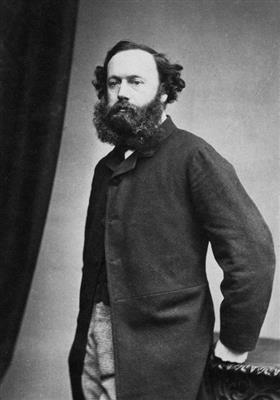
Biography
Trained at the Royal Academy, Fripp exhibited for the first time in 1842[1] with studies of Irish and Welsh peasant subjects. He was elected an Associate of the Old Watercolour Society in 1844 and a full Member two years later. The death of his first wife in 1850 prompted a period abroad; he spent roughly four years in Italy, where he worked alongside Frederick Leighton and Edward Poynter in Rome, both at the outset of careers that would carry them far further into the English art establishment.
Returning to Britain in 1854[1], Fripp resumed his focus on rural figures in landscape. He developed a particular attachment to the Dorset countryside around Lulworth, often using his wife Eliza's younger siblings as models. The combination of accessible subjects and clean watercolour technique placed him at the more popular end of the Victorian watercolour tradition, and his work was consistently shown at the Society's exhibitions for decades.
His son, Sir Alfred Downing Fripp, became a noted surgeon. The elder Fripp died in London on 13 March 1895[1].
Timeline
- 1822Born in Bristol, England
- 1842First exhibited studies of Irish and Welsh subjects.
- 1844Elected Associate of the Old Watercolour Society.
- 1846Became a full Member of the Old Watercolour Society.
- 1850Death of his first wife.
- 1850Spent four years in Italy.
- 1854Returned to Britain, focused on rural figures.
- 1870Became Secretary of the Old Watercolour Society.
- 1895Died in London.
Notable Works
Tap to view larger.
Next stop
Browse the movements →
Every movement in the collection, from the Renaissance to Pop art.
Related Artists




Frequently Asked Questions
What is Alfred Downing Fripp known for?
Alfred Downing Fripp is known for translating English, Irish, Italian, and Welsh rural life into watercolour. His accessible subjects and clean watercolour technique placed him at the more popular end of the Victorian watercolour tradition.What is Alfred Downing Fripp's most famous work?
Without more information about Alfred Downing Fripp's body of work, it isn't possible to name his single most famous piece. However, we can examine other artists' bodies of work to understand how fame is assigned. Walter Sickert, for example, painted many scenes of Dieppe, France, and its environs, leading Jacques-Emile Blanche to call him the Canaletto of Dieppe. Among these Dieppe paintings, The Flower Market, Dieppe (c. 1898) is well known, along with Une Rue a Dieppe, 1898. Similarly, Sickert's Brighton Pierrots (1915) is a noted work from his time on the English south coast, depicting a concert party on Brighton beach. Another well-known work, The New Home (1908), typifies Sickert's Camden Town figure studies, portraying a young woman in a lodging-room setting, reflecting a class and way of life.What should I know about Alfred Downing Fripp's prints?
Alfred Downing Fripp (1822[1]-1895[1]) was associated with the Pre-Raphaelite movement, which embraced printmaking to broaden its reach. Pre-Raphaelite prints allowed their style to reach a wider audience at a lower cost than original paintings. Fripp's prints, like those of his contemporaries, helped to popularise the Pre-Raphaelite aesthetic throughout middle-class Britain. These prints became social and artistic documents that allow us to understand popular taste in the period. Printmakers employed various techniques, including etching, engraving, mezzotint, and photogravure. These reproductions were produced in large numbers. Some prints were issued in editions as large as 775 Artist Proofs. The numbering of prints is a relatively recent convention. Early prints were not usually numbered or signed.What style or movement did Alfred Downing Fripp belong to?
Alfred Downing Fripp was active during a period of considerable stylistic change. One can consider his work in relation to both the Arts and Crafts movement and early Modernism. The Arts and Crafts movement, which began in the 1880s, promoted the idea that art and craft could improve people's lives. It valued simplicity, purity and expressiveness. Figures such as C.R. Ashbee and C.F.A. Voysey established high standards for design. Early Modernism shared the Arts and Crafts movement's dedication to sincerity. It also valued purity of form, which led to simplification and qualities of bareness. Roger Fry, a translator and critic, presented Post-Impressionism as a modern movement linked to French practices. He saw it as a return to formal design, giving emotional significance to the imitation of nature. Fry emphasised the process of imposing order on vision, a concept related to Arts and Crafts theories.What techniques or materials did Alfred Downing Fripp use?
Alfred Downing Fripp was a painter who worked primarily in watercolours. He is known for his depictions of British[1] rural life, architecture, and animals. Fripp received his artistic training at the Royal Academy Schools. There, he would have been instructed in the established methods of watercolour painting, including layering washes and using dry-brush techniques for details. His subjects often included farm animals, especially sheep. The artist paid close attention to the textures of wool and the effects of light on the animals' forms. He also depicted buildings, often ruins, with careful attention to detail. These architectural studies show his skill in rendering stonework and the effects of weathering. Fripp's work displays a traditional approach to watercolour painting, focusing on accurate representation and atmospheric effects. His paintings often evoke a sense of calm observation, typical of British watercolour artists of his time.What was Alfred Downing Fripp known for?
Alfred Downing Fripp (1822[1]-1895[1]) was an English watercolourist. He came from a family of artists; his brothers George Arthur Fripp and Henry Charles Fripp were also painters. Alfred Downing Fripp is mainly known for his genre scenes and historical subjects, often featuring figures in detailed costumes. He also produced some illustrations. His early work displays Pre-Raphaelite influences, with attention to detail and naturalistic representation. He exhibited at the Royal Academy, the British[1] Institution, and the Society of British Artists. Fripp's watercolours often depict scenes from everyday life, such as rural landscapes with peasants, or historical events with figures in period attire. His work was popular during the Victorian era, appealing to the taste for sentimental and narrative subjects.When did Alfred Downing Fripp live and work?
Alfred Downing Fripp (1822[1]-1895[1]) was a British[1] watercolourist. He came from a family of artists; his father was a clergyman, and his brothers included the painter George Arthur Fripp. Fripp studied art under William James Müller. He became a member of the Royal Watercolour Society in 1843[1], and he exhibited regularly at their shows. His early works often depicted scenes from Wales and the West Country. Later in his career, Fripp travelled extensively. He visited Italy, Switzerland, and France, creating watercolours of continental subjects. These paintings display his skill in capturing light and atmosphere. He is known for genre scenes, often featuring figures in rural settings. Fripp's work can be found in several public collections. These include the Victoria and Albert Museum, the British Museum, and the National Gallery of Ireland. His art provides a view into 19th-century British watercolour painting.Where was Alfred Downing Fripp from?
Alfred Downing Fripp was born in Clifton, Gloucestershire, in 1822[1]. He came from a family of artists; his father, James Fripp, was also a painter, and his uncle, Nicholas Pocock, was a marine artist. Fripp received his early artistic training from his father. Later, he studied at the New School of Painters in Water Colours. He became a member of the Royal Society of Painters in Water Colours in 1845[1]. Although born in Gloucestershire, Fripp spent a significant portion of his career working in Wales. He is particularly associated with the area around Snowdonia. Many of his works depict Welsh subjects, including scenes of rural life and the Welsh countryside. He died in 1895[1] in Hampstead, London.Who did Alfred Downing Fripp influence?
Alfred Downing Fripp's artistic impact is difficult to measure directly. The late nineteenth century saw many British[1] artists looking to France for inspiration, but also trying to create something identifiably British. French artists like Bastien-Lepage were influential on British art students in the early 1880s. His style was seen in rural artist colonies in Brittany, Newlyn in Cornwall, and Cockburnspath in Scotland. However, these artists were not considered the most progressive. Whistler, Degas, and Monet had followers in Britain too; Sickert and George Moore admired Degas, while others looked to Monet for his use of colour and light. By the 1890s, there was a sense that British artists were borrowing too much from France. Some critics urged artists to return to British traditions, such as the Pre-Raphaelites. By 1900, some tried to reconcile French and British styles. Later, around 1905, younger British artists again looked to France, learning from Sickert and Lucien Pissarro. New exhibition societies emerged, creating more opportunities for artists to display their work.Who was Alfred Downing Fripp?
Without more information, it is difficult to provide a detailed biography of Alfred Downing Fripp. However, some facts can be gleaned from historical records. The surname Fripp appears in British[1] records from at least the 18th century. A family of artists is known, active around Bristol in the early 1800s. These include members such as Henry Albin Fripp (1822[1]-1895[1]), a watercolourist, and George Arthur Fripp (1813-1896[1]), also a watercolourist. Given the absence of further information, it is possible that Alfred Downing Fripp was a member of this family, or another artist working in a similar period. Further research in art indexes, census records, and local archives might yield more specific biographical details.Why are Alfred Downing Fripp's works important today?
Alfred Downing Fripp (1822[1]-1895[1]) was active during a period of change in British[1] art. His career occurred before the rise of modernism, a movement that fractured the art world into distinct camps with separate standards. One can understand Fripp's position by examining the debates around Roger Fry's Post-Impressionist exhibitions in London in the early 20th century. Fry championed artists like Cézanne, whose work he described as having an "abstract system of plastic rhythms". Fry believed future viewers might prefer the understatement of such works. The exhibitions and Fry's writings provoked strong reactions from traditionalist painters and critics. They felt Fry's "avant-garde" was separate and judged by different standards. Some artists, like Burne-Jones and Richmond, publicly attacked Fry and his promotion of Post-Impressionism. These disputes illustrate the shift in taste and artistic values that occurred after Fripp's death. Examining Fripp's artistic choices allows us to understand what the modernists were reacting against, and what Fry and others found lacking in the art of the previous generation.What was Alfred Downing Fripp's art style?
Alfred Downing Fripp's work focused on rural figures in landscape. He developed an attachment to the Dorset countryside around Lulworth.
Sources
Editorial draws on the following primary and tertiary references for Alfred Downing Fripp.
- [1] wikipedia Wikipedia: Alfred Downing Fripp Used for: biography, birth dates, death dates, identifiers, movement attribution, nationality.
- [2] book Beard, Lee, 1973- author, Butler, Adam, author; Van Cleave, Claire, author; Fortenberry, Diane, author; Stirling, Susan, author, Beard, Lee, 1973- author, Butler, Adam, author; Van Cleave, Claire, author; Fortenberry, Diane, author; Stirling, Susan, author - The Art Book_ New Edition, Mini Format Used for: biography.
- [3] book Post-impressionism : cross-currents in European painting Used for: biography.
- [4] book Sickert, Walter, 1860-1942, Sickert, paintings Used for: biography.
Editorial overseen by Solis Prints. Sources verified 2026-09-30. Click a source for details, or hover over [N] in the page above to preview.
Editorial standardsMethodologyCorrectionsAI disclosureAbout the editorial team