



Alexander Rodchenko
When Vladimir Mayakovsky needed someone to design state product advertisements in the mid-1920s, he chose Alexander Rodchenko. The two men stamped their shared work 'Advertisement Constructors, Mayakovsky-Rodchenko,' and the posters they produced for beer, cigarettes, and airline shares became some of the most imitated graphic design of the century: two-colour, built for cheap printing, and as direct as a shout.
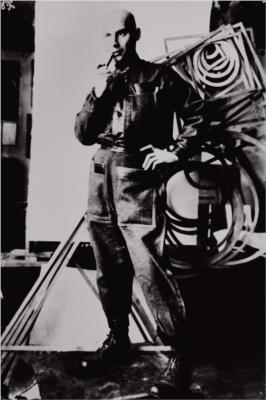
Biography
Born in St. Petersburg in 1891[1], Rodchenko trained at the Kazan Art School from 1910[1] to 1914, where he met Varvara Stepanova, whom he later married. He entered Moscow's cultural scene during the revolutionary period, designing the Café Pittoresque interior with Tatlin and Yakulov in 1917. In 1920 he co-founded Inkhuk, and in 1921 publicly abandoned easel painting for design and photography, declaring that the downfall of all the isms of painting marked the beginning of his real work.
His photography, which he began in earnest in 1924[1], established its own visual vocabulary. 'Rodchenko perspective' and 'Rodchenko foreshortening' entered common usage for his extreme low- and high-angle compositions. His close-up portrait of his mother, taken in 1924, is among the period's finest works. His influence on Eisenstein, Kuleshov, and Dziga Vertov was direct and acknowledged. In 1928 he was accused of plagiarising from László Moholy-Nagy and defended himself in print in Novyi lef.
He represented the Soviet Union at the 1925[1] Paris Exhibition of Decorative Arts with a workers' club installation that has since become one of the canonical Constructivist spaces. He returned intermittently to painting in the 1930s and 1940s alongside ongoing design work, and died in Moscow in 1956[1].
Timeline
- 1891Born in St. Petersburg, Russia
- 1910Studied at Kazan Art School
- 1914Met Varvara Stepanova at Kazan Art School
- 1917Designed Café Pittoresque interior with Tatlin and Yakulov
- 1920Co-founded Inkhuk
- 1921Abandoned easel painting for design and photography
- 1924Began photography in earnest
- 1925Represented USSR at Paris Exhibition with workers' club installation
- 1928Accused of plagiarizing László Moholy-Nagy
- 1956Died in Moscow
Notable Works
Tap to view larger.
Next stop
Browse the movements →
Every movement in the collection, from the Renaissance to Pop art.
Related Artists



Frequently Asked Questions
What is Alexander Rodchenko known for?
Alexander Rodchenko is known for his graphic design, particularly the posters he created with Vladimir Mayakovsky for state product advertisements in the mid-1920s. He is also known for his photography, which began in 1924[1] and established its own visual vocabulary, including extreme low- and high-angle compositions known as 'Rodchenko perspective' and 'Rodchenko foreshortening'.Who was Alexander Rodchenko?
Alexander Rodchenko was a Russian[1] artist who trained at the Kazan Art School and later designed the Café Pittoresque interior with Tatlin and Yakulov in 1917[1]. In 1921, he abandoned easel painting for design and photography, believing this marked the start of his real work, and he later represented Russia at the 1925 Paris Exhibition of Decorative Arts.What was Alexander Rodchenko's art style?
Alexander Rodchenko's art style included Constructivism[1], design, and photography. His photography established its own visual vocabulary, with 'Rodchenko perspective' and 'Rodchenko foreshortening' becoming common terms for his extreme low- and high-angle compositions.How did Alexander Rodchenko die?
Alexander Rodchenko died in 1956[1] at the age of 65.
Sources
Editorial draws on the following primary and tertiary references for Alexander Rodchenko.
- [1] wikipedia Wikipedia: Alexander Rodchenko Used for: biography, birth dates, death dates, identifiers, movement attribution, nationality.
- [2] book Beard, Lee, 1973- author, Butler, Adam, author; Van Cleave, Claire, author; Fortenberry, Diane, author; Stirling, Susan, author, Beard, Lee, 1973- author, Butler, Adam, author; Van Cleave, Claire, author; Fortenberry, Diane, author; Stirling, Susan, author - The Art Book_ New Edition, Mini Format Used for: biography.
- [3] book Jed Rasula, Destruction Was My Beatrice Used for: biography.
- [4] book guggenheim-kandinskyrussian00kand Used for: biography.
- [5] book J. E. Bowlt, Russian Art of the Avant Garde - Theory and Criticism 1902-1934 Used for: biography.
- [6] book edited and translated by John E. Bowlt, Russian Art of the Avant-Garde_ Theory and Criticism 1902-1934 (The Documents of 20th-Century Art) (English and Russian Edition) Used for: biography.
Editorial overseen by Solis Prints. Sources verified 2026-09-23. Click a source for details, or hover over [N] in the page above to preview.
Editorial standardsMethodologyCorrectionsAI disclosureAbout the editorial team