

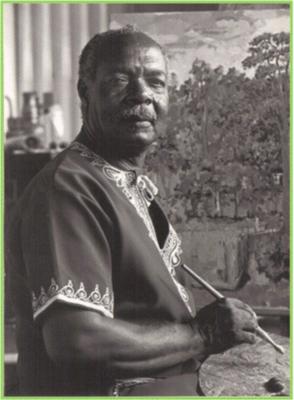
Albert Huie
Albert Huie held a unique position in Jamaican art history: when he mounted his first solo exhibition at the Institute of Jamaica[1] in 1943[1], he became the first modern Jamaican artist to receive that honour. Born on 31 December 1920[1] in Falmouth, Trelawny, Huie trained under Armenian painter Koren der Harootian at the Institute's classes during the 1930s, later assisting sculptor Edna Manley at Kingston's Junior Centre.
Biography
His early canvases took aim at subjects the colonial tradition had overlooked: manual labour, Pocomania gatherings, jitterbug dances, the textures of ordinary black Jamaican life. The influence of Post-Impressionism is clear, as are traces of Mexican mural painting and Art Deco. He also worked in linocut, producing silhouetted prints with an economy of line that recalls Matisse.
A British Council scholarship in 1947[1] took him to Camberwell School of Arts and Crafts in London. On returning, he became one of the founding tutors at the Jamaica[1] School of Art and Crafts in 1950, shaping the country's art education at its inception. Throughout the 1940s he published images in Public Opinion, the cultural nationalist magazine that was a platform for the island's emerging identity.
His landscapes, perhaps his most sustained body of work, track how Jamaican light and colour shift across the hours and across seasons. The Institute of Jamaica[1] awarded him the Musgrave Silver Medal in 1958[1] and the Gold Medal in 1974. He took an international prize at the Spanish Bi-Annual exhibition in Havana in 1959. Huie died on 31 January 2010[1] in Baltimore, aged 89; his work remains held in the National Gallery of Jamaica.
Timeline
- 1920Born in Falmouth, Trelawny, Jamaica on December 31st.
- 1930Trained under Koren der Harootian at the Institute of Jamaica.
- 1943First solo exhibition at the Institute of Jamaica.
- 1947Awarded British Council scholarship to Camberwell School of Arts and Crafts.
- 1950Founding tutor at the Jamaica School of Art and Crafts.
- 1958Awarded the Musgrave Silver Medal by the Institute of Jamaica.
- 1959Won international prize at the Spanish Bi-Annual exhibition in Havana.
- 1974Awarded the Musgrave Gold Medal by the Institute of Jamaica.
- 2010Died in Baltimore on January 31st at age 89.
Notable Works
Tap to view larger.
Next stop
Browse the movements →
Every movement in the collection, from the Renaissance to Pop art.
Related Artists

Frequently Asked Questions
What is Albert Huie known for?
Albert Huie is known for his paintings of manual labour, Pocomania gatherings, jitterbug dances, and ordinary black Jamaican life. He is also known for his landscapes, which track how Jamaican light and colour shift across the hours and across seasons.What is Albert Huie's most famous work?
Albert Huie is best known for his paintings of Jamaican life and people. Born in Falmouth, Jamaica[1], in 1920[1], he is considered one of the most important figures in Jamaican art history. While it is difficult to identify a single "most famous" work, several paintings are particularly well regarded. *Father and Son* (1956[1]) is one example. It portrays a rural Jamaican man with his child. The work is admired for its sensitive depiction of family and its social commentary. It reflects the realities of working-class Jamaicans in the mid-20th century. Another important painting is *The Annunciation* (1953). This piece departs from traditional European depictions of the Annunciation. Huie sets the scene in a Jamaican context, with a Black Virgin Mary. This indigenisation of religious iconography is a recurring theme in his art. Huie's paintings are held in major collections, including the National Gallery of Jamaica. He died in 2010[1], leaving behind a substantial body of work that continues to be celebrated for its artistic merit and cultural significance.What should I know about Albert Huie's prints?
When considering Albert Huie's prints, bear in mind some basic facts about the fine art print market. An 'original print' is an image conceived as a print and executed solely as a print, usually in a numbered edition, and signed by the artist. Each print in the edition is an original, printed from a plate, stone, screen, block or other matrix created for that purpose. There is no one original print from which copies are made. Each print is inked and pulled individually; it is a multi-original medium. The number of prints in the edition is decided by the artist. The sequential numbering provides an accounting for the number of prints in the edition. Each print has a specific number; i.e. 12/25 (The edition is 25, the particular print is number 12). Publishers create editions by collaborating with the artist or by working from existing works. Prices for prints vary widely depending on the quantity available; the artist’s reputation; the popularity of the image; the quality of the paper, ink, and printing process.What style or movement did Albert Huie belong to?
It is difficult to assign Albert Huie to a single style. He resisted Modernist influences, viewing Cubist canvases as mechanically produced salon art. He also thought Bauhaus variants resulted from an authoritarian rationality that could enslave society. Huie began painting non-objectively in 1947[1]. His later works maintained a certain quality, expressing ideals of American pioneers. He venerated the individual struggle to produce a unique vision. Some have compared Huie to members of the Color Field painters, an informal group that included Barnett Newman. These painters shared ideas and evoked a sense of holiness. They explored the sublime, which one writer described as the artist's search for epic self-realisation. This involved a solitary journey through dark valleys to reach clear skies and limitless plains, where imagination and vision unite.What techniques or materials did Albert Huie use?
Albert Huie, a Jamaican artist born in 1920[1], worked primarily as a painter. He favoured oil paint, and his style moved from social realism toward looser, more expressive brushwork later in his career. Huie received early training in Jamaica[1] from art teacher, Mrs. M. L. Rhodes, and later studied at the Ontario College of Art in Toronto during the 1940s. His time in Canada exposed him to European modernism, but he remained committed to depicting Jamaican subjects. Early works, such as "Sunday Morning" (1943[1]), show a concern for accurate representation and social commentary. These paintings often feature carefully observed scenes of everyday life. Later paintings demonstrate a move away from strict realism. The brushstrokes become more visible, and the colour palette becomes brighter. This shift is evident in pieces like "Mother and Child". While oil paint remained his primary medium, the way he handled it changed over time, reflecting a developing artistic vision. Huie died in 2010[1].What was Albert Huie known for?
Albert Huie (1920[1]-2010[1]) was a Jamaican artist, sometimes called the "father of Jamaican painting". He is recognised as one of the first Jamaican artists to paint in a style that moved beyond strict realism, towards something more expressive. Born in Falmouth, Trelawny, he received early instruction from art classes offered by the Jamaica[1] Welfare Commission. Huie studied at the Ontario College of Art in Toronto during the 1940s. He then returned to Jamaica and became an influential figure; he was known for his portraits and genre scenes. He captured the daily life and people of Jamaica, moving away from earlier styles popular with tourists. Huie's work often depicted rural communities and workers. He also painted historical subjects and figures.Where can I see Albert Huie's work?
It is difficult to pinpoint exactly where you can view Albert Huie's work. However, many major museums hold collections of paintings and other fine art. These include institutions in the United States, such as the Metropolitan Museum of Art (New York), the Museum of Modern Art (New York), the Los Angeles County Museum of Art, the Minneapolis Institute of Arts, the Virginia Museum of Fine Arts (Richmond), the Charles Hosmer Morse Museum of American Art (Winter Park, Florida), and the Wolfsonian at Florida International University (Miami Beach). In Canada, collections can be found at the Royal Ontario Museum (Toronto). In the United Kingdom, try the Victoria & Albert Museum (London), the Brighton Museum & Art Gallery, the Manchester Art Gallery, and the National Museums of Scotland (Edinburgh).Where was Albert Huie from?
Albert Huie was born in Falmouth, Jamaica[1], on 31 December 1920[1]. He is considered one of Jamaica's most important artists. Huie's parents were farmers. He showed artistic talent early, drawing with charcoal on walls as a child. Huie received his formal art training abroad. He studied at the Ontario College of Art in Toronto, Canada, from 1945[1] to 1947. Later, he studied at the Camberwell School of Art in London, England, from 1949 to 1951. These experiences exposed him to different artistic styles and techniques. Huie returned to Jamaica and became a significant figure in the island's art scene. He taught art and mentored many younger artists. His work often depicted Jamaican life, culture, and people. He aimed to capture the essence of his homeland in his paintings. Huie died in Kingston, Jamaica, on 31 January 2010[1].Who did Albert Huie influence?
It is difficult to assess definitively who Albert Huie influenced. Modernism's growth in Los Angeles during the 1920s was confined to a small group. They included Helena Dunlap, Ben Berlin, E. Roscoe Shrader, Peter Krasnow, Knud Merrild, Henrietta Shore, and Belle Baranceanu, as well as Mabel Alvarez, Edouard Vysekal, and Nick Brigante, who were students of Macdonald-Wright. Shore helped to plan independent exhibitions outside the conservative annuals of the California Art Club, where she also exhibited. She gained a local reputation for a colourful, expressionistic style. It recalled the work of Robert Henri, one of her teachers at the New York School of Art, but in brighter tones influenced by California light. Always open to new opportunities, Shore returned to New York in 1920[1], likely prompted by the “American Modernists” exhibition. In search of a new idiom, she began producing radical, semi-abstract still lifes with natural undertones, using line and shape to create rhythmic effects.Why are Albert Huie's works important today?
Albert Huie (1920[1]-2010[1]) was a Jamaican artist whose work provides insight into social and political issues in Jamaica[1] during the mid-20th century. After World War II, black artists increasingly attended art schools, coinciding with the rise of Abstract Expressionism in America. The civil rights movement aided black artists in establishing their artistic identities and finding styles to express them. This period saw a surge of artistic expression, particularly after the assassinations of Malcolm X in 1965[1] and Martin Luther King Jr in 1968. Huie's representational style allowed him to communicate a distinct perspective directly to his community. His art offers a window into Jamaican life and thought during a period of significant change. By engaging with social and political themes, Huie's work remains relevant for understanding the cultural history of Jamaica and the broader context of post-colonial art in the Caribbean.What was Albert Huie's art style?
Albert Huie's art style shows the influence of Post-Impressionism, Mexican mural painting, and Art Deco. His linocut prints, with their economy of line, recall Matisse.
Sources
Editorial draws on the following primary and tertiary references for Albert Huie.
- [1] wikipedia Wikipedia: Albert Huie Used for: biography, birth dates, death dates, identifiers, movement attribution, nationality.
- [2] book Beard, Lee, 1973- author, Butler, Adam, author; Van Cleave, Claire, author; Fortenberry, Diane, author; Stirling, Susan, author, Beard, Lee, 1973- author, Butler, Adam, author; Van Cleave, Claire, author; Fortenberry, Diane, author; Stirling, Susan, author - The Art Book_ New Edition, Mini Format Used for: biography.
- [3] book guggenheim-futurismmodernfo00solo Used for: biography.
- [4] book guggenheim-onehundredpainti00thom Used for: biography.
Editorial overseen by Solis Prints. Sources verified 2026-09-30. Click a source for details, or hover over [N] in the page above to preview.
Editorial standardsMethodologyCorrectionsAI disclosureAbout the editorial team