



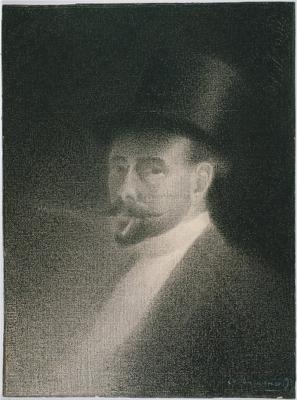
Albert Dubois-Pillet
Emile Zola drew on Albert Dubois-Pillet's painting *Enfant Mort* (1881[1]) when writing *L'Oeuvre* in 1886, a fact that places the artist at the centre of Parisian avant-garde life in the 1880s. He had no formal art training: a graduate of the Ecole Militaire at Saint-Cyr in 1867, Dubois-Pillet maintained an active military career throughout his short life, concealing his painting practice under his mother's maiden name 'Pillet' from 1884 to avoid professional complications.

Biography
Alongside Seurat, Signac, and Redon, he co-founded the Societe des Artistes Independants on 29 July 1884[1], creating an exhibition structure with no jury and no prizes. He was among the first painters to adopt Pointillism[1], applying the divisionist method with what contemporaries described as photographic precision. Works like *La Dame a la Robe Blanche* (c. 1886) and *The Banks of the Marne at Dawn* (c. 1888) showed his command of the technique. His studio-apartment in Paris became an informal gathering place for the Neo-impressionist circle.
Dubois-Pillet died of smallpox in Le Puy-en-Velay in August 1890[1], aged 43. A fire destroyed much of his remaining work shortly afterwards, making his surviving paintings rare. *Le Puy in the Snow* (1889[1]), painted in his final months, is among the most striking records of what his practice might have become.
Timeline
- 1846Born Albert Dubois, later Dubois-Pillet.
- 1867Graduated from the Ecole Militaire at Saint-Cyr.
- 1881Painted *Enfant Mort*.
- 1884Co-founded the Societe des Artistes Independants.
- 1884Began using 'Pillet' to conceal his art practice.
- 1886Zola referenced Dubois-Pillet's work in *L'Oeuvre*.
- 1886Painted *La Dame a la Robe Blanche* (approximate date).
- 1888Painted *The Banks of the Marne at Dawn* (approximate date).
- 1889Painted *Le Puy in the Snow*.
- 1890Died of smallpox in Le Puy-en-Velay.
Notable Works
Tap to view larger.
Next stop
Pointillism →
Explore the artists and ideas of Pointillism.
Related Artists




Frequently Asked Questions
What is Albert Dubois-Pillet known for?
Albert Dubois-Pillet is known for co-founding the Societe des Artistes Independants with Seurat, Signac, and Redon. He was also among the first painters to adopt Pointillism[1].What is Albert Dubois-Pillet's most famous work?
It is difficult to name one single work as Albert Dubois-Pillet's "most famous". However, two paintings are often discussed in relation to his artistic development: *Wash-house Boat at Saint Maurice* (1886[1]/7) and *Saint Michel d’Aiguilhe in the Snow* (1890[1]). *Wash-house Boat at Saint Maurice* demonstrates Dubois-Pillet's move toward Neo-Impressionism. Painted in 1886 or 1887, it shows the influence of Seurat and Signac, with small flecks of colour added to broader paint zones. The scene depicts a moored boat used for washing clothes on the river Marne, near Charenton, on the outskirts of Paris. *Saint Michel d’Aiguilhe in the Snow*, painted in 1890, is a later work, more systematically executed, although the 'points' of paint still vary in size. The limited local colours, due to the snow, allowed Dubois-Pillet to base his composition on variations of blue and mauve against yellow and orange. The painting emphasises the verticality of the church of Saint Michel d’Aiguilhe, located on a volcanic pinnacle in Le Puy, where Dubois-Pillet spent his final months.What should I know about Albert Dubois-Pillet's prints?
When considering Albert Dubois-Pillet's prints, bear in mind that the art market distinguishes among vintage, period, modern, and facsimile prints. A vintage print is made around the time the negative was taken; a period print within roughly 15 years. Anything printed later is considered either an old print or a modern print. An original print is one made by the artist or under their direct supervision. A facsimile is a print made by re-photographing a print, or produced using the original negative, with print base and processing as close as possible to a vintage print. Photographic prints result from an artisan process of shooting, developing the negative, and printing. The unique print is a constant reference in the print market. The practice of numbering prints, following the model of engraving, is now established, though not exclusive. The number of prints in an edition is decided by the artist, with each print given a specific number (for example, 12/25 means print number 12 of an edition of 25).What style or movement did Albert Dubois-Pillet belong to?
Albert Dubois-Pillet (1846[1]-1890[1]) moved through several styles, starting with naturalism, then impressionism, before adopting a form of neo-impressionism by 1886[1]. Self-taught, Dubois-Pillet was a professional soldier based in Paris from 1880 to 1889. He helped found the Société des Artistes Indépendants in 1884; his artistic work caused frequent conflict with his military superiors. His move toward neo-impressionism involved the use of 'petit point'. This can be seen in *Wash-house Boat at Saint Maurice* (1886/7). The painting shows the influence of Seurat and Signac, visible in the small, regular touches. Dubois-Pillet added flecks of colour to broader paint zones, creating small-scale contrasts and atmospheric nuances. Like other neo-impressionists, Dubois-Pillet depicted working-class themes in semi-urban, semi-rural settings. Over time, Dubois-Pillet developed his own peculiarities in painting through varying the size and shape of coloured dots.What techniques or materials did Albert Dubois-Pillet use?
Albert Dubois-Pillet, active in the late 19th century, explored various techniques and materials in his art. Traditional painting methods involved a sequence of steps: outlining the composition on prepared canvas, indicating the modelling with reddish-brown "sauce", applying local colour, light, and shade, and refining the sketch with a full range of tones. Some artists used a double ground on canvas, while others preferred a single red ground because colours sank less. Some artists used canvas with a white glue ground for oil paint. The artist could retouch and rework the painting as often as required; all excess oil floated off in the water. Another method involved painting on glass in reverse, with details applied first. This approach did not require knowledge of draughtsmanship. The artist could lay a mezzotint print onto glass with an adhesive, rub off the paper, and colour the inked outlines with oil varnish or watercolours to resemble an oil painting.What was Albert Dubois-Pillet known for?
Albert Dubois-Pillet (1846[1]-90) was a self-taught artist and professional soldier. Based in Paris from 1880[1] until 1889, he was then transferred to Le Puy, where he died. Dubois-Pillet is known as a motive force behind the founding of the Société des Artistes Indépendants in 1884. His work with the group brought him into conflict with the military authorities. His art evolved from a naturalist style, seen in *Dead Baby* (1881), to Impressionism, and finally to a Pointillist technique by 1886-7. His *Wash-house Boat at Saint Maurice* (1886/7) shows an early, unsystematic form of this, with small flecks of colour added to broader zones of paint. The painting depicts a working-class scene on the river Marne, near Paris. Later, Dubois-Pillet developed his own theories of colour, advocating the use of 'passages' to express the presence of all spectral elements in every colour, beyond local colour, lighting, reflections, and complementary colours. *Saint Michel d’Aiguilhe in the Snow* (1890[1]) demonstrates a more systematic execution, using variations of blue and mauve against yellow and orange. The abnormally narrow canvas emphasises the verticality of the church on its volcanic pinnacle.When did Albert Dubois-Pillet live and work?
Albert Dubois-Pillet was born on 28 October 1846[1] in Paris. He died on 18 August 1890[1] in Le Puy. In 1884[1], Dubois-Pillet co-founded the Société des Artistes Indépendants. This group was formed in response to the restrictive policies of the official Salon. The Société provided an alternative venue for artists to exhibit their work, free from the constraints of a jury. The Société des Artistes Indépendants held exhibitions where Dubois-Pillet displayed his art. In September-October 1889, he participated in the exhibition alongside Anquetin, Van Gogh, Hayet, Luce, Pissarro, Rousseau, Seurat, Signac and Toulouse-Lautrec. Biographies of Dubois-Pillet, Pissarro, Seurat, Luce, Cezanne, Schuffenecker and Van Gogh were published in *Les Hommes d'aujourd'hui* in 1890.Where can I see Albert Dubois-Pillet's work?
Albert Dubois-Pillet's work can be found in numerous public and private collections, primarily in France. Many museums across France hold pieces by the artist. In Paris, his work is held by the Musée des Arts Décoratifs, the Musée du Louvre, the Musée National d’Art Moderne (Centre Georges Pompidou), the Musée d’Orsay, and the Musée du Petit Palais. Outside Paris, museums with Dubois-Pillet works include the Musée des Beaux-Arts in Nancy, the Musée des Beaux-Arts in Nantes, the Musée des Beaux-Arts Jules Cheret and the Musée Matisse, both in Nice. Further afield, examples can be found at the Musée des Beaux-Arts in Rouen, the Musée des Beaux-Arts in Reims, the Musée des Beaux-Arts in Rennes, and the Musée d’Art et d’Industrie in Saint Etienne. Other locations are the Musée Crozatier in Le Puy, the Musée de la Chartreuse in Douai, and the Musée des Beaux-Arts in Dijon. There are also pieces in the Musée des Augustins in Toulouse, and the Musée d’Art Moderne in Strasbourg.Who did Albert Dubois-Pillet influence?
Albert Dubois-Pillet, a self-taught artist and professional soldier, significantly contributed to the Parisian art scene. Based in Paris from 1880[1] to 1889, he was a driving force behind the founding of the Société des Artistes Indépendants in 1884. His involvement with the group often caused friction with military authorities. Initially working in a naturalist style, exemplified by his 1881 painting *Dead Baby*, Dubois-Pillet transitioned through an Impressionist phase before adopting the ‘petit point’ technique around 1886-7. His move towards a more regular touch, influenced by Seurat and Signac, is evident in *Wash-house Boat at Saint Maurice* (1886/7). Dubois-Pillet varied the size and shape of coloured dots in his still lifes and paintings. His colour theories advocated for the incorporation of ‘passages’ to express the presence of elements from other parts of the spectrum within each colour. Camille Pissarro explored similar ideas concurrently. One of the closest artists to Seurat was Charles Angrand. Angrand felt that attentive observation of nature paralysed the artist.Who influenced Albert Dubois-Pillet?
Albert Dubois-Pillet (1846[1]-90) was a self-taught artist. Initially, his style aligned with naturalism, exemplified by his 1881[1] painting *Dead Baby*. This work may have inspired a passage in Zola’s *L’Oeuvre*. Subsequently, Dubois-Pillet transitioned through an Impressionist phase. By 1886-7, he adopted the ‘petit point’ style, influenced by Seurat and Signac. This is evident in *Wash-house Boat at Saint Maurice* (1886/7), where small flecks of colour are added to broader paint zones. These introduce small-scale contrasts and atmospheric nuances. Dubois-Pillet's theories of colour involved ‘passages’. These expressed the presence of elements from other parts of the spectrum in every colour. This was in addition to the basic elements studied by Neo-Impressionists: local colour, lighting, reflections, and induced complementary colours. These theories appear to increase the colour-rhymes in his pictures, linking each area to the others. Camille Pissarro explored similar ideas concurrently.Who was Albert Dubois-Pillet?
Albert Dubois-Pillet (1846[1]-1890[1]) was a French[1] artist and a professional soldier. Largely self-taught as an artist, he was based in Paris from 1880[1] until 1889. In 1889, he was transferred to Le Puy, where he died. Dubois-Pillet was a motivating force behind the founding of the Société des Artistes Indépendants in 1884. His involvement with the organisation led to frequent conflict with the military. His art evolved from a naturalist style, exemplified by his 1881 painting *Dead Baby* (which may have inspired a passage in Zola’s *L’Oeuvre*), through an Impressionist phase. By 1886-7, he had adopted a ‘petit point’ style. His 1886/7 work, *Wash-house Boat at Saint Maurice*, shows him adopting a smaller, more regular touch under the influence of Seurat and Signac. The painting features small flecks of colour added in parts of the picture to broader paint zones, introducing small-scale contrasts and atmospheric nuances. Another painting, *Saint Michel d’Aiguilhe in the Snow* (1890), is more systematically executed, though the ‘points’ of paint still vary much in size.Why are Albert Dubois-Pillet's works important today?
Albert Dubois-Pillet (1846[1]-1890[1]) was a French[1] painter and a career army officer who helped found the Société des Artistes Indépendants in 1884[1]. This organisation allowed artists to exhibit work without submitting to a jury. Dubois-Pillet began as a realist painter, but he moved toward Neo-Impressionism in the mid-1880s. He experimented with divisionism, a technique of applying small dots of pure colour to the canvas, allowing the viewer's eye to blend them. Although he was not the first to use pointillism, his interpretations contributed to its development. His military career complicated his artistic pursuits. Stationed in different locations, he often painted scenes from his surroundings, such as landscapes and cityscapes. His paintings offer a view into late 19th-century France, capturing the atmosphere of both urban and rural settings. His work provides insight into the artistic transition from Realism to Neo-Impressionism.
Sources
Editorial draws on the following primary and tertiary references for Albert Dubois-Pillet.
- [1] wikipedia Wikipedia: Albert Dubois-Pillet Used for: biography, birth dates, death dates, identifiers, movement attribution, nationality.
- [2] book Masterpieces of western art : a history of art in 900 individual studies from the Gothic to the present day Used for: biography.
- [3] book Post-impressionism : cross-currents in European painting Used for: biography.
- [4] book Post-impressionism : cross-currents in European painting Used for: biography.
Editorial overseen by Solis Prints. Sources verified 2026-08-29. Click a source for details, or hover over [N] in the page above to preview.
Editorial standardsMethodologyCorrectionsAI disclosureAbout the editorial team