



Albert Benois
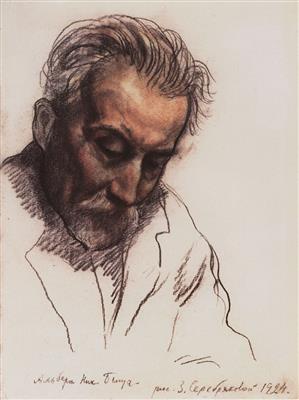
Albert Nikolayevitch Benois spent fifty years travelling, and his watercolours prove it. Born in St Petersburg in 1852[1] into one of Russia's most distinguished artistic families, his brother Alexandre was the theatrical designer and critic, his brother Leon the architect, he trained at the Imperial Academy of Arts under Luigi Premazzi, graduating in 1877[1] with the title of Artist-Architect. He chose the watercolour brush over the drawing board almost immediately.
Biography
In 1880[1] he was a founding member of the Circle of Russian[1] Watercolorists, and in 1884 the Imperial Academy awarded him the title of Academician for two works painted in Italy. A decade later he was appointed Professor of Watercolours at the Academy, a post he held until 1905. Throughout this period and beyond, he painted with extraordinary range: the Gulf of Finland coast, the Crimea, the Caucasus, the Volga, but also Siberia, Manchuria, China, Japan, Korea, Venice, Palermo, Cairo, Constantinople, Capri, Samarkand, and Bukhara. The list reads less like an itinerary than a competitive exercise.
In 1924[1] he went to Paris to visit his daughter, the opera singer Maria Tcherepnin, and stayed. Two years later he was elected to the Académie des Beaux-Arts, a notable honour for a Russian[1] exile in his seventies. He died at a nursing home outside Paris in 1936[1]. He was also uncle to the painter Zinaida Serebriakova and great-uncle to the actor Peter Ustinov, whose family's gift for the arts clearly ran wide.
Timeline
- 1852Born in St. Petersburg, Russia
- 1877Graduated from Imperial Academy of Arts with title Artist-Architect
- 1880Founding member of the Circle of Russian Watercolorists
- 1884Awarded title of Academician by Imperial Academy for Italian works
- 1894Appointed Professor of Watercolours at the Academy
- 1905Resigned as Professor of Watercolours at the Academy
- 1924Went to Paris to visit his daughter and stayed
- 1926Elected to the Académie des Beaux-Arts
- 1936Died at a nursing home outside Paris
Notable Works
Tap to view larger.
Next stop
Browse the movements →
Every movement in the collection, from the Renaissance to Pop art.
Related Artists



Frequently Asked Questions
What is Albert Benois known for?
Albert Benois is known for his watercolours, which depict locations such as the Gulf of Finland coast, the Crimea, and Venice. He was also appointed Professor of Watercolours at the Academy in 1894[1].What is Albert Benois's most famous work?
Albert Benois is best known for his contributions to stage design and his historical paintings, rather than one single, definitive work. He was a prominent member of the Mir iskusstva (World of Art) movement, which aimed to integrate art into all aspects of life. Benois's designs for the Ballets Russes, particularly his sets and costumes for Igor Stravinsky's ballet *Petrushka* (1911[1]), are among his most celebrated achievements. These designs, with their historical accuracy and attention to detail, helped to create a visually stunning and immersive theatrical experience. He also produced a number of significant historical paintings, often depicting scenes from 18th-century Russia. These works demonstrate his interest in the past and his ability to evoke a sense of atmosphere and period detail. His illustrations for Alexander Pushkin's *The Bronze Horseman* are also highly regarded. While no single piece overshadows his other creations, his collective output across theatre design, painting, and illustration has secured his place in the history of Russian[1] art.What should I know about Albert Benois's prints?
Albert Benois (1852[1]-1936[1]) was a Russian[1] artist, stage designer, and art critic, active in the late 19th and early 20th centuries. While primarily known for his watercolour paintings and theatrical designs, he also produced prints, often connected to his other artistic endeavours. Benois was part of the Mir iskusstva (World of Art) movement, which aimed to integrate art into all aspects of life. This included book illustration and graphic design, so prints were a natural extension of his aesthetic principles. Prints from this period were increasingly viewed as an important artistic medium. Artists at this time began signing their prints, which distinguished original graphics, possessing aesthetic value, from reproductions. A signature also confirmed the print's authenticity, as well as the artist's approval of a particular proof. Artists also controlled quality by limiting the size of print editions, and numbering them. The practice influenced the price of each print, relative to the number of works on the market. It also prevented prints from being pulled after the plate or stone degraded from excessive use.What style or movement did Albert Benois belong to?
Albert Benois (1852[1]-1936[1]) was associated with several artistic movements, most notably Symbolism and the Ballets Russes. Born into a family of artists, he received his initial training at the Academy of Arts in St Petersburg. Although he did not complete the formal course, he gained valuable skills and contacts. Benois became a prominent figure in the Russian[1] art world through his involvement with the Mir iskusstva (World of Art) movement. This group, active from the late 1890s, rejected academic art in favour of Symbolism and aestheticism. They promoted art for art's sake and sought inspiration in historical styles, particularly the 18th century. Benois shared these interests, as seen in his book *Tsarstvennoye Selo in the Reign of Elizabeth Petrovna* (1910[1]). His work with Sergei Diaghilev's Ballets Russes further solidified his position as a leading artist. Benois designed sets and costumes for productions such as *Le Pavillon d'Armide* (1909) and *Petrushka* (1911), contributing to the ballet's innovative blend of art forms. His designs often evoked historical periods and reflected his deep understanding of Russian culture.What techniques or materials did Albert Benois use?
Albert Benois worked in varied media, including watercolours and tempera. He also designed sets and costumes for the theatre, notably for the Ballets Russes. In painting, an underpainting with neutral monotones was common, creating a smooth, even base. Some artists used a pumice stone to smooth the surface further. For oil paint, some painters mixed poppy oil, walnut oil, and rectified turpentine. Some recipes call for yellow amber dissolved in aspic oil, sometimes with wasps soaked in the mixture. The rise of colour merchants in the 18th century meant that artists could purchase ready-made materials. However, some artists felt that the traditional methods had been lost, so they tried to rediscover them.What was Albert Benois known for?
Alexander Nikolayevich Benois (1870[1]-1960[1]) was a Russian[1] artist, critic, art historian, and stage designer. Born in Saint Petersburg, he came from a family of artists; his father was an Academician of Architecture, and his brother Albert was an academician of watercolour painting who instructed him. Benois studied law, but his interest in art led him to travel widely in Europe, where he produced many landscapes. He was actively involved with the World of Art movement and its journal. From 1918 to 1926, Benois headed the Picture Gallery at the Hermitage Museum. He designed productions for the Ballets Russes, including Igor Stravinsky's *Petrouchka*, and later worked as chief artist for Ida Rubinstein's theatre company from 1927 to 1935. Benois designed over sixty productions in cities across Europe and in the United States. He also wrote books on art, including *History of Painting in the Nineteenth Century* and *The Russian School of Painting*.When did Albert Benois live and work?
Albert Benois (1852[1]-1936[1]) was a Russian[1] artist, historian, and critic, who is best known for his stage designs and his association with the Ballets Russes. Born in Saint Petersburg, into a family with artistic talent, Benois initially studied law, but he pursued his interests in art and history. Benois became a prominent figure in the Russian art world in the late 19th century. He was a member of the Mir iskusstva (World of Art) movement, which advocated for aestheticism and the synthesis of the arts. He collaborated with Sergei Diaghilev on the Ballets Russes, creating set and costume designs for productions such as *Les Sylphides* (1909[1]) and *Petrushka* (1911). These designs were celebrated for their historical accuracy and artistic flair. After the Russian Revolution, Benois worked as a curator at the Hermitage Museum. He emigrated to Paris in 1926, where he continued his work as a stage designer and painter. He produced designs for productions in Europe and maintained his connection to the world of ballet and theatre. He died in Paris in 1936.Where can I see Albert Benois's work?
To view works by Albert Benois, you might start with museums that hold collections of Post-Impressionist or Russian[1] art. Many galleries are located in France; for example, Musée des Arts Décoratifs, Musée du Louvre, Musée Gustave Moreau, Musée National d’Art Moderne (Centre Georges Pompidou), Musée d’Orsay, and Musée du Petit Palais, all in Paris. Other French museums include Musée des Beaux-Arts (Besançon), Musée des Beaux-Arts (Dijon), Musée de la Chartreuse (Douai), Musée de Peinture et de Sculpture (Grenoble), Musée Crozatier (Le Puy), Musée des Beaux-Arts (Lille), Musée des Beaux-Arts (Nancy), Musée des Beaux-Arts (Nantes), Musée des Beaux-Arts Jules Cheret and Musée Matisse (Nice), Musée des Beaux-Arts (Orleans), Musée des Beaux-Arts (Quimper), Musée Saint-Denis (Reims), Musée des Beaux-Arts (Rennes), Musée des Beaux-Arts (Rouen), Musée d’Art et d’lndustrie (Saint Etienne), Musée du Prieure (Saint Germain-en-Laye), Musée de l’Annonciade (Saint Tropez), Musée du Haubergier (Senlis), Musée d’Art Moderne (Strasbourg), and Musée des Augustins (Toulouse). Museums outside of France include the Tretyakov Gallery and the Hermitage Museum in Russia, and the National Gallery of Scotland in Edinburgh.Where was Albert Benois from?
Albert Benois's son, Alexandre Benois, was born in Saint Petersburg on 21 April 1870[1]. The youngest of nine sons, his father was Nikolaï Benois, an Academician of Architecture. Alexandre studied at the Law Faculty of Saint Petersburg University from 1890 to 1894, after attending K. May’s private school. He also studied drawing and painting with his elder brother, Albert, an academician of watercolour painting. After 1926, Alexandre lived in Paris. He continued to paint and work in the graphic arts, but focused on theatre. From 1927 to 1935 he was the chief artist in Ida Rubinstein’s troupe, designing over sixty productions in Paris, London, Milan, New York, and Vienna. He died in Paris on 9 February 1960.Who did Albert Benois influence?
Albert Benois had a considerable influence on several artists, particularly within the Ballets Russes circle and among stage designers. As a member of the Mir iskusstva (World of Art) movement, he promoted a style that looked back to earlier eras for inspiration. One notable figure influenced by Benois was Léon Bakst, also a member of Mir iskusstva. Both artists shared an interest in historical styles and theatrical design, and they collaborated on stage productions. Sergei Diaghilev, the founder of the Ballets Russes, was another individual who felt Benois's impact. Benois acted as an artistic advisor and designer for the Ballets Russes, contributing to the company's aesthetic direction and success. His designs for productions such as "Le Pavillon d'Armide" (1907[1]) and "Petrushka" (1911) set a standard for stage design. Igor Stravinsky also acknowledged Benois's contribution. Benois helped to shape the visual aspects of Stravinsky's ballet "Petrushka". Through his work with these and other figures, Benois helped to shape early twentieth-century ballet and theatre design.Who influenced Albert Benois?
Alexandre Benois, also known as Albert, came from a family of artists. His father, Nikolai Benois, was a well-known architect. Albert's brother, Leon Benois, also trained as an architect. Benois's artistic influences included his family and the art world around him. He studied at the Academy of Arts in St Petersburg. There, he absorbed academic traditions. However, he became more interested in contemporary European art movements. His work shows an appreciation for French Impressionism and Post-Impressionism. These styles shaped his approach to colour and composition. Also, Benois engaged with the Symbolist movement. Symbolism affected his subject choices and the atmosphere of his paintings. He admired artists such as Edgar Degas and Constantin Guys. These artists helped him develop his skills in watercolour and drawing. Benois synthesised various influences. He created a personal style within the context of early 20th-century Russian[1] art.Who was Albert Benois?
Alexander Nikolayevich Benois (1870[1]-1960[1]) was a Russian[1] artist, critic, historian, and stage designer. Born in Saint Petersburg, he came from a family of artists; his father was an academician of architecture, and his brother Albert was an academician of watercolour painting who instructed him. Benois studied law at Saint Petersburg University, while also attending the Academy of Arts as an unmatriculated student. He travelled extensively in Europe, visiting Italy, Switzerland, Spain, and France. From 1895 to 1899, he curated Princess Tenisheva’s collection. As an artist, Benois worked in watercolour, gouache, pastel, and oil. He created series of paintings such as *The Last Walks of Louis XIV* and the *Versailles Series*. He also produced views of Saint Petersburg and its suburbs, plus illustrations for literary works by Pushkin and others. Benois was a founder of the World of Art association and co-editor of its journal. After 1900, he became involved in stage design, contributing to productions by Sergei Diaghilev, including *Boris Godunov*. He designed ballets such as Stravinsky’s *Petrouchka*, for which he also wrote the libretto. After 1926, Benois lived in Paris, where he continued to work in the theatre. He designed over sixty productions in various cities and wrote books, including *Reminiscences of the Ballet*.
Sources
Editorial draws on the following primary and tertiary references for Albert Benois.
- [1] wikipedia Wikipedia: Albert Benois Used for: biography, birth dates, death dates, identifiers, movement attribution, nationality.
- [2] book edited and translated by John E. Bowlt, Russian Art of the Avant-Garde_ Theory and Criticism 1902-1934 (The Documents of 20th-Century Art) (English and Russian Edition) Used for: biography.
- [3] book Russian art of the avant-garde : theory and criticism, 1902-1934, with 105 illustrations Used for: biography.
- [4] book Peter. Leek, Russian Painting Used for: biography.
Editorial overseen by Solis Prints. Sources verified 2026-10-07. Click a source for details, or hover over [N] in the page above to preview.
Editorial standardsMethodologyCorrectionsAI disclosureAbout the editorial team