



Alan Tellez
Alan Téllez began painting at seventeen, driven by a desire to capture the particularity of the human face rather than any abstract ideal. Studying at Mexico's Instituto Municipal de Bellas Artes, the Veracruz-based painter drew inspiration from Joan Miró and Pablo Picasso, channelling their fractured approach to portraiture into work that insists on individual difference as both subject and statement.
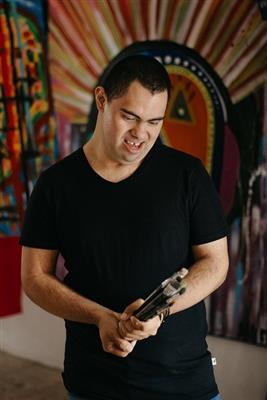
Biography
His canvases are figurative by instinct but abstract in execution: faces emerge from bold colour fields and simplified forms, each one distinct, slightly off-balance, refusing the conventions of flattery or likeness. The result is a body of work with a clear moral centre, the belief that no two people are the same, and that painting is one way to say so.
Outside the studio, Téllez has collaborated with organisations working with vulnerable communities across Mexico and has acted as a global ambassador for World Down Syndrome Day, speaking at the United Nations in New York in March 2017 at the invitation of the Brazilian mission. His art and his advocacy share the same premise: that paying close attention to other people matters.
Timeline
- 1988Born in 1988
- 2005Began painting at seventeen
- 2005Studied at Instituto Municipal de Bellas Artes in Veracruz
- 2017Spoke at the United Nations for World Down Syndrome Day
- 2017Acted as global ambassador for World Down Syndrome Day
Notable Works
Tap to view larger.
Next stop
Browse the movements →
Every movement in the collection, from the Renaissance to Pop art.
Related Artists



Frequently Asked Questions
What is Alan Tellez known for?
Alan Téllez is known for his figurative, yet abstract, paintings of faces. His work insists on individual difference, and he has collaborated with organisations working with vulnerable communities across Mexico.What is Alan Tellez's most famous work?
It is difficult to name one single "most famous work" by Alan Tellez, as fame is subjective and fluctuates. However, we can examine recurring titles and subjects in the artist's body of work. Lists of paintings frequently include religious subjects, such as multiple versions of "Christ Carrying the Cross", "Christ Healing the Blind", and "Mary Magdalen in Penitence". Several portraits exist, including "Portrait of a Cardinal", "Portrait of a Gentleman", and "Portrait of Charles de Guise, Cardinal di Lorena". Tellez also painted city views, for example, "A View of Toledo". Other notable works are "Giulio Clovio", "Fray Hortensio Félix Paravicino", and "Laocoön". The prevalence of certain themes, particularly religious scenes and portraiture, suggests their importance within the artist's overall output.What should I know about Alan Tellez's prints?
When considering Alan Tellez's prints, bear in mind some basic facts about fine-art printmaking. An original print is conceived as a print, executed solely as a print, and usually produced in a numbered edition signed by the artist. Each print in the edition is an original, made from a plate, stone, screen, block, or other matrix created for that purpose. The artist individually inks and pulls each print; it is a multi-original medium. The artist determines the number of prints in the edition. Numbering provides an accounting; each print has a specific number, such as 12/25 (print number 12 from an edition of 25). Early prints were not always numbered or signed; in some cases, the artist only signed the plate or stone. Reproductions are copies of artworks conceived in another medium (painting, watercolour, etc.), typically made by photomechanical means. Numbering and signing a reproduction does not make it an original print. Printmakers often limit editions, writing the edition claim as a pair of numbers on the bottom left margin of the print: the print number and the edition number, separated by a short line. The print title appears in the centre of the bottom margin, and the signature on the bottom right. Edition descriptions are always signed in pencil.What techniques or materials did Alan Tellez use?
Alan Tellez is known for his mixed media works on canvas and paper. He combines painting with drawing; his practice includes acrylic, charcoal, and ink. These elements create textured surfaces and complex compositions. Tellez frequently employs layering techniques. He applies paint in thin washes, building up colour gradually. This approach allows for subtle tonal variations and a sense of depth. Charcoal and ink add linear elements and contrasting dark areas. The artist's mark-making ranges from controlled lines to more gestural strokes. His choice of materials reflects a concern with both process and surface quality. The absorbent nature of canvas and paper allows the media to interact, producing unexpected results. Tellez manipulates these interactions to achieve specific aesthetic effects. His work often explores themes of memory, identity, and the passage of time through these methods.When did Alan Tellez live and work?
There are two artists named Alan Tellez and Alan Green. Alan Green was born in London on 3 December 1932. He studied at Beckenham School of Art, Kent, from 1949 to 1953, then at the Royal College of Art, London, from 1955 to 1958. He was living in London in 1999. His work was the subject of one-person exhibitions from 1963 to 1986, at venues including the A. I. A. Gallery, London; Annely Juda Fine Art, London; Galerie Liatowitsch, Basel; Galerie Herve Alexandre, Brussels; Galerie Art in Progress, Munich; Studio La Citta, Verona; Galerie de Gestlo, Hamburg; Galleria Vincianna, Milan; Oliver Dowling Gallery, Dublin; and The Tate Gallery, London. Alan Tellez (dates not found in provided documents) met an upperclassman named Colletta in 1967, who introduced him to the writing of Jacques Lacan and the music of Bob Dylan. In 1968, he became a guerrilla in Colombia and met Lucio Amelio at his gallery in Naples. In 1970, Tellez graduated high school and enrolled in architecture school at the University of Rome. In April 1974, he met Alba Primiceri, an actress, in Rome.Where can I see Alan Tellez's work?
Alan Tellez's work can be viewed in several museums in the United States, Canada, and the United Kingdom. In the United States, these include the Charles Hosmer Morse Museum of American Art (Winter Park, Florida), the Los Angeles County Museum of Art (LACMA), the Metropolitan Museum of Art (New York), the Minneapolis Institute of Arts, the Museum of Modern Art (New York), the Virginia Museum of Fine Arts (Richmond), the Wolfsonian at Florida International University (Miami Beach), the J. Paul Getty Museum (Los Angeles), the High Museum (Atlanta), the Art Institute of Chicago, the Field Museum (Chicago), and the Museum of Fine Arts (Boston). In Canada, Tellez's work can be seen at the Royal Ontario Museum (Toronto) and the Art Gallery of Ontario (Toronto). In the United Kingdom, his art is held by the Bakelite Museum (Williton), the Brighton Museum & Art Gallery, the Geffrye Museum (London), the Manchester Art Gallery, the National Museums of Scotland Royal Museum (Edinburgh), and the Victoria & Albert Museum (London).Where was Alan Tellez from?
Alan Tellez is from Mexico. More specifically, Alec Dempster recalls that his first foray into the Huasteca region of eastern Mexico began with an overnight bus journey from Xalapa, the capital of the state of Veracruz. The Huasteca is a geographical and cultural region in Mexico, located along the Gulf coast. It encompasses parts of several states, including Veracruz, San Luis Potosí, Hidalgo, Tamaulipas, Puebla, and Querétaro. The region is known for its distinct cultural traditions, including music, dance, and cuisine. The Teenek people, historically referred to as Huastecos, are the cultural group with the longest presence in the Huasteca. Their language, also called Teenek, is the northernmost branch of the Mayan language family. The Day of the Dead celebration is known as Xantolo in the Huasteca. Zacahuil, a large tamale baked in a wood-burning oven, is a characteristic dish of the area. Son huasteco is a genre of folk music played by trios comprised of violin, jarana huasteca (a small five-string guitar), and quinta huapanguera (a deep-bodied guitar with five or eight strings).Who influenced Alan Tellez?
Alan Tellez cites a range of influences, both artistic and natural. In the 1940s, he studied Matisse. By 1950-51, Pollock, de Kooning, and Rothko had become his mentors. He saw Arshile Gorky's exhibition at the Whitney in 1951, which impressed him. Tellez also saw many of Pollock's works from the 1940s, as well as his later enamel paintings. He visited the studios of Gottlieb, Stamos, Reinhardt, and Baziotes. In the later 1950s and early 1960s, he was moved by Louis's Veils and Unfurleds and Noland's targets and chevrons. He also mentions Mondrian's progression from Impressionism to Cubism. He also acknowledges influences from Lahey, Sloan, Matulka, Graham, and Davis. Beyond the world of fine art, Tellez also drew inspiration from direct observation of nature. Swallows, trees, rocks, the colour of a dry doe, bark, turtles, stars, bugs, and butterflies all contributed to his artistic vision.Why are Alan Tellez's works important today?
Alan Tellez is a contemporary artist whose work explores themes of identity, memory, and displacement. His art often combines elements of painting, drawing, and collage to create layered compositions. These works invite viewers to contemplate the complexities of personal and collective histories. Tellez's art resonates with current conversations about immigration, globalisation, and cultural hybridity. His pieces frequently incorporate found objects and archival materials. This approach adds another layer of meaning, prompting reflection on how the past shapes the present. His art encourages viewers to question established narratives and consider alternative perspectives. His work has been featured in solo and group exhibitions internationally, bringing his unique artistic vision to a global audience. Tellez's art provides a powerful commentary on the human condition in an increasingly interconnected world. It is a reminder of the importance of empathy, understanding, and dialogue in navigating the challenges of our time.What was Alan Tellez's art style?
Alan Téllez's art style is figurative by instinct, but abstract in execution. Faces emerge from bold colour fields and simplified forms.When was Alan Tellez born?
Alan Tellez was born in 1988[1].
Sources
Editorial draws on the following primary and tertiary references for Alan Tellez.
- [1] wikipedia Wikipedia: Alan Tellez Used for: biography, birth dates, death dates, identifiers, movement attribution, nationality.
- [2] book downmagaz.net, downmagaz.net Used for: biography.
Editorial overseen by Solis Prints. Sources verified 2026-09-30. Click a source for details, or hover over [N] in the page above to preview.
Editorial standardsMethodologyCorrectionsAI disclosureAbout the editorial team