



Agostino Tassi
- landscape painting
Agostino Tassi was not his real name. Born Agostino Buonamici in Perugia in 1578[2], he invented a noble Roman identity and a borrowed surname to advance his career in Rome's competitive fresco trade. The deception was characteristic: Tassi was an exceptional draughtsman in perspective and architectural illusionism, a collaborator on the decoration of the Quirinale Palace (1611[2]-12), and a man whose personal biography reads as a catalogue of disreputation.
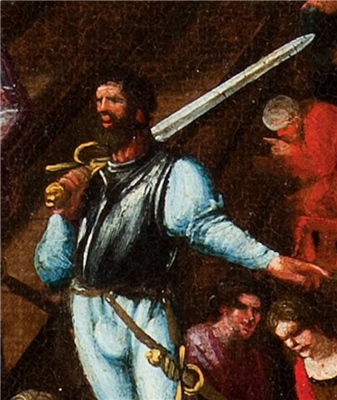
Biography
In 1612[2], Tassi was tried and convicted of raping Artemisia Gentileschi, then eighteen years old and already among the most accomplished painters in Rome. The trial lasted seven months and exposed not only the assault but plans to murder his own wife and to steal paintings from the Gentileschi household. He served part of a two-year sentence before an annulment released him. Artemisia's subsequent career, and the long scholarly attention paid to her in feminist art history, means Tassi is now principally remembered through her story.
What that framing risks obscuring is the genuine importance of his other work. From April 1625[2] he employed the young Claude Lorrain, requiring him to grind colours and run the household while absorbing the master's approach to light and atmospheric distance. Claude would go on to define European landscape painting[2] for two centuries. Tassi also influenced Dutch painter Leonaert Bramer through his night scenes, and his seascape compositions drew on years of maritime experience, possibly including galley service. He died in Rome in January 1644[2].
Timeline
- 1578Born Agostino Buonamici in Perugia
- 1611Collaborated on decoration of the Quirinale Palace
- 1612Tried and convicted of raping Artemisia Gentileschi
- 1612Sentenced to two years, served part of sentence
- 1625Employed Claude Lorrain as assistant
- 1644Died in Rome
Notable Works
Tap to view larger.
Next stop
Browse the movements →
Every movement in the collection, from the Renaissance to Pop art.
Related Artists


Frequently Asked Questions
What is Agostino Tassi known for?
Agostino Tassi is now principally remembered through Artemisia Gentileschi's story, as he was convicted of raping her. However, he is also known as the master of Claude Lorrain, who defined European painting for two centuries.What is Agostino Tassi's most famous work?
Agostino Tassi is best known for his skill in perspective and quadratura, a form of illusionistic painting that creates the impression of extended space. Although he produced independent paintings, he frequently collaborated with other artists, providing the architectural framework for their compositions. A prime example of Tassi's quadratura is his work in Guercino's fresco *Aurora* (1621[2]) at the Casino Ludovisi in Rome. Tassi created the feigned architectural settings, which, combined with Guercino's figures and a *di sotto in sù* (seen from below) viewpoint, make the ceiling seem to open up to the sky. The fresco, commissioned by Cardinal Ludovico Ludovisi to celebrate his uncle's election to the papacy, depicts Aurora, goddess of the dawn, in her chariot. The illusion is so convincing that the painted architecture appears to extend the room's actual architecture.What style or movement did Agostino Tassi belong to?
Agostino Tassi was an Italian[2] painter of the Baroque period (roughly, the early 17th to mid-18th century). The Baroque style, which first appeared in Italy, is typified by dynamism and movement. Baroque artists aimed to replace the ordered coherence of the Renaissance with more energetic compositions. Painters such as Peter Paul Rubens, who lived in Italy from 1600[2] to 1608, developed techniques of Baroque movement. Rubens would build compositions around a dynamic spiral line, a 'line of force' that gives vitality to the whole picture. Figures twist and turn; even draperies flow. Italian artists reached an equivalent stage in the 1620s; Bernini's sculptures, for example, have a similar thread of energy and three-dimensional conception.What techniques or materials did Agostino Tassi use?
Agostino Tassi was an Italian[2] painter of the Baroque period, active mainly in Rome and specialising in architectural interiors and marine subjects. The additive process involves modelling a form from a soft substance, such as clay, plaster, or sculptor’s wax, before it is cast into bronze. Casting is completed in a foundry by specialist craftsmen; the artist usually oversees this part. Bernini’s studio used gesso, a white mixture of animal glue and chalk, as a priming and smoothing layer before gilding or painting a terracotta. Bole, a paint-like mixture of animal glue, iron oxide, and clay, was applied over smoothed gesso. It provided a secure surface for metal leaf, allowing it to withstand burnishing. Water gilding involves the gilder reactivating the adhesive in the bole with hot water, then applying the metal leaf using a wide, flat brush. Once firm, the gilder burnishes it with an agate stone or an animal tooth. Oil gilding could be applied over gesso or directly to the raw terracotta. It cannot be burnished; the surface therefore has a matte appearance, without the sheen of water gilding. Cloth wrapped around the fingers could smooth the clay. Used damp, it produced a softer, smoother appearance.What was Agostino Tassi known for?
Agostino Tassi (1566-?) was an Italian[2] painter, born Agostino Buonamici in Perugia. He trained in Rome with Paul Bril, one of the first artists to paint what was called 'pure' depictions of the external world. Tassi is said to have been a hot-headed character. While in Florence, hoping to secure the favour of the Grand Duke Cosimo, he was involved in a street fight and sentenced to ten years in the galleys at Leghorn. He subsequently worked in Genoa with the Salimbeni and the Gentileschi. Tassi returned to Rome and worked for Pope Paul V. He became known for his skills in perspective, his ornamental designs, and his marine paintings; his speciality was said to be storms. Examples of his work are now scarce, but some can be found in Florence and Rome. In later years, Tassi suffered from gout, but he is thought to have been good-natured and to have taken an interest in his pupil, Claude Lorrain.When did Agostino Tassi live and work?
Agostino Tassi was born in 1580[2] in Florence. He died in 1644[2] in Rome. Tassi's early career involved sailing, including time as a pirate. He then studied painting in Rome with Orazio Lomi Gentileschi. He specialised in quadratura, a form of illusionistic architectural painting. His initial Roman work included commissions at the Palazzo Quirinale and the Palazzo Rospigliosi. Later, he worked at locations such as Livorno and Genoa. In Genoa, he painted vault decorations in the Palazzo Centurione, Palazzo Spinola, and Palazzo Doria. His skill earned him significant recognition. Tassi is also known for his personal life. He was accused of raping Artemisia Gentileschi, Orazio's daughter, in 1612. This event led to a sensational trial in 1612, which exposed details of Tassi's private life and artistic practices. Despite the accusations, Tassi continued to receive commissions and remained active in the art world.Where can I see Agostino Tassi's work?
It is difficult to pinpoint exactly where one can view works by Agostino Tassi. Many museums and collections around the world hold paintings; however, without a catalogue raisonné or collection list, it is impossible to say which ones have works by Tassi. Furthermore, many paintings are not on public display. They may be in storage or on loan. Museums also regularly rotate their displays. Paintings may come and go from view. If you are planning to view a specific painting, it is always best to check with the museum in advance. Paintings by Nicolas Poussin, for example, can be found in the Musée Fesch (Ajaccio, Corsica), the Baltimore Museum of Art, the Palace of the President of Yugoslavia (Belgrade), Belvoir Castle (Leicestershire), the Staatliche Museen (Berlin, East and West), the Barber Institute of Fine Arts, University of Birmingham (England), the Museum of Fine Arts (Boston), and the Musée des Beaux-Arts (Caen).Where was Agostino Tassi from?
Agostino Buonamici, called Tassi, was born in Perugia in 1566. As a young man, he went to Rome. There, he studied with Paul Bril, one of many Dutch painters who had settled in Rome during the sixteenth and seventeenth centuries. Bril was among the first artists to paint what was called 'pure and simple' at the time. According to Passeri, Tassi was a vain and hot-headed character. He went to Florence hoping to gain favour with the Grand Duke Cosimo. However, he was involved in a street riot and sentenced to ten years in the galleys at Leghorn. Later, he worked in Genoa with the Salimbeni and the Gentileschi families. He returned to Rome and worked for Pope Paul V. He became known for his skill with perspective, his ornamental designs, and his marine paintings; his speciality was storms. Examples of his work, which is now rare, can be found in Florence and Rome.Who did Agostino Tassi influence?
Agostino Tassi's influence is most clearly seen in the work of Artemisia Gentileschi, daughter of Orazio Gentileschi. Artemisia, herself a gifted and successful painter, was raped by Tassi. Orazio Gentileschi, once a close acquaintance of Caravaggio, was one of the few artists from that circle to achieve significant artistic merit. He eventually became a court painter for Charles I, dying in London in 1639[2]. Other artists, such as Mario Minniti and Cecco Boneri, who were close to Caravaggio, failed to leave a notable mark on art history. Giovanni Baglione, despite being Caravaggio's adversary and biographer, secured commissions from popes, princes, and aristocrats, but is primarily remembered for his connection to Caravaggio. Annibale Carracci, influenced by Titian, initiated the Baroque style in Rome alongside Caravaggio. His frescoes in the Palazzo Farnese, begun in 1597, had a considerable influence on European art during the sixteenth century.Who influenced Agostino Tassi?
Agostino Tassi's artistic development occurred in a milieu where artists routinely studied and emulated the masters. Students gained "an easy habitude" by imitating the invention and manner of admired artists. The Romans, Venetians, Parmesans, and Bolognese were considered exemplary. Raphael was admired for his gift of invention and natural grace; Michelangelo, for his powerful design. Giulio Romano revealed the "sacred mysteries of Apollo" in his poetry of painting. Correggio excelled in broad lights and delicate colour, while Titian mastered colour harmony. Annibale Carracci assimilated the excellencies of all these artists. Nicolas Poussin, arriving in Rome at 30, felt his training lacking and essentially went back to school. He studied anatomy, geometry, and perspective, drawing from models in the studios of Domenichino and Andrea Sacchi. Poussin was deeply affected by the art around him, including antiquity and masters such as Raphael, Michelangelo, and Titian. He was also influenced by the Carracci and, despite ignoring Michelangelo and Caravaggio, was particularly drawn to Domenichino's *Flagellation of St Andrew*.Who was Agostino Tassi?
Agostino Tassi (1566-?) was an Italian[2] painter, born Agostino Buonamici in Perugia. As a young man, he moved to Rome and studied with Paul Bril, one of many Dutch artists working in Rome. Bril was among the first artists to paint pure . Tassi was known for his skill with perspective, his ornamental designs, and his marine paintings; storms were his speciality. According to Passeri, Tassi had a difficult personality. While in Florence, hoping to gain favour with the Grand Duke Cosimo, he was involved in a street riot and sentenced to ten years in the galleys at Livorno. Later, he worked in Genoa with the Salimbeni and the Gentileschi families. He returned to Rome and worked for Pope Paul V. Tassi is most significant as the principal master of Claude Lorrain. Examples of Tassi's paintings are rare, but some can be found in Florence and Rome. In later life, he suffered from gout but, according to Sandrart, remained good-natured and took an interest in his pupil.Why are Agostino Tassi's works important today?
Agostino Tassi (1580[2]-1644[2]) was an Italian[2] painter of the early Baroque period, active mainly in Rome and Genoa. Although not as widely known as some of his contemporaries, Tassi's importance lies in his influence on other artists, particularly as the teacher of Claude Lorrain. Tassi specialised in painting *quadratura*, illusionistic architectural paintings, and seascapes. These skills were highly sought after for decorating palaces and villas. His frescoes can be seen in the Palazzo Pamphilj and the Villa Lante in Rome. His ability to create convincing illusions of depth and space was innovative for the time. Beyond his artistic skills, Tassi's life was marked by controversy. He was accused of raping Artemisia Gentileschi, a fellow painter. The trial and its scandalous details have made Tassi a figure of interest in studies of gender and power in the art world. While his paintings continue to be studied for their artistic merit, his biography offers insight into the social dynamics of seventeenth-century Italy.
Sources
Editorial draws on the following primary and tertiary references for Agostino Tassi.
- [1] museum Royal Castle in Warsaw Used for: museum holdings.
- [2] wikipedia Wikipedia: Agostino Tassi Used for: biography, birth dates, death dates, identifiers, movement attribution, nationality.
- [3] book Gellée Lorrain , Claude, Masters of Art - Claude Lorrain Used for: biography.
- [4] book Hodge, Susie, 1960- author, The short story of women artists : a pocket guide to movements, works, breakthroughs, & themes Used for: biography.
Editorial overseen by Solis Prints. Sources verified 2026-09-30. Click a source for details, or hover over [N] in the page above to preview.
Editorial standardsMethodologyCorrectionsAI disclosureAbout the editorial team