



Achille Pinelli
- landscape painting
Born in Rome in 1809[1] to the painter and engraver Bartolomeo Pinelli, Achille Pinelli grew up in one of the city's most distinctive artistic households. His father had made his name illustrating Italian pastoral life and scenes from Roman history; the son turned his attention to Rome itself, working as a vedutista at street level.
Biography
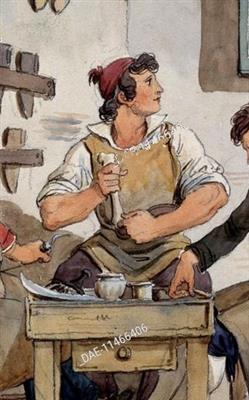
Between 1826[1] and 1835, Pinelli produced around 200 watercolours now preserved at the Museo di Roma. He recorded church facades throughout the city, but what separates his work from straightforward architectural documentation is its social density: his compositions include processions of condemned prisoners on their way to execution, street vendors, monks, nuns, police, civilians, children at play, and beggars. These are not picturesque vignettes; they are records of how a city organised itself in the last decades of the Papal States.
He died in September 1841[1], aged thirty-two, leaving a body of work that has grown in interest as the world it depicted receded. Several church facades he painted have since been altered or demolished. His watercolours are now among the more reliable documents of Rome's built and social environment in the period before Italian unification.
Timeline
- 1809Born in Rome to painter Bartolomeo Pinelli
- 1826Began producing watercolours of Rome
- 1835Completed approximately 200 watercolours of Rome
- 1841Died in September at age 32
Notable Works
Tap to view larger.
Next stop
Browse the movements →
Every movement in the collection, from the Renaissance to Pop art.
Related Artists



Frequently Asked Questions
What is Achille Pinelli known for?
Achille Pinelli is known for his watercolours of Rome, specifically his records of church facades and the city's social environment between 1826[1] and 1835. His works offer insight into how Rome organised itself during the final decades of Italy, capturing scenes of daily life with civilians, religious figures, and even prisoners.What is Achille Pinelli's most famous work?
Achille Pinelli (1809[1]-1841[1]) was an Italian artist, known for his costumed genre scenes and depictions of Roman monuments. He was the son of the better-known artist Bartolomeo Pinelli, from whom he likely received his initial training. Although Achille Pinelli produced many works, no single piece can be definitively called his "most famous". He is best known for his extensive series of watercolours and etchings documenting the costumes and customs of the Roman people, along with views of the city's ancient ruins and contemporary life. These works were popular with tourists and collectors, who sought picturesque souvenirs of their travels. His output includes numerous scenes of daily life in Rome: street vendors, religious processions, and festivals. Many of his works are held in private collections; others are in the collections of institutions such as the British Museum and the Victoria and Albert Museum. These works provide valuable insights into the social history of Rome during the early 19th century.What should I know about Achille Pinelli's prints?
Achille Pinelli (1809[1]-1841[1]) was an Italian artist, active primarily in Rome. He is best known for his etchings and watercolours depicting Roman life, architecture, and costume. Pinelli came from an artistic family. His father, Bartolomeo Pinelli, was a well-known printmaker; Achille continued in his father's style. Both artists created many prints of Rome. These prints were popular with tourists and locals alike. Achille Pinelli's prints often feature scenes of everyday life. He depicted people in traditional costumes, Roman monuments, and views of the city. His work provides a record of Rome in the early 19th century. Many prints were sold as souvenirs. Pinelli's prints are characterised by their detailed linework and picturesque compositions. He often used a combination of etching and aquatint to create tonal effects. His prints are valued for their historical and artistic merit. They offer insights into Roman culture and the artistic trends of his time.What style or movement did Achille Pinelli belong to?
Achille Pinelli (1809[1]-1841[1]) was an Italian painter and printmaker, active in Rome. He is best known for his costumbrista scenes and cityscapes. These works depict the everyday life, customs, and costumes of the Roman people. Pinelli's artistic style aligns with the Biedermeier movement. This central European style, prominent from 1815[1] to 1848, favoured realism and detailed observation. Biedermeier art often presented intimate scenes of middle-class life. Pinelli's focus on Roman street life and local characters shares similarities with this aesthetic. His output also connects to the broader genre of vedute, or view paintings. These became popular during the Grand Tour era. Artists created detailed and accurate depictions of cities and monuments for travellers. While Pinelli's work included elements of vedute, his primary interest lay in portraying the people of Rome. He captured their daily activities with a documentary-like approach. This distinguishes him from artists who focused solely on architectural accuracy. Pinelli's work provides valuable insights into Roman culture during the early 19th century.What techniques or materials did Achille Pinelli use?
Achille Pinelli was an Italian artist known for his city views and architectural studies, particularly of Rome. He primarily worked in watercolour and etching. Pinelli's watercolours often feature precise architectural details combined with lively depictions of everyday life. He captured the atmosphere of Rome, showing both its grand monuments and its ordinary citizens. His skill in watercolour allowed him to create luminous effects and subtle gradations of tone, bringing depth to his compositions. In addition to watercolour, Pinelli was a skilled printmaker. His etchings share the same attention to detail and interest in Roman life as his watercolours. He used etching to create multiple versions of his views, making them accessible to a wider audience. His prints often feature strong lines and contrasts, giving them a graphic quality.What was Achille Pinelli known for?
Achille Pinelli (1809[1]-1841[1]) was an Italian artist, active in Rome, who specialised in watercolour paintings and prints depicting Roman scenes. His works often featured views of the city, its monuments, and the surrounding countryside. He produced numerous prints of Roman costumes, as well as of historical and contemporary events. These prints were popular with tourists and locals alike. His work captures the spirit of Rome in the early 19th century. Pinelli's images provide valuable documentation of the city's architecture and social life during that period. He died at a young age, but his artistic output was considerable. His works can be found in many public and private collections today. Pinelli's detailed and evocative depictions of Rome continue to be appreciated for their historical and artistic value.When did Achille Pinelli live and work?
The reference passages do not contain specific dates for Achille Pinelli's life or work. However, they do mention a portfolio called *One year in Rome and its surroundings*, and that Pinelli worked "in Rome". Other artists are mentioned in the passages, including Antoine Jean-Baptiste Thomas, who produced works such as “Blessing by the Pope” and “Blessing of the ‘Bambino’ at the Basilica of Our Lady of Ara Coeli on the Capitoline Hill”. These works, like many of Pinelli's, depict Roman scenes and customs. Without explicit dates, it is difficult to establish a precise period for Pinelli's activity. The presence of other artists working in Rome during the timeframe covered by the source material suggests a possible context for Pinelli's career. Further research would be needed to determine the exact years of his birth, death, and artistic production.Where can I see Achille Pinelli's work?
Achille Pinelli's works can be viewed in several locations. These include the Ackland Art Museum, University of North Carolina at Chapel Hill; Allen Memorial Art Museum, Oberlin College; Art Gallery of Ontario, Toronto; and The Art Institute of Chicago. Other locations include The Art Museum, Princeton University; The Baltimore Museum of Art; The Cleveland Museum of Art; Cooper-Hewitt Museum, The Smithsonian Institution's National Institute of Design, New York; Fogg Art Museum, Harvard University, Cambridge, Massachusetts; and The J. Paul Getty Museum, Malibu. More places that hold his work are the Los Angeles County Museum of Art; The Metropolitan Museum of Art, New York; Museum of Fine Arts, Boston; National Gallery of Art, Washington, D.C.; National Gallery of Canada, Ottawa; The Nelson-Atkins Museum of Art, Kansas City; The Philadelphia Museum of Art; and The Pierpont Morgan Library, New York. Also, The Saint Louis Art Museum; The Snite Museum of Art, University of Notre Dame; University Art Museum, University of California, Santa Barbara; The University of Michigan Museum of Art, Ann Arbor; Wallace Collection, London; Worcester Art Museum; and Yale University Art Gallery, New Haven.Who did Achille Pinelli influence?
It is difficult to identify specific artists who were directly influenced by Achille Pinelli, as the provided texts do not focus on his artistic impact. However, one can discuss the broader artistic movements that Pinelli's work may have contributed to or reflected. One passage mentions Caravaggio's influence on various artists, including Dutch, French, and Spanish painters. These include Hendrick ter Brugghen, Gerrit van Honthorst, Dirck van Baburen, Rembrandt van Rijn, Simon Vouet, Valentin de Boulogne, Georges de La Tour, Francisco Ribalta, Jusepe de Ribera, and Diego Velázquez. The passage notes that their work is "inconceivable without his example". Another passage discusses Pellegrini's role in the international development of Rococo decoration. Pellegrini's travels and work in various European courts made him an important figure in spreading Rococo styles. His work anticipated that of Giambattista Tiepolo.Who influenced Achille Pinelli?
Achille Pinelli (1809[1]-1841[1]) came from a family of artists. His father, Bartolomeo Pinelli (1781-1835[1]), was a well-known printmaker in Rome. Bartolomeo's prints, often depicting Roman costumes and historical subjects, were a clear influence on Achille. Achille followed in his father's footsteps, producing many prints of Roman life. However, Achille's work also shows the impact of other artists and trends. He was part of a generation that moved away from the older style of picturesque printmaking. Artists such as the French painter Horace Vernet, who worked in Rome during the same period, may have affected his approach. Vernet's more naturalistic style, and his interest in contemporary life, are reflected in Achille's compositions. While Bartolomeo provided a direct artistic lineage, Achille engaged with a broader artistic world. He absorbed aspects of contemporary painting into his printmaking, moving beyond the purely historical focus of his father's generation.Who was Achille Pinelli?
Achille Pinelli (1809[1]-1841[1]) was a Roman artist, known for his drawings and prints of Roman costumes and city views. He came from an artistic family; his father was the better-known artist Bartolomeo Pinelli (1781-1835[1]). Achille continued his father's work of documenting the costumes of the Roman people, producing a series of fifty etchings on this theme. These were published in Rome in 1832[1], under the title *Nuova raccolta di cinquanta costumi pittoreschi*. The images depict the clothes worn by ordinary people in Rome and its surrounding areas. They include, for example, shepherds, farmers, pilgrims, and tradesmen. Pinelli also produced prints of Roman monuments and antiquities. These images catered to the market for Grand Tour souvenirs. Unlike his father, Achille also experimented with watercolour painting. His works provide a record of Roman life and architecture in the early nineteenth century. He died at a young age, only six years after his father.Why are Achille Pinelli's works important today?
Achille Pinelli (1809[1]-1841[1]) was a Roman artist known for his depictions of the city and its surrounding areas. His watercolours and prints offer a view into 19th-century Roman life and architecture. Pinelli's works are valued as historical documents. They capture the appearance of buildings, streets, and customs before modernisation altered the urban environment. His images provide details about daily life, costumes, and social interactions. His output is also appreciated for its artistic qualities. Pinelli's skill in watercolour painting and printmaking is evident in the detail and atmosphere of his compositions. He captured light and shadow effectively, adding depth to his scenes. His works appeal to those interested in the history of Rome, as well as collectors of topographical art. They offer a glimpse into a bygone era.
Sources
Editorial draws on the following primary and tertiary references for Achille Pinelli.
- [1] wikipedia Wikipedia: Achille Pinelli Used for: biography, birth dates, death dates, identifiers, movement attribution, nationality.
- [2] book Jennifer Montagu;, Gold, Silver, and Bronze Used for: stylistic analysis.
- [3] book Neoclassicism and romanticism : architecture, sculpture, painting, drawings, 1750-1848 Used for: biography.
- [4] book Post-impressionism : cross-currents in European painting Used for: biography.
- [5] book Post-impressionism : cross-currents in European painting Used for: biography.
Editorial overseen by Solis Prints. Sources verified 2026-08-30. Click a source for details, or hover over [N] in the page above to preview.
Editorial standardsMethodologyCorrectionsAI disclosureAbout the editorial team