


On 20 February 1909, the Paris newspaper Le Figaro published a manifesto on its front page. It was written by Filippo Tommaso Marinetti, an Italian poet, and it argued for the destruction of museums, libraries, and academies. It called for celebration of war, machinery, and speed. It was the first manifesto of Futurism, and within five years the movement had produced some of the most distinctive paintings and sculptures of the early twentieth century.
Marinetti was thirty-three. He paid Le Figaro to print the manifesto. The newspaper agreed because the text was provocative enough to drive sales, and because its absurdist tone could be read as performance art rather than political programme.
A Movement Built on a Document
Most art movements get their name from a critic, in retrospect. Futurism named itself in advance and then recruited members. Marinetti's manifesto was followed within a year by the Manifesto of Futurist Painters, signed by Umberto Boccioni, Carlo Carra, Luigi Russolo, Giacomo Balla, and Gino Severini. A Manifesto of Futurist Sculpture, a Manifesto of Futurist Music, a Manifesto of Futurist Cinema, and several others followed.
The Futurists believed that art should reflect the conditions of modern life: cars, aeroplanes, electricity, factories, crowds, war. They rejected the Italian veneration of the past, which they considered a brake on the country's development. The Venice they grew up with was a museum. Marinetti wrote that he wanted to drain the canals and bury the place under concrete.
Painting Motion
The technical problem the Futurist painters set themselves was how to represent motion on a flat surface. They borrowed from the chronophotography of Etienne-Jules Marey and Eadweard Muybridge, who had used multiple-exposure photography to break down the movements of running horses and walking humans into sequences of frozen positions.
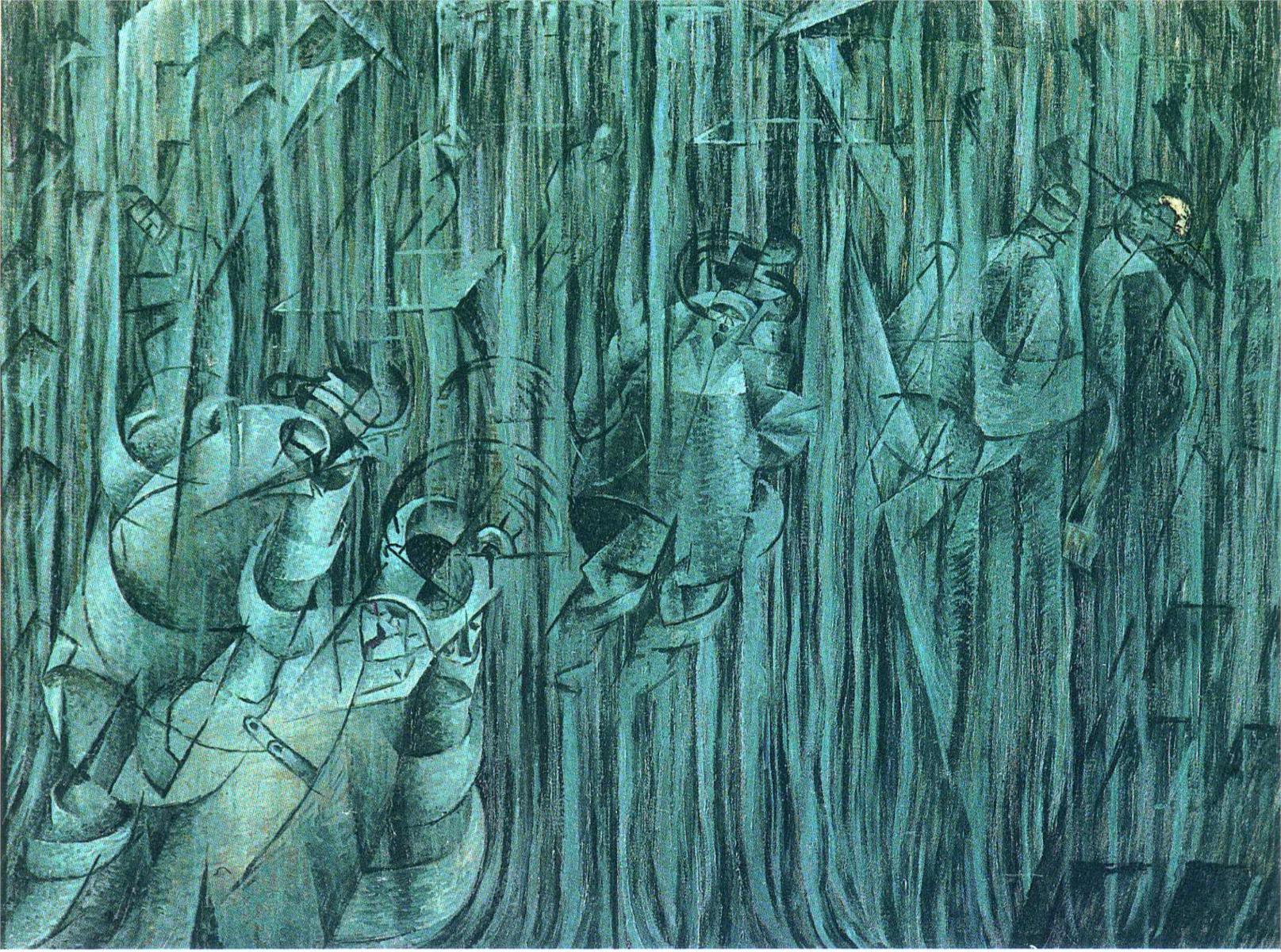
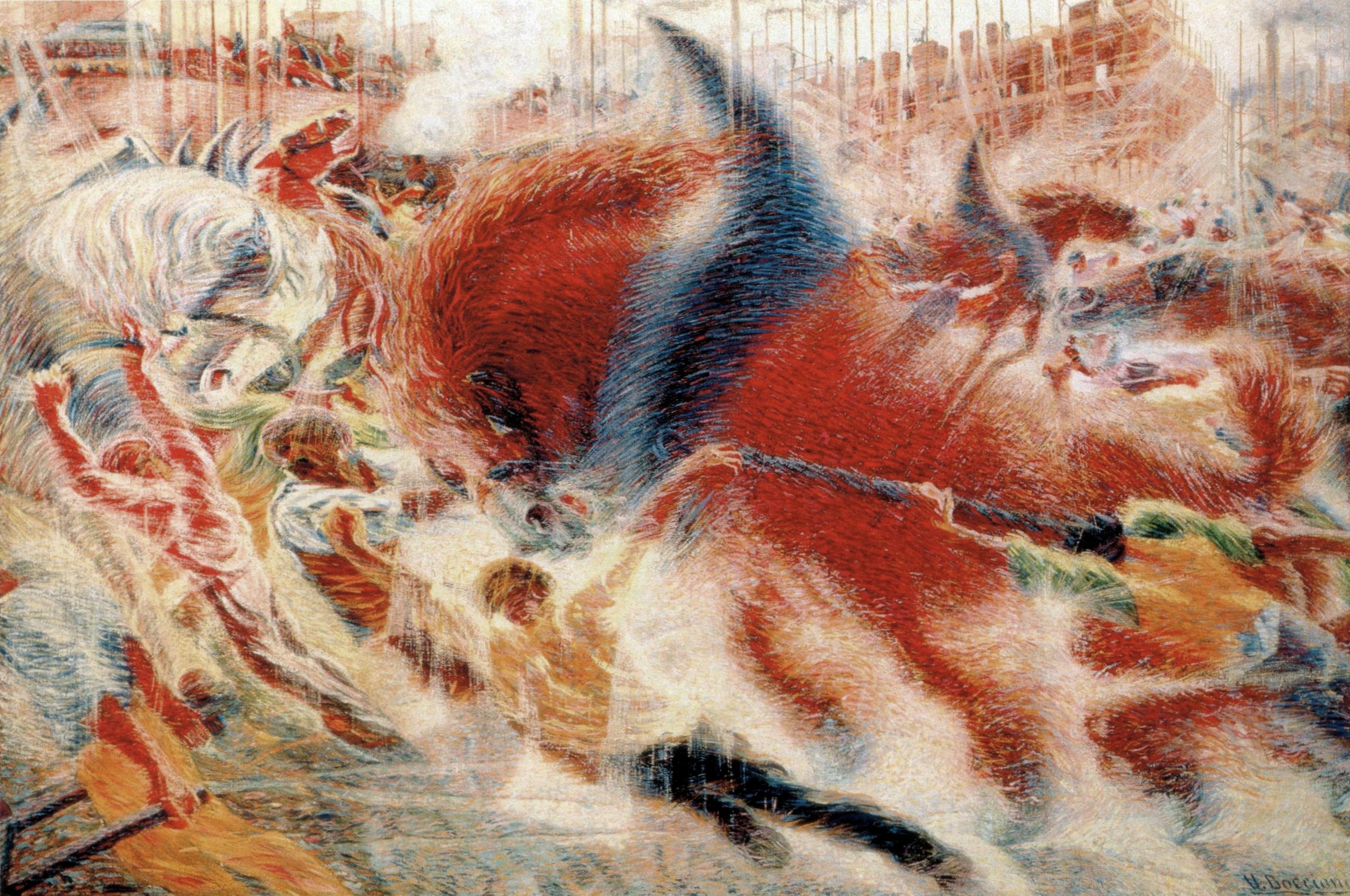
Boccioni took this in two directions. His paintings of crowds (The City Rises, The Riot in the Galleria) used diagonal lines and overlapping figures to suggest the energy of urban scenes without depicting any specific motion. The crowd is the subject; the individuals dissolve into it. His States of Mind series broke a single emotional moment into three panels, each capturing a different aspect of the same farewell at a railway station.
The Sculpture
Boccioni's Unique Forms of Continuity in Space (1913) is the most famous Futurist work. It shows a striding figure whose body is sculpted not as solid mass but as the trail of forms left behind by a moving body. The flames of motion replace muscles. The figure has no face, no hands distinguishable from its arms, no clothing details. It is a body reduced to the act of walking forward.
The sculpture exists in several casts, made after Boccioni's death. The plaster original is in the Museum of Contemporary Art in Sao Paulo. Bronze casts are in the Tate Modern, MoMA, and the Metropolitan Museum. Italy put the image on the back of its twenty-cent euro coin in 2002.
The War
The Futurists welcomed the First World War. Marinetti had written in the manifesto that "war is the only hygiene of the world." When Italy entered the war in 1915, several Futurists volunteered.
The war killed Boccioni in 1916. He was thrown from a horse during a cavalry exercise and died of his injuries. He was thirty-three. Antonio Sant'Elia, the Futurist architect whose drawings of an unrealised city of skyscrapers and elevated trains had inspired the movement's vision of the future, was killed in the same year.
After the war, what remained of the Futurist movement increasingly aligned with Italian Fascism. Marinetti became one of Mussolini's first allies and helped found the Fasci Italiani di Combattimento in 1919. The movement that had begun as an aesthetic celebration of modernity ended as a propaganda arm for a regime.
What Survived
The Futurist preoccupation with motion, machinery, and the visual conditions of modern life entered the bloodstream of the avant-garde. Marcel Duchamp's Nude Descending a Staircase (1912) used Futurist sequential motion, although Duchamp himself rejected the affiliation. The Russian Constructivists drew on Futurist typography. The Bauhaus absorbed Futurist ideas about the unity of art, architecture, and industrial design.
The 1909 manifesto's call to destroy the past failed. The museums Marinetti wanted burned now contain his movement's paintings.


