

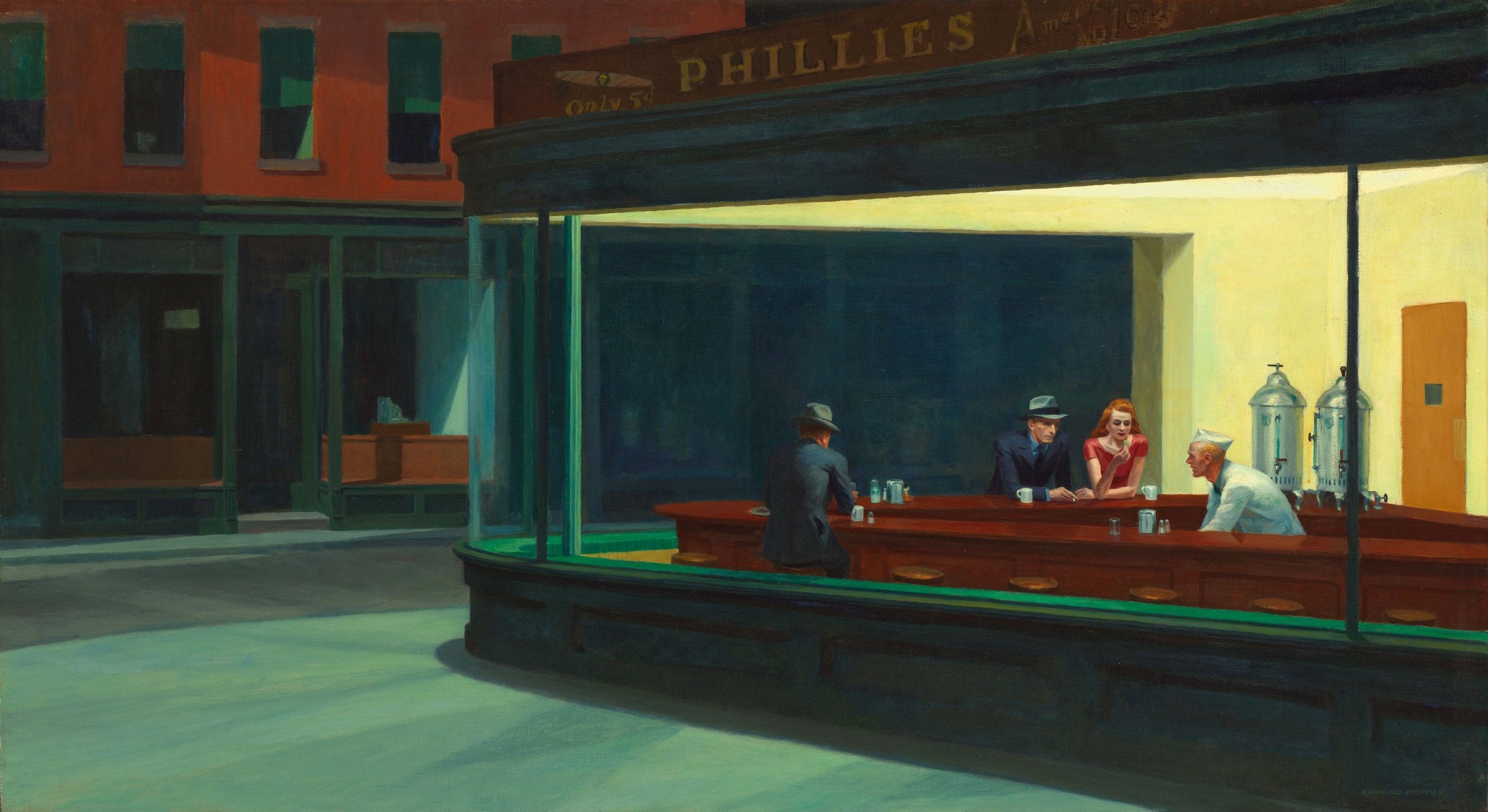
Edward Hopper produced about 366 oil paintings in a working life of nearly fifty years. Nighthawks, painted in January 1942 and finished by 21 January, is the one everyone knows. Four figures inside a corner diner late at night. The light inside is fluorescent and harsh. The street outside is empty. The figures do not look at each other.
Hopper said, several times across his life, that the painting was not about loneliness. He said this in the kind of weary tone people use when they have been asked the same question for forty years. He may have been telling the truth, and the picture may still be about loneliness anyway. Paintings often outpace the things their painters meant by them.
The Slow Career
Hopper was born in 1882 in Nyack, a small town up the Hudson from New York. He studied illustration in New York, then painting, and spent the years 1906 to 1910 making three trips to Paris where he ignored Cubism and Fauvism and looked instead at Manet and Degas. He came home and worked as a commercial illustrator for the next sixteen years. He was nearly forty by the time he sold a single watercolour and began the career people know him for.
He married Josephine Nivison in 1924. She was a painter too, kept the household accounts and the studio ledger, and modelled for almost every female figure in Hopper's mature work. The Nighthawks woman is Josephine. So are the women in Office at Night, Morning Sun, Western Motel, Hotel Window, and dozens of others.
The Method
Hopper painted slowly, and he painted few paintings. The 366 oils represent decades of work; many years produced only three or four pictures. He worked from sketches, then small oil studies, then the canvas. The sketches still exist in the bequest now held at the Whitney Museum, and they show how methodically Hopper built the compositions: the angle of a roofline, the exact position of a window, the line where shadow meets sun.
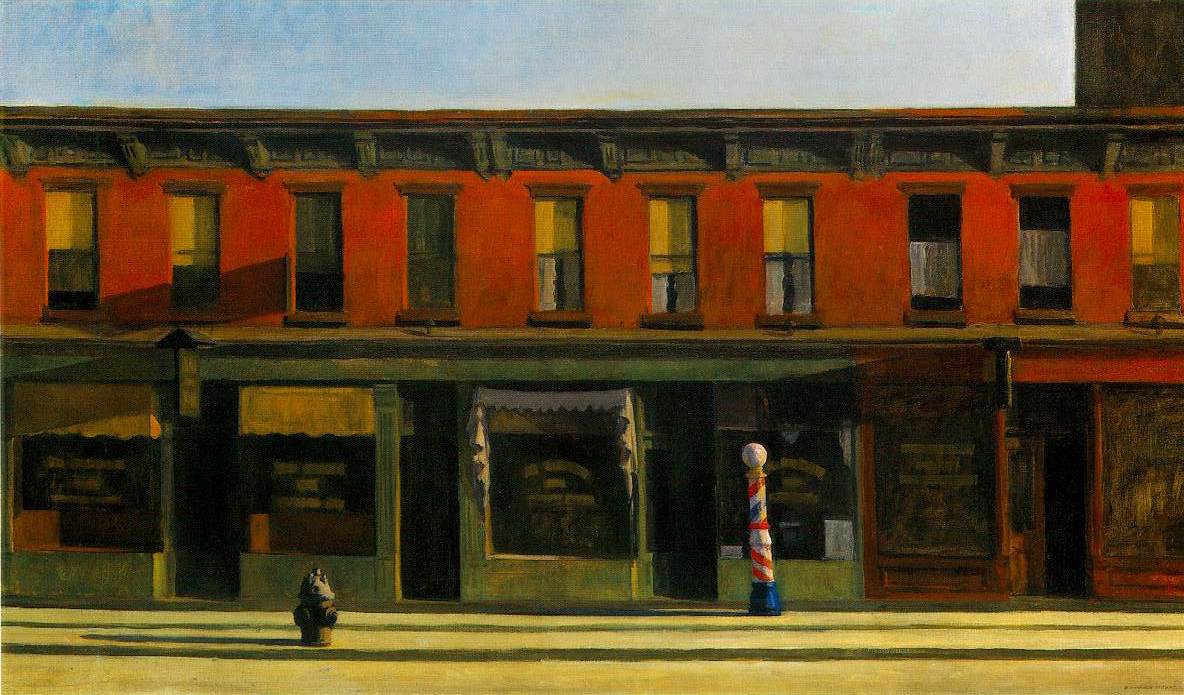
The light was the subject. Hopper was a painter of light first and people second. The morning sun on a brick wall in Early Sunday Morning. The fluorescent flood in Nighthawks. The slanting afternoon shadow across the door in Office at Night. The painters Hopper looked at hardest were not the obvious American precedents but Manet and Vermeer, both painters who understood how a single direction of light could organise a picture.
Nighthawks
The Nighthawks diner was based on a real corner in Greenwich Village, possibly on the site of a now-demolished restaurant near the junction of Greenwich Avenue and Eleventh Street. Hopper denied that it was that particular diner. Researchers have not been able to confirm or refute him. What is certain is that the diner in the painting does not exist as built: the front window is impossibly seamless, with no door visible, and the geometry of the interior is squared off in a way no real diner has.
The picture was begun shortly after Pearl Harbor. The country was at war, the streets at night were under blackout regulations, and the Bowery cafeterias and Automats Hopper habitually walked past on his evening rounds were the only lit spaces in otherwise dark blocks. Nighthawks shows this without illustrating it: the picture is about the city becoming strange at night, and the harshly lit interior of one bright building amplifying the dark outside.
The Art Institute of Chicago bought it in 1942 for $3,000, in the same month Hopper finished it. It has hung there since. It is now the single most reproduced American painting of the twentieth century.
What Hopper Was Doing
The lazy reading of Hopper is that he painted urban alienation. The more accurate reading is that he painted urban architecture and the way figures look against it. The alienation is a side effect of his real interest, which was light, geometry, and the awkwardness of bodies in rooms designed for other things.
The figures in Hopper's interiors are rarely doing what the rooms are for. They sit in cinemas without watching the film, in motels without sleeping, in offices without working. The architecture has a function. The bodies are not using it. The misfit between space and inhabitant is what gives the paintings their charge.
Hopper's contemporaries, the Regionalists Benton and Curry and Wood, painted small-town America as a moral landscape. Hopper painted small-town America as a series of empty rooms. His America has been emptied of moral content. It is a country of architecture, weather, and people who happen to be in the architecture.
The Long Silence
Hopper worked steadily from 1924 until his death in 1967. His prices rose, his reputation grew, and the art world's interest moved through Surrealism, Abstract Expressionism, Pop Art, and Minimalism while Hopper kept painting the same kinds of pictures. By the 1960s, he was considered a marginal figure to the avant-garde and a central figure to the public.
The reversal began after his death. Hopper became the painter the second wave of American painters (the photo-realists and the New Realists) cited as a precedent. By the 1980s, his pictures were on the covers of Vintage paperbacks, in opening credits of films, on coffee mugs and posters. Wim Wenders cast a still-life version of Nighthawks in a film. Steve Martin and Robin Williams stood inside a recreated diner on stage.
The pictures bore all this without collapsing. Most paintings cannot be reproduced ten million times and stay interesting. Hopper's can, because what they show is not a story or a mood but a relationship between light and a brick wall, and that relationship does not wear out with reproduction.
The Question
Was Nighthawks about loneliness? Hopper said no. The picture says yes anyway. Painters do not always own the meanings of what they paint. The figures in Nighthawks do not look at each other because Hopper was working out a compositional problem about how the diner counter could function as a horizontal anchor, and he needed the figures' heads turned to specific angles to make that anchor read. The fact that the result was also one of the most accurate visual accounts of urban loneliness produced in the twentieth century is a side effect, but a true one.
Hopper painted loneliness before America had a vocabulary for it. The word and the cultural concept arrived later, by which time the painting had already shown what it looked like.


